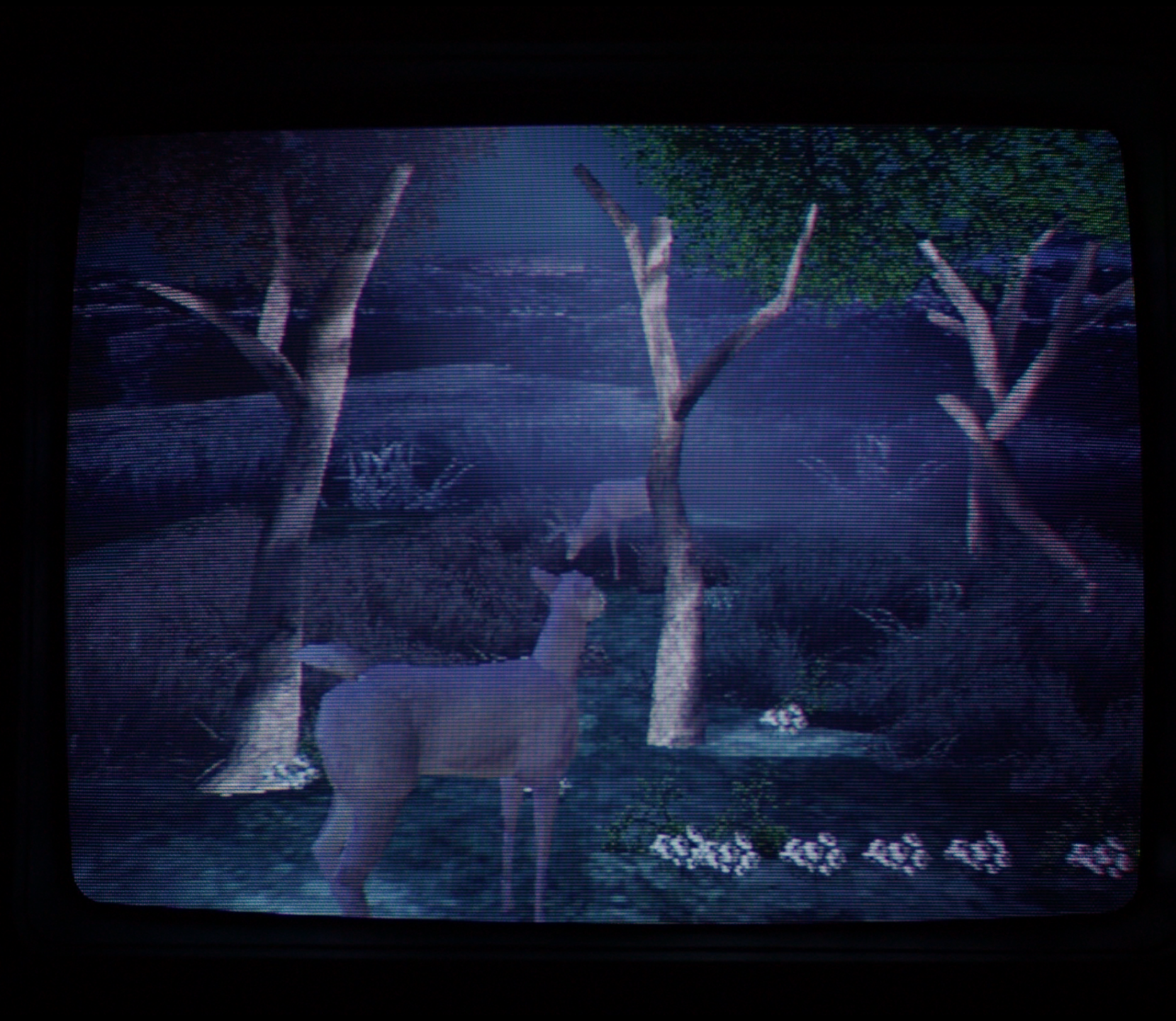
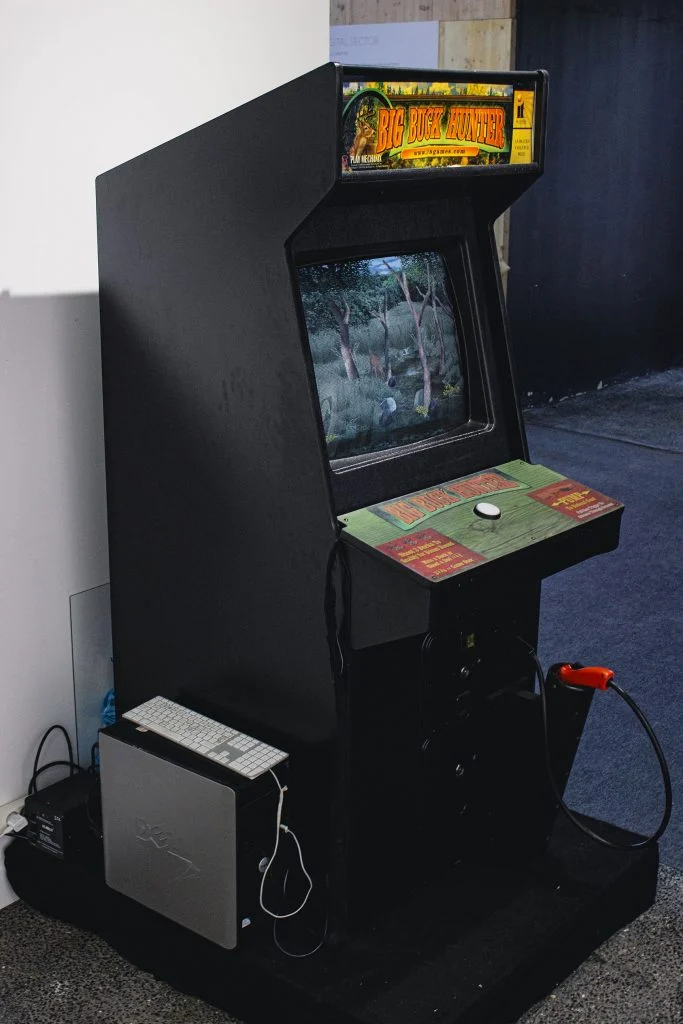
Big Buck Hunter: Restoration
What is Big Buck Hunter?
“Big Buck Hunter” is a hunting arcade game released in 2000 by incredible technologies.
The player uses a lightgun - a plastic shotgun with a light sensor in the barrel -
and aims it directly at the screen. The goal of the game is to shoot and kill bucks (male deer), while avoiding does
(female deer, without antlers). The entire gameplay consists of shooting deer, and on bonus rounds you shoot other types
of animals. The gameplay is spread across a fixed number of levels in an outdoor/forest setting.
Big Buck Hunter was notably popular - even saving the developer and publisher from bankruptcy at the time.
Over time, with multiple releases, it has evolved into almost an entirely
different game than it was in 2000. While newer versions of Big Buck Hunter (e.g. Big Buck Hunter: Pro) continue to be popular and
culturally relevant today, for this project the only version of Big Buck Hunter that is relevant is the first
release from 2000.
Visually, Big Buck Hunter is a strikingly beautiful game.
Unlike most arcade games before 2000 that set themselves in a fantasy world or exaggerated reality,
Big Buck Hunter tries to depict the natural world as faithfully as possible; every level has a photorealistic background,
usually of American forest or plains.
However, in an unmodified state, every aspect of the game is built around violence.
The deer only have programmed behavior related to fear or death, and the landscapes
in the game are designed carefully to create a ‘shooting challenge’ for the player.
In this state, instead of reflecting the full beauty of nature, the game is based
on our broken relationship with it. The purpose of this project, “Big Buck Hunter: Restoration,”
is not to create a new game, but to modify and restore Big Buck Hunter and the game-world
inside of it to a pre-fall state (the garden of Eden and the rest of the world before the fall of man),
free of violence and death, reflecting the original and ultimate aim of creation: harmony, peace, and communion.
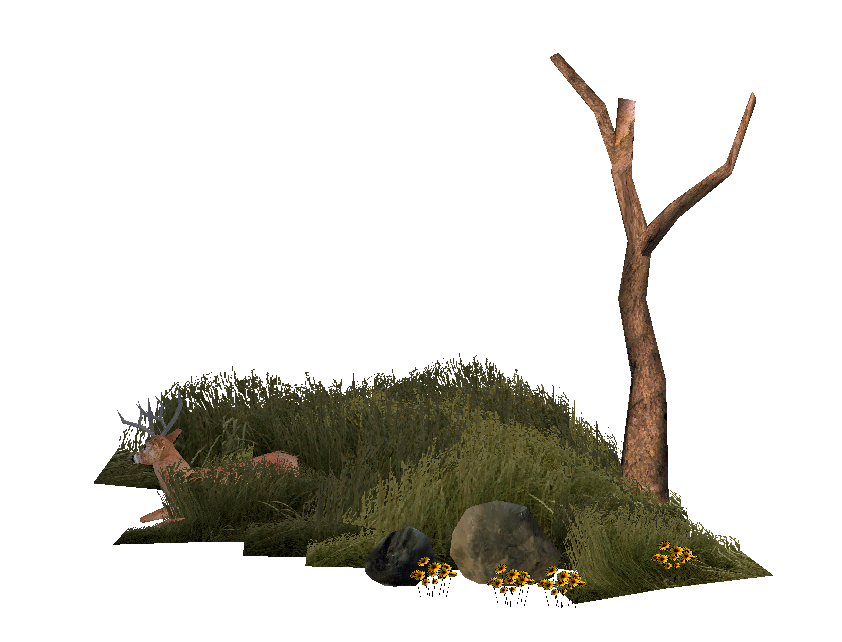
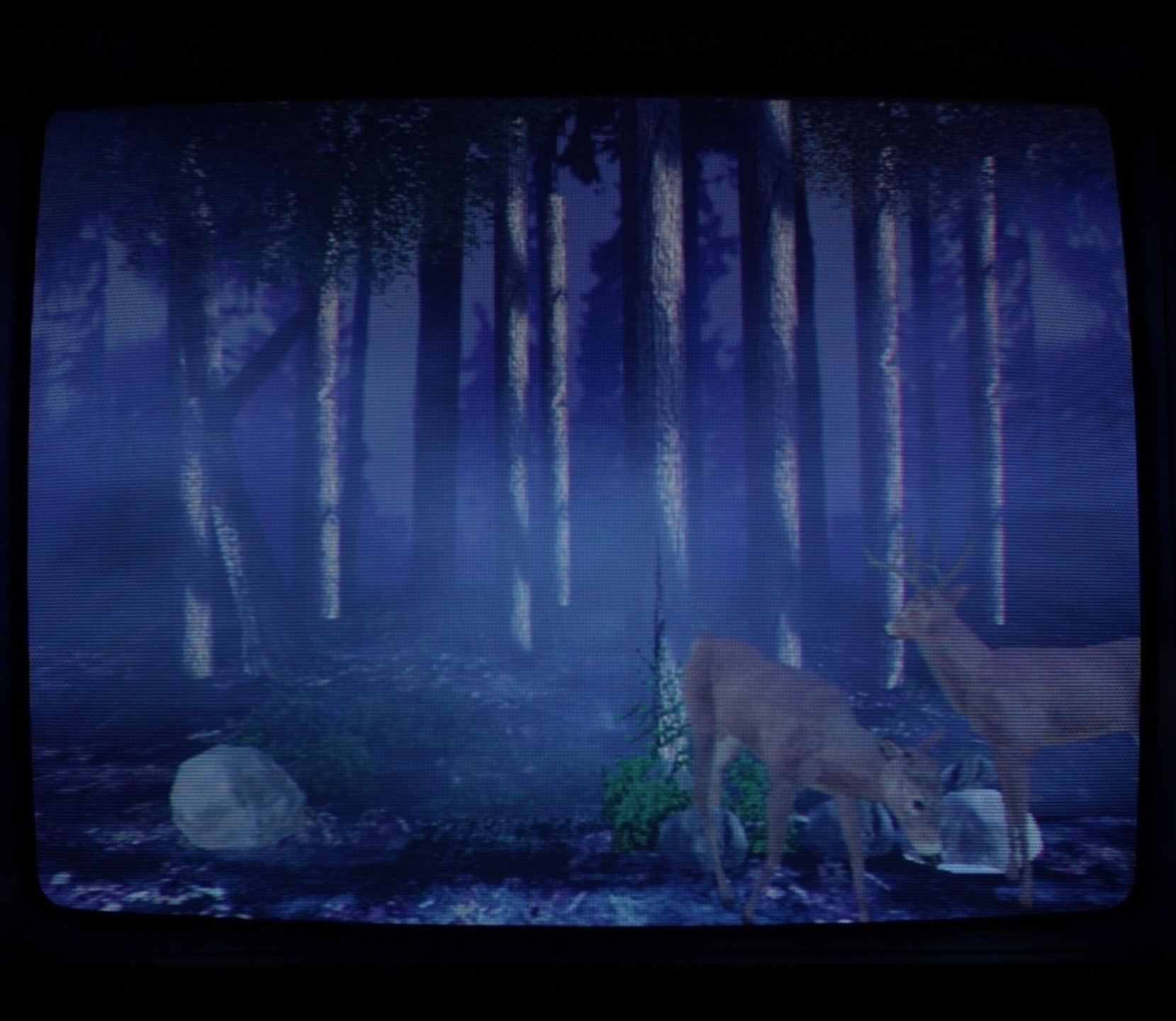
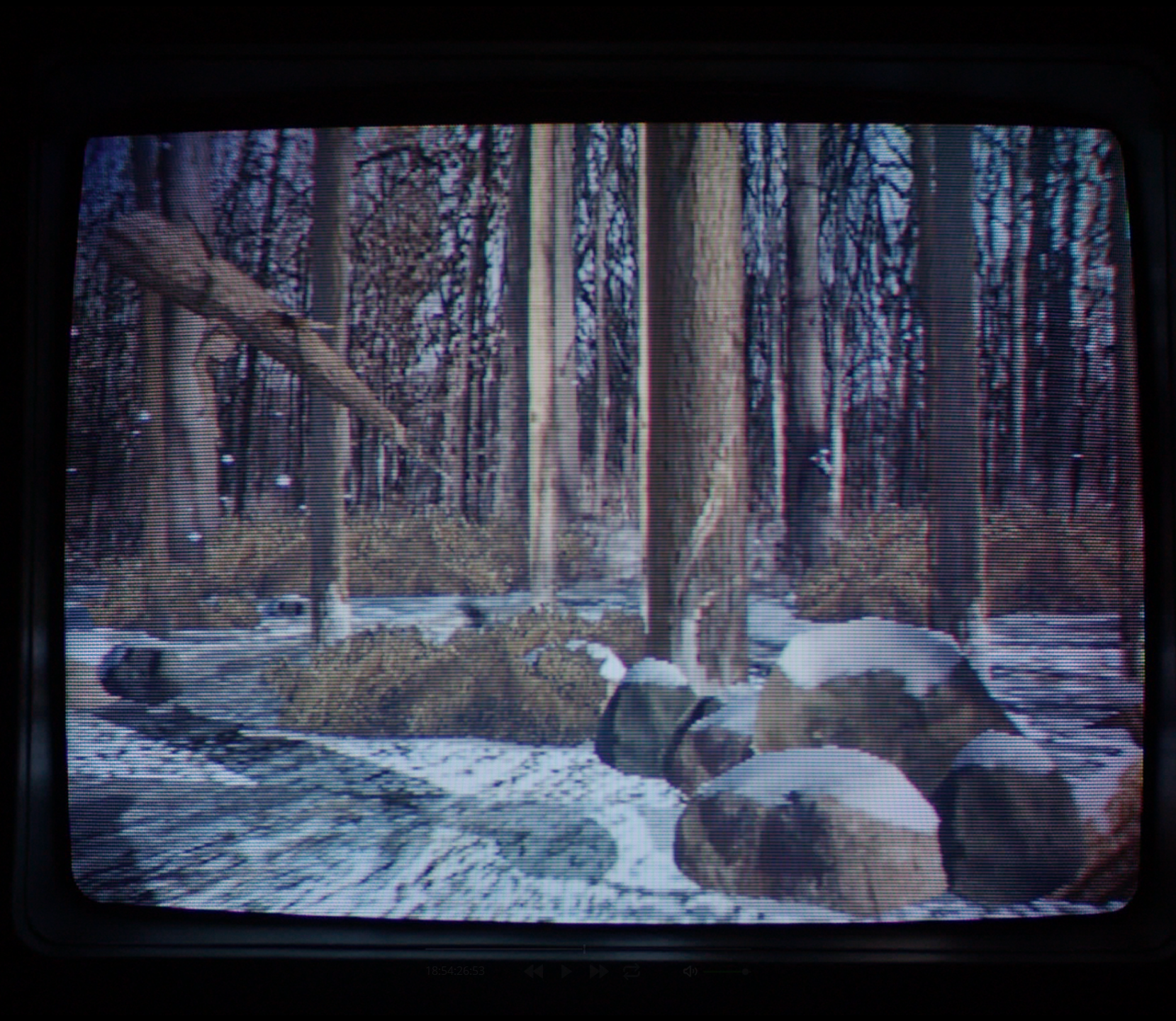
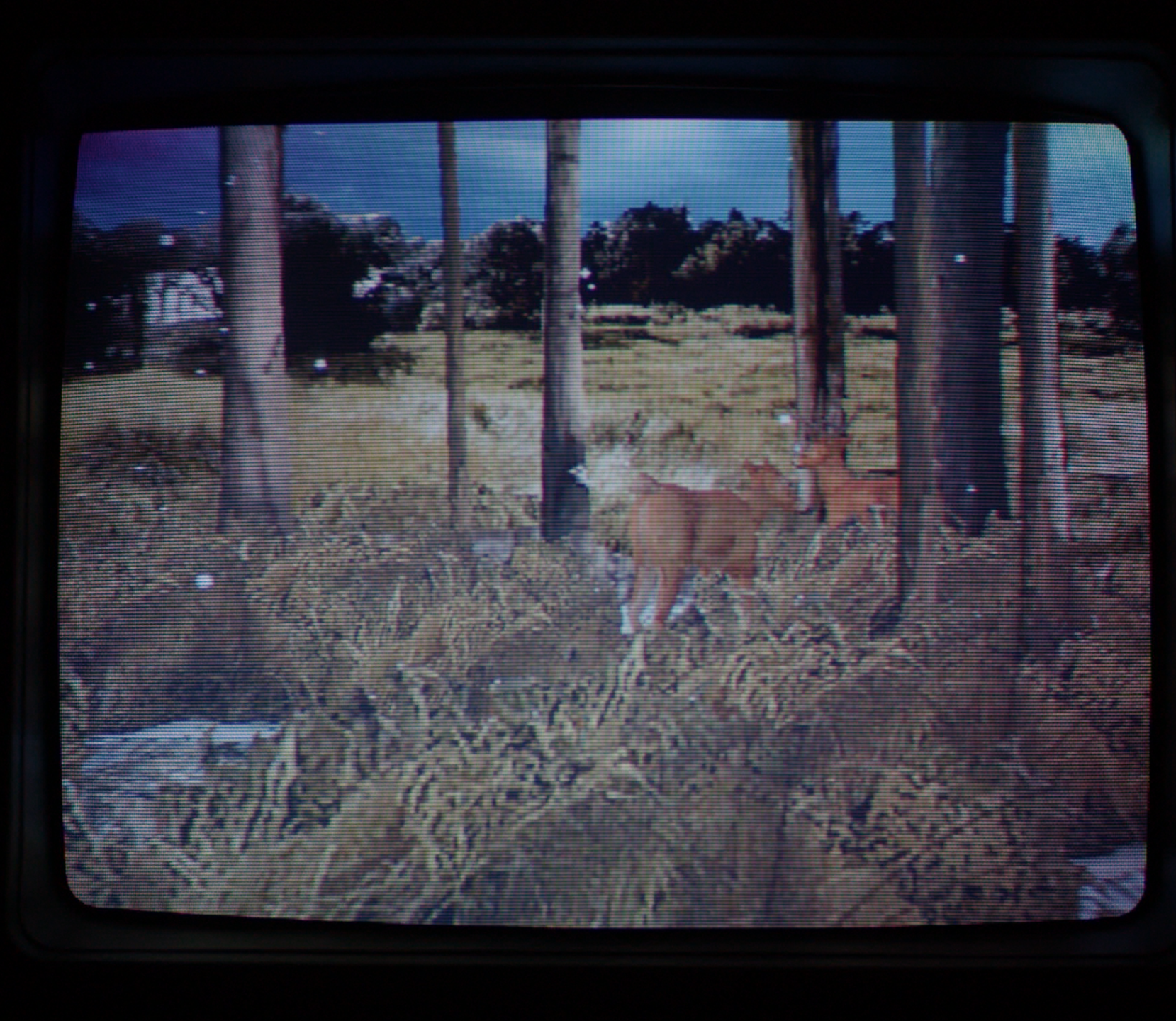
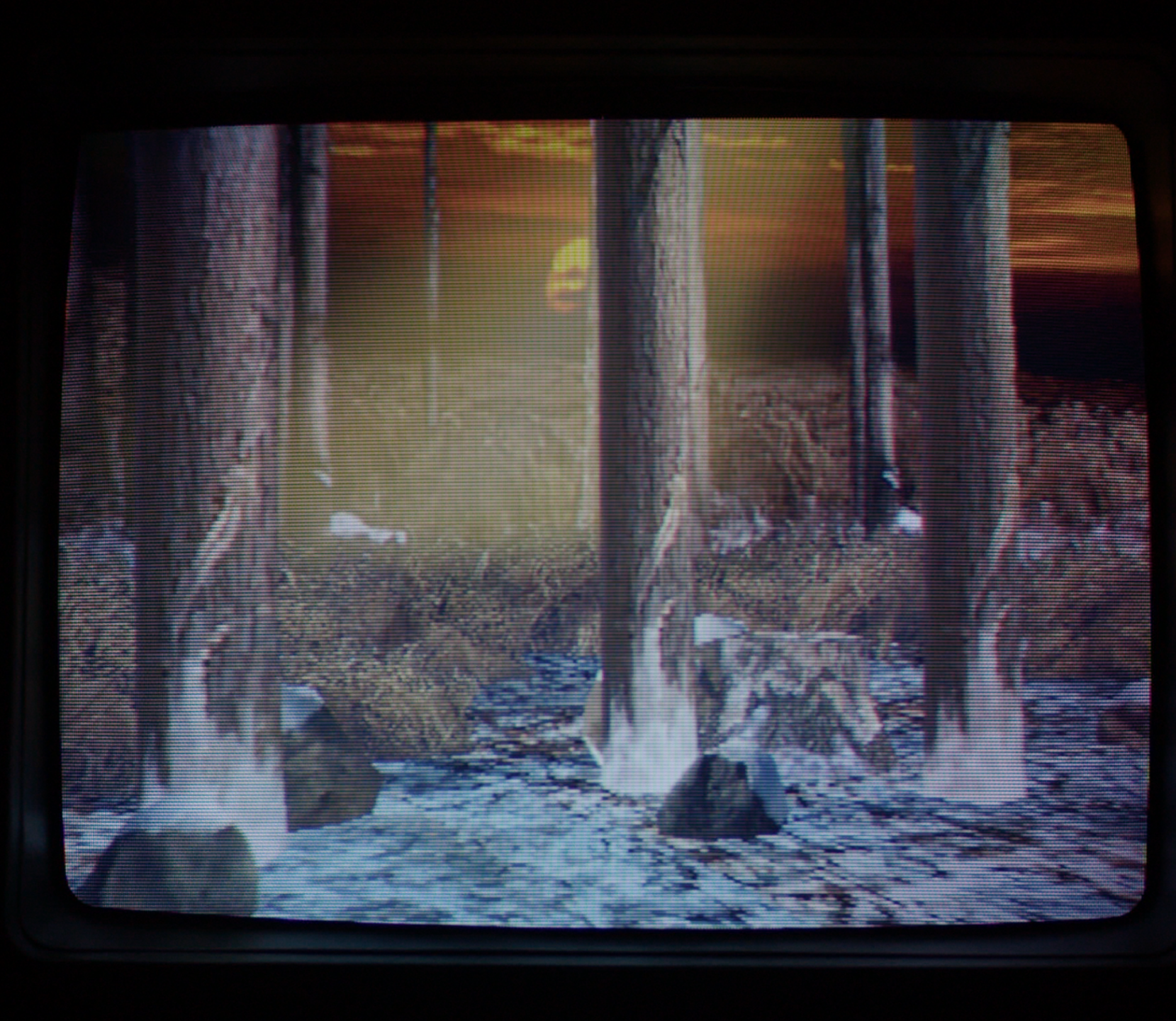
The key differences from the original game and Big Buck Hunter: Restoration include endlessly
generating landscapes instead of a fixed number of levels, corresponding to the eternal quality of life
before the fall. The deer now exhibit restful and peaceful behaviors, and are now present in the same landscapes alongside
turkeys, pheasants, quail, and ducks - who would never see each other in the
original game since other animals are only present in bonus levels. The different types of animals can now interact with one another, to try and reflect the intended unity of the first-created world.
To accomplish these changes and other smaller additions and removals, everything is achieved using
only the original game’s assets. New code is written, but no additional 3D models, textures,
or audio assets (aside from background music) are introduced or created - every texture, model, and sound present is painstakingly reverse
engineered from the original game’s hard drive. This project only employs traditional generative processes and does not use any AI (neural networks, etc). Technically it would have been possible to do this project when Big Buck Hunter was originally released.
Big Buck Hunter: Restoration is realized by modifying the original arcade cabinet to run the new software. The piece is presented as the arcade machine itself; the physical appearance of the cabinet remains unchanged, and the gun, though now inoperative, is still present - to stress that it is not a new game, but a modification/restoration of the original title. It is roughly 76 inches high × 30 inches wide × 31 inches deep, and about 500 lbs. It is an edition of one, with two artist proofs.
Sections of this webpage (click to jump to a section):
(Recommended to read in order by scrolling down though)
Project Aim / Personal Intent
What does "Big Buck Hunter: Restoration" change from the original game, and why?
Wild Deer Photographs + Videos
Photographs of the modified arcade cabinet
Next Steps + Exhibition History
Other Reading
"Thank you"s
Project Aim / Personal Intent
The aim of this project from its conception is to 'restore' the world in Big Buck Hunter
back to something like a pre-fall or Edenic state. This work is not the
creation of a new game or a 'peaceful sequel' to Big Buck Hunter, but the changes
described above place it as a modification of the original title.
I do not see it as a pacifist/vegan/gun-control statement piece, since in those
cases there would just be a removal of the shooting mechanics; while most of this project
is additive. The two largest components of this mod are the added animal behavior and the different
generative systems used to produce landscapes.
With a large portion of this project being landscape work with the idea of returning to a
pre-fall state, the technical process is very closely connected with the idea of the 'replanting of the garden of Eden'
- a metaphor used when discussing Christ's resurrection. It is no coincidence that Mary Magdalene,
the first to see the risen Christ, initially mistook Him for a gardener. On this connection, G.K.
Chesterton writes:
“On the third day, the friends of Christ coming at day-break to the place found the grave empty
and the stone rolled away. In varying ways they realized the new wonder; the world had died in
the night. What they were looking at was the first day of a new creation, with a new heaven and
a new earth; and in a semblance of a gardener God walked again in the garden, not in the cool of
the evening, but in the dawn.”
This project seeks to mirror the restoration of creation, pointing toward the "eighth day"
of creation; the day of the new creation begun by Christ's resurrection. It is an
attempt to depict a suffering world healed, transfigured, and brought back to God.
In this light, the project does not seek to recreate Eden as it was; it does not make sense to try to “go back to Eden”
(God is in the present not the past), but to align the game with the future reality, after the general resurrection,
that Eden points toward. Drawing on the first-created world as a model, Big Buck Hunter: Restoration is connected to
the idea that "The Holy Fathers’ vision of the first-created world was at the same time a glimpse of the future age."
The harmony and union with God of Eden, disrupted by the Fall, are not merely a lost past but a foretaste of the
redeemed and glorified creation in the age to come.
“So, icons are God-bearing pieces of creation, a creation made by God in the first place but somehow tainted, its spiritual quality made less obvious through the great tragedy we call the Fall. However, since God became man, this same material, through the work of the forester, the carpenter, the paint-maker, and eventually the icon painter, is returned to the fullness of its spiritual origins in a way most of the stuff that surrounds us is not."
- Archimandrite Meletios Webber, “Bread & Water, Wine & Oil” p. 105
Icons are one of my life interests (see more about iconography of the Orthodox Church on my page here), they point towards the same thing; the transfiguration and restoration of creation.
I can't paint them yet since I am still waiting to be received into the Church.
This project was, very roughly, a way for me to make work in line with icons without making an icon. Big Buck Hunter: Restoration cannot achieve the fullness of restoration that icons manifest, but the aim of this project is to reflect, however imperfectly, the beginnings of such restoration.
Big Buck Hunter (2000) - Development and Nature of the Original Game
This section covers the characteristics of the original game, what exactly it contains,
and reasoning/details of the major modifications made to it.
Section Contents (click to skip to a section):
Levels/landscapes in the original game
Animals in the original game
Levels in the original game
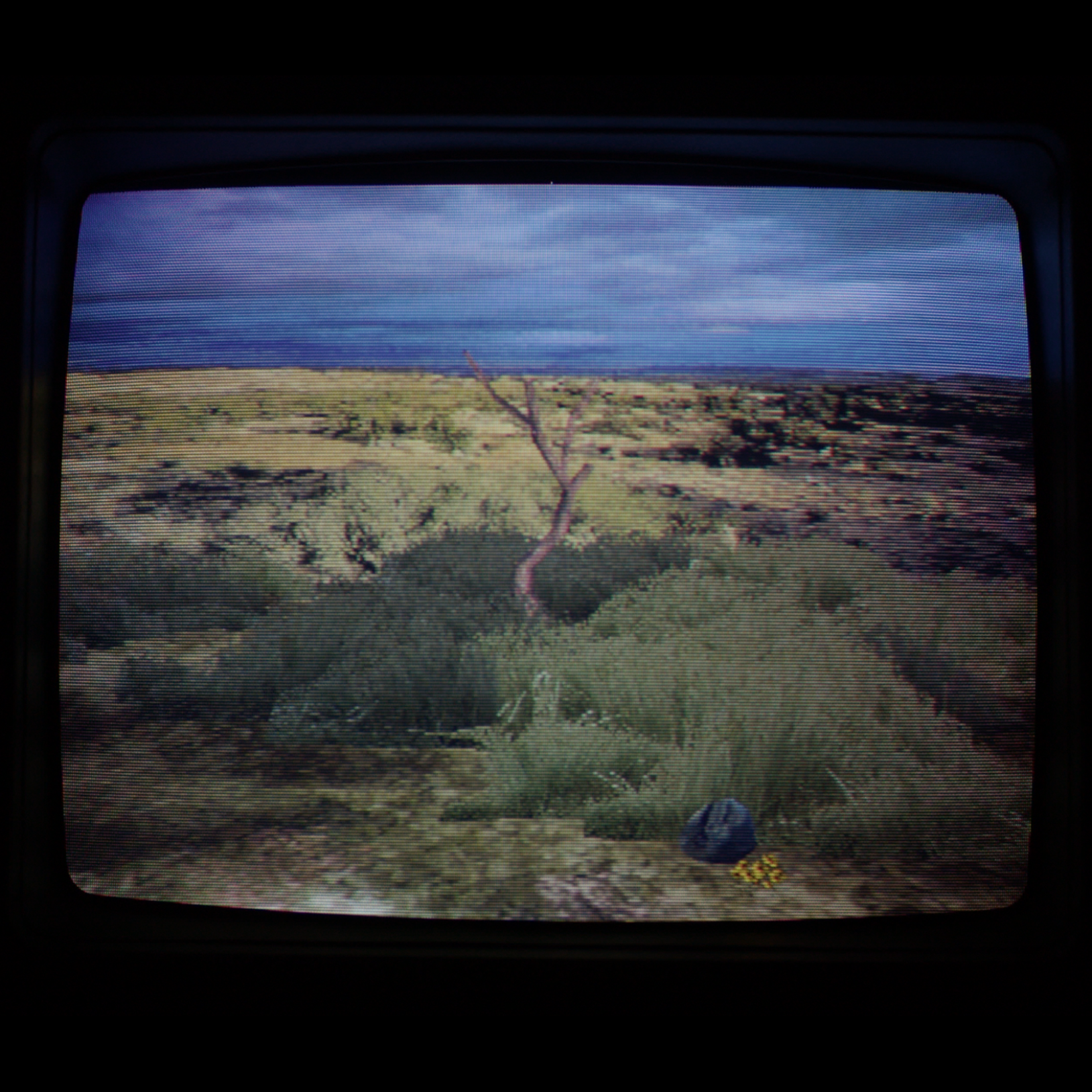
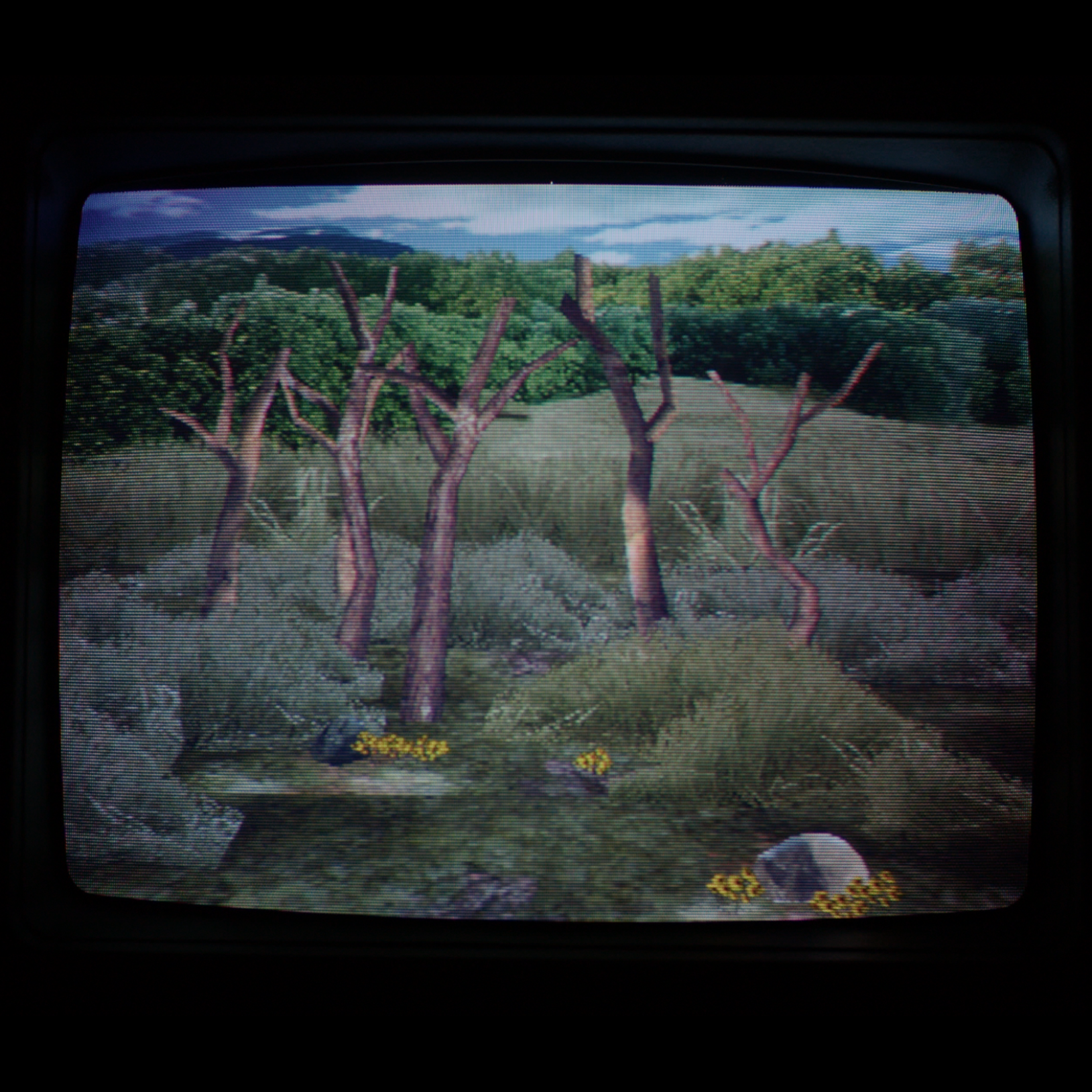
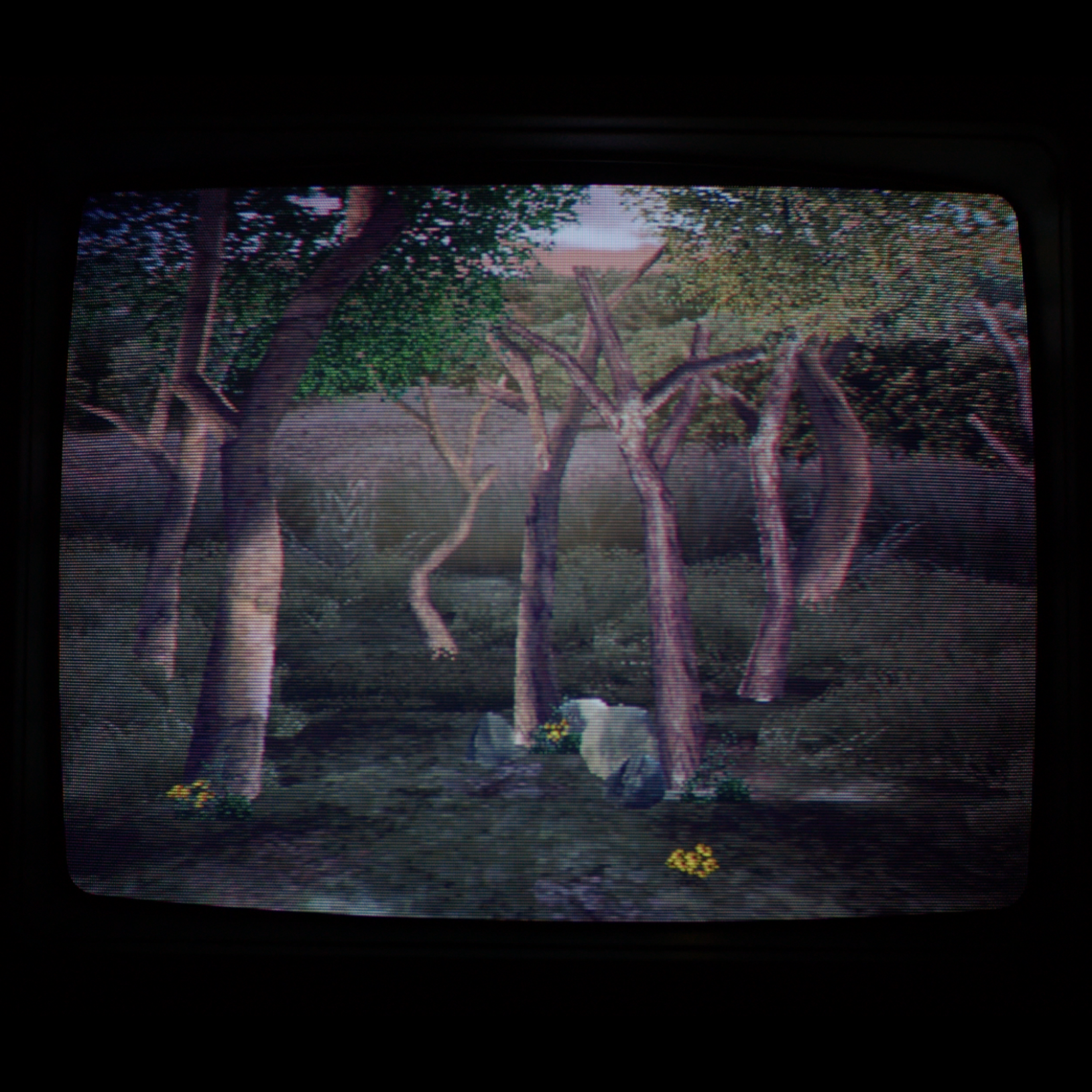
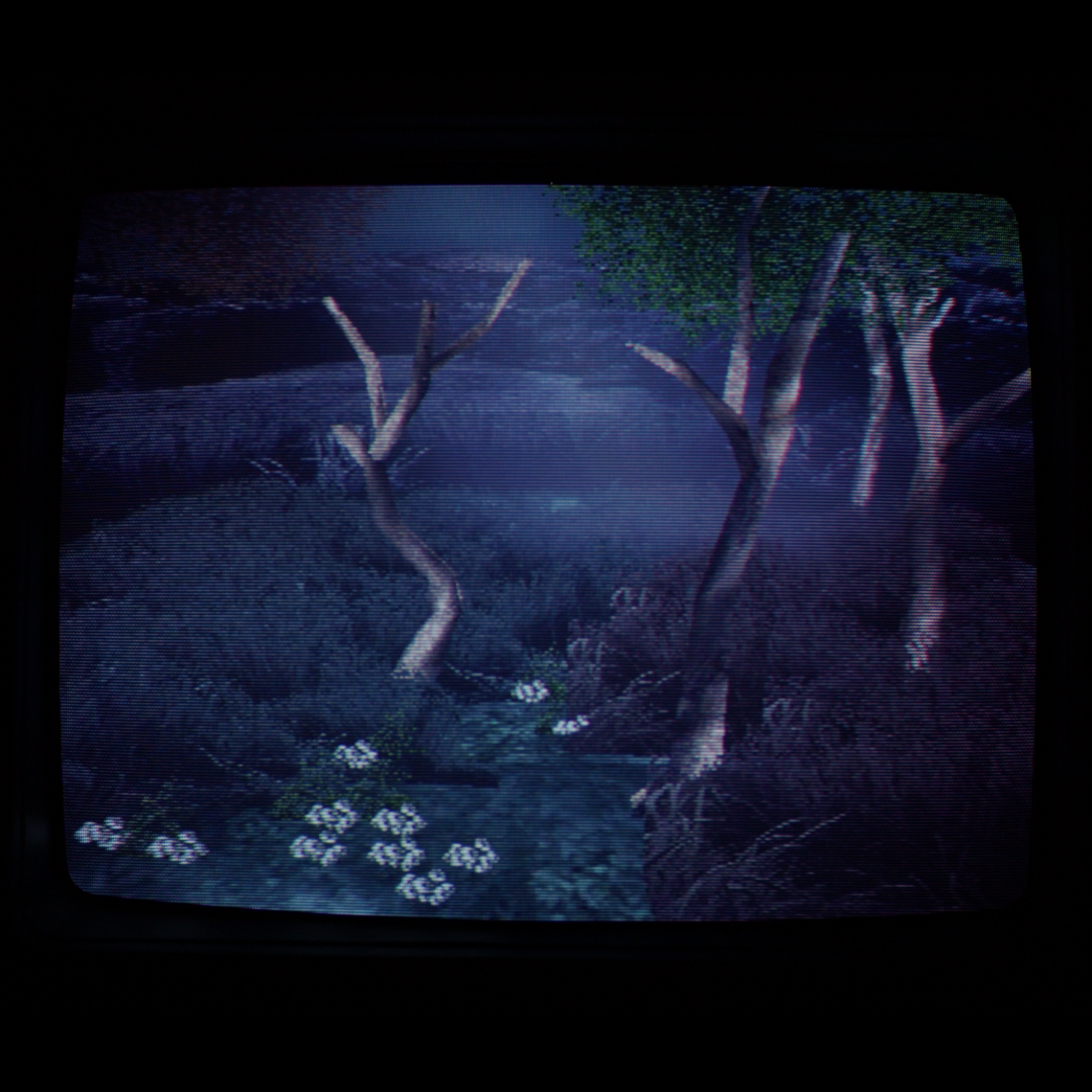
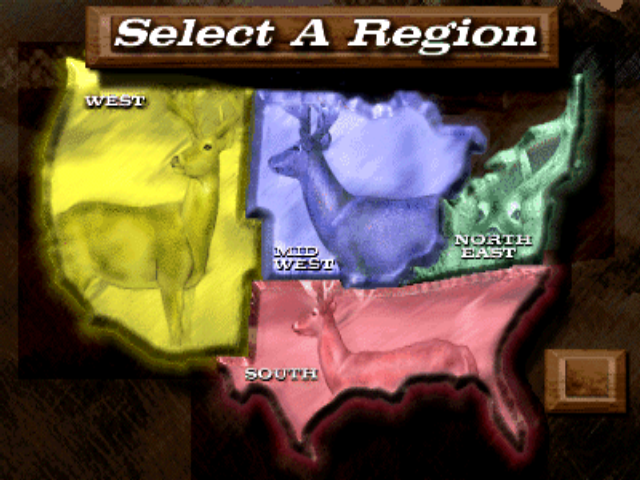
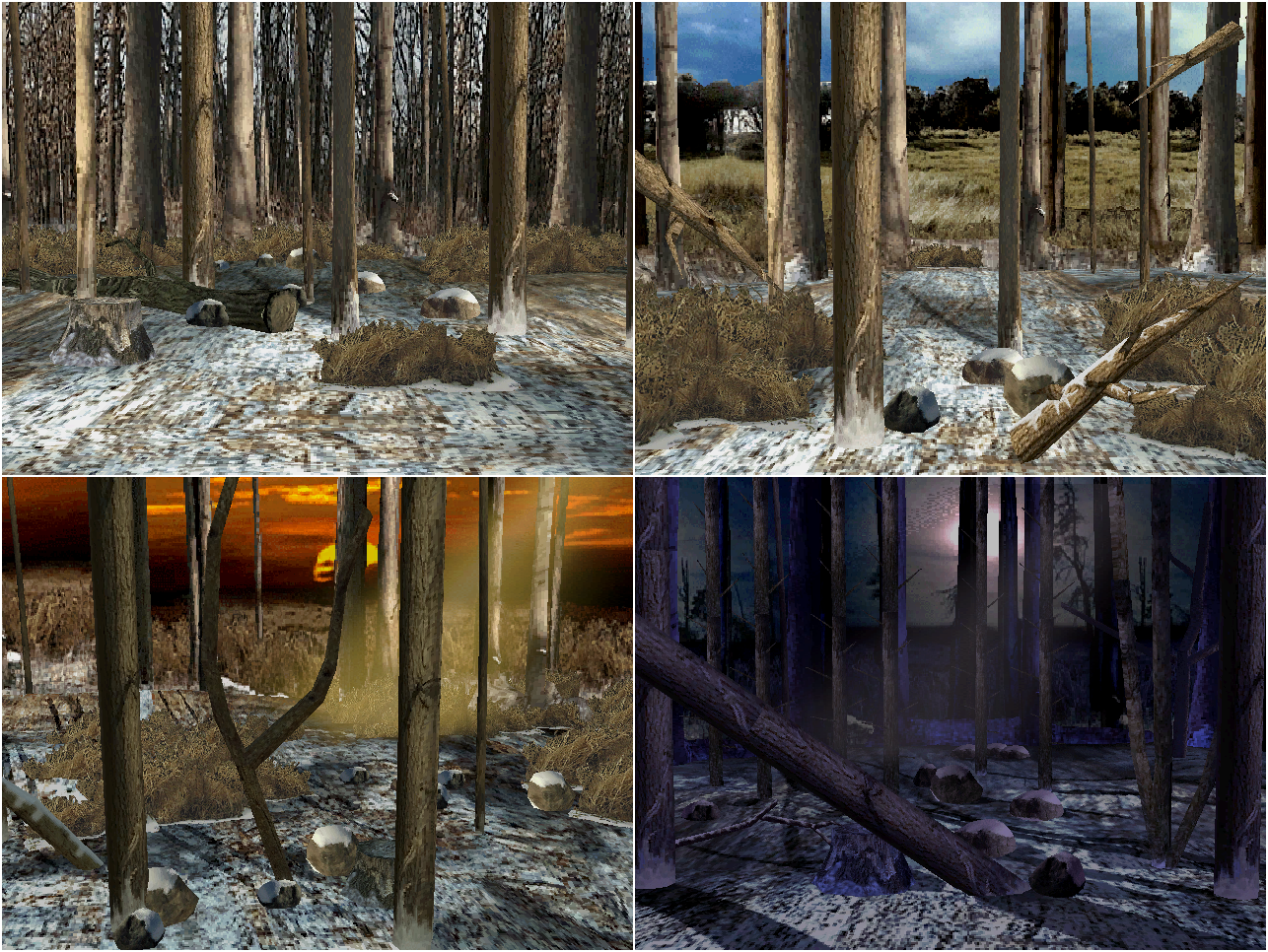
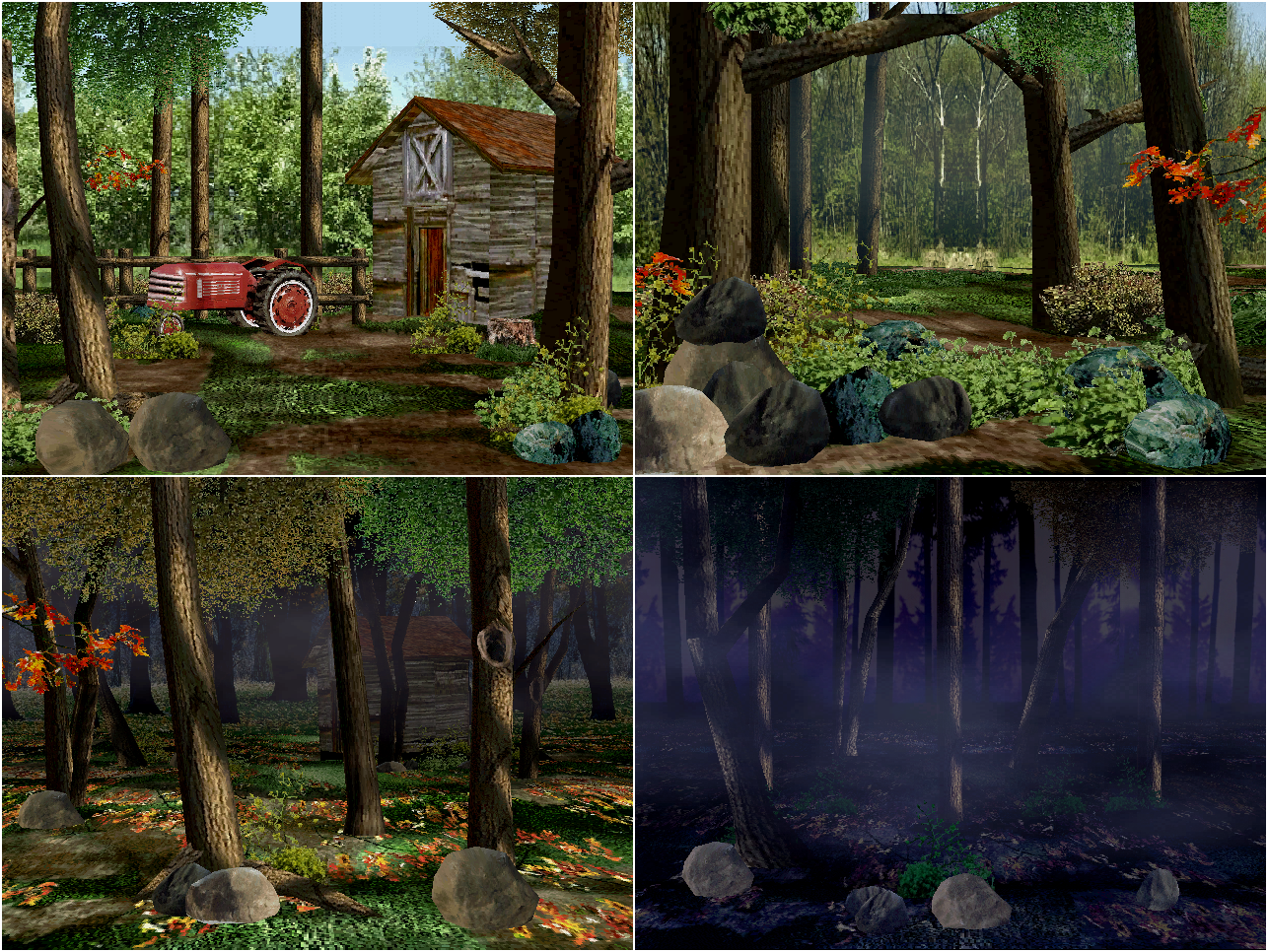
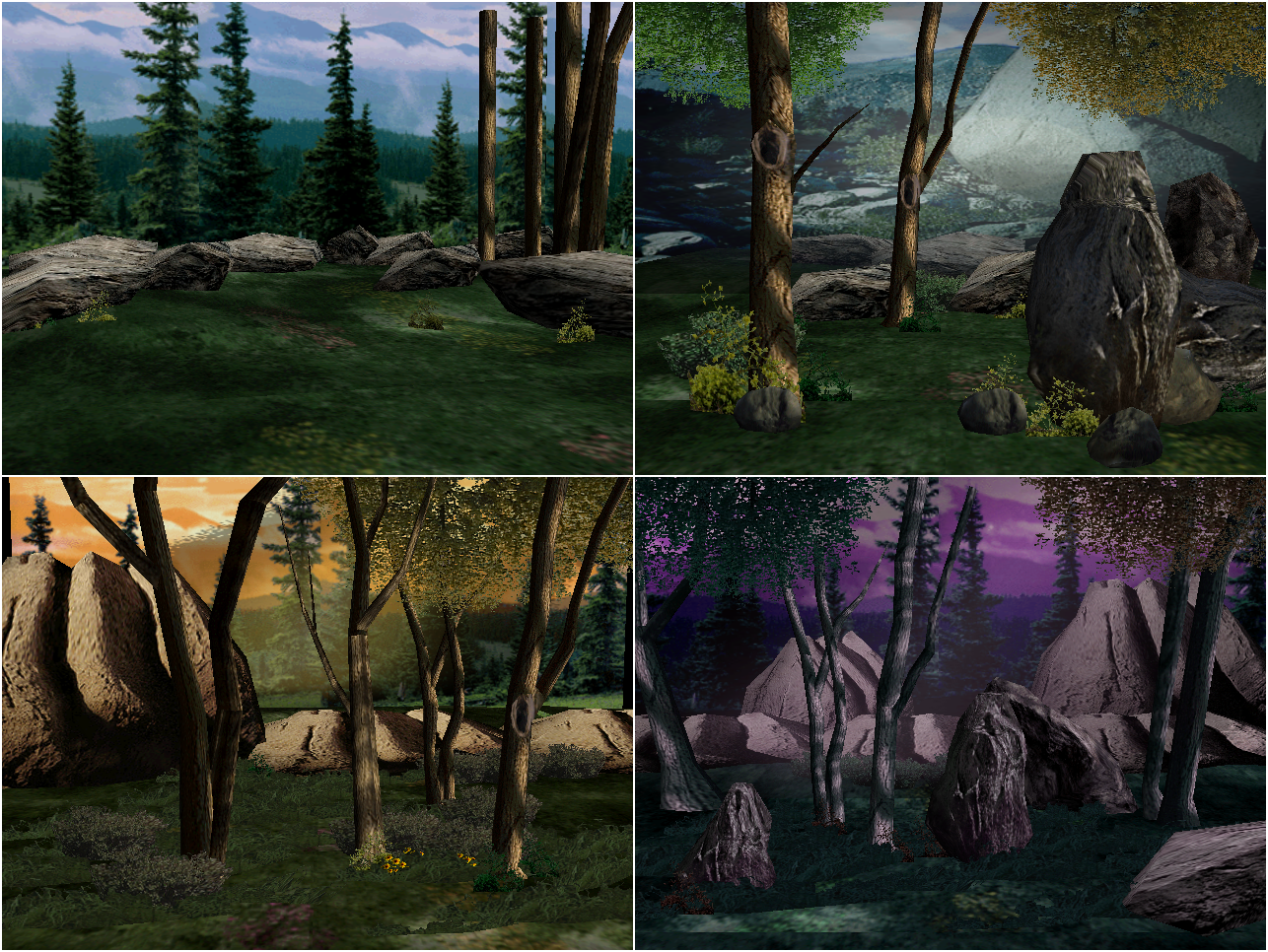
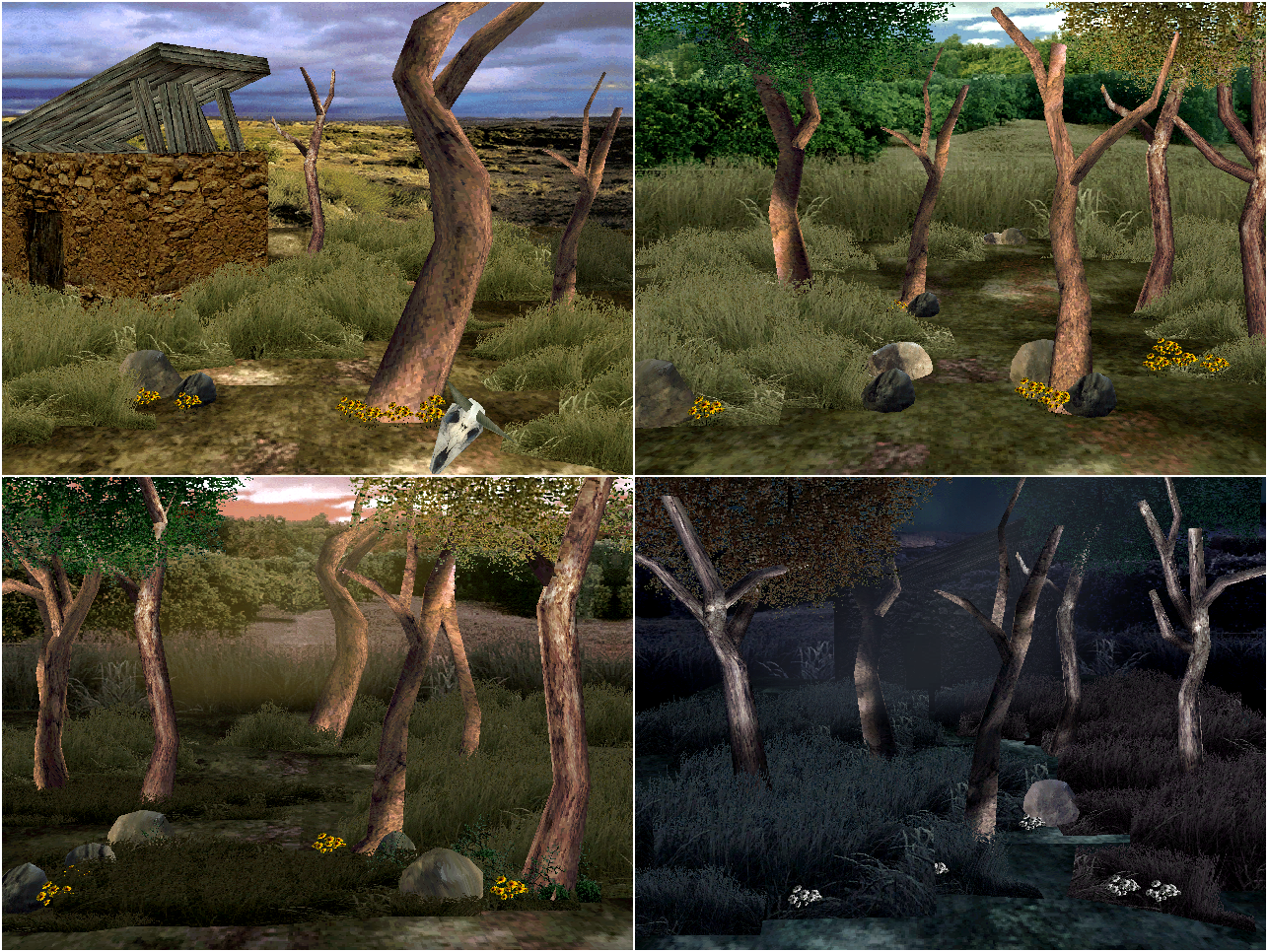
Big Buck Hunter features four distinct regions, the South, Midwest, Northeast, and the West.
Each region is further divided into four groups corresponding to times of day - morning, noon,
evening, and night. For each of these times of day, there are four levels that can be played.
The player has to kill three bucks before they can advance to the next time of day, killing
a maximum of one buck per level. If the player successfully finishes an entire day, from
morning to night, the game displays a congratulatory message and requires more money to
choose another region to play. The game is finished when all four regions are completed,
and 48 bucks are killed.
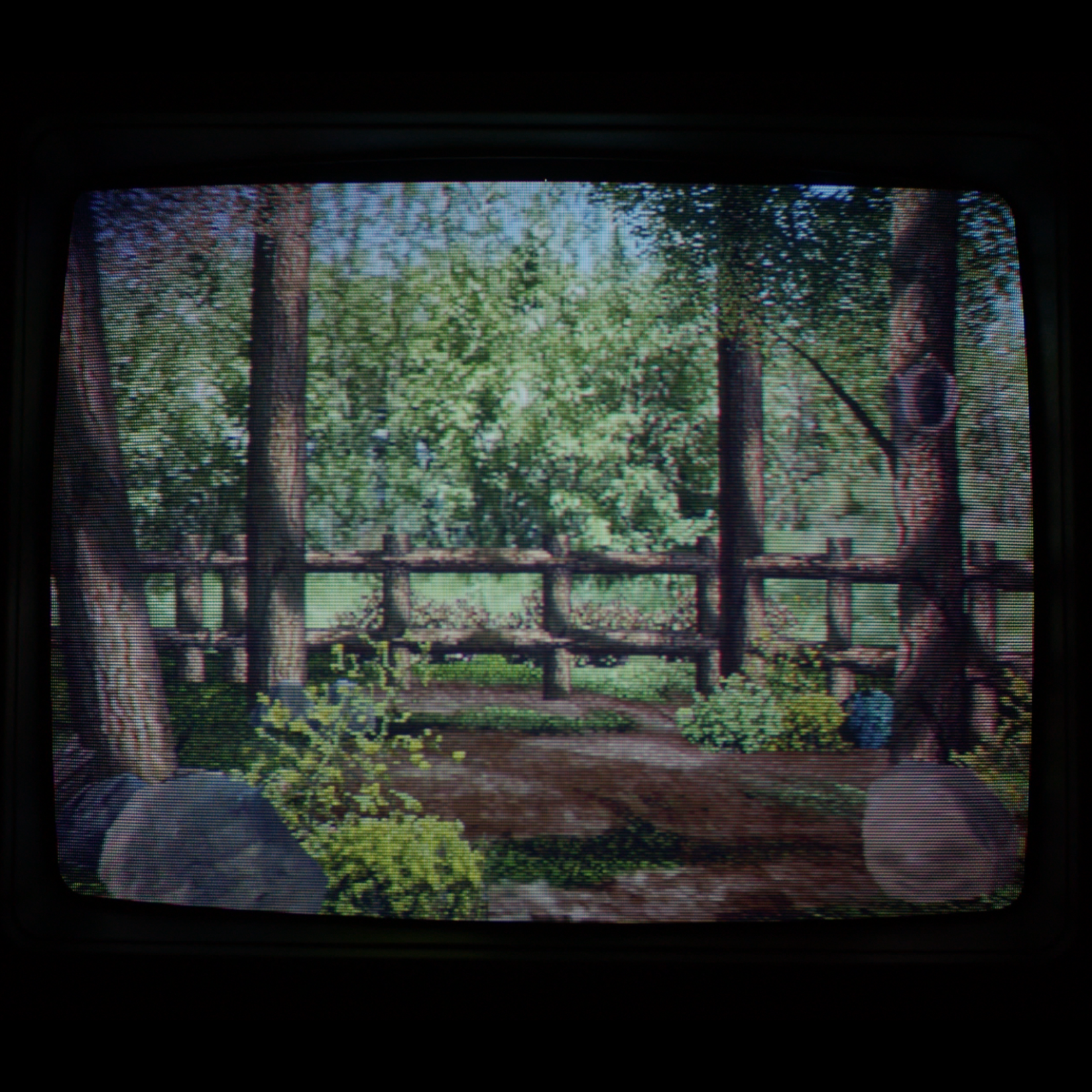
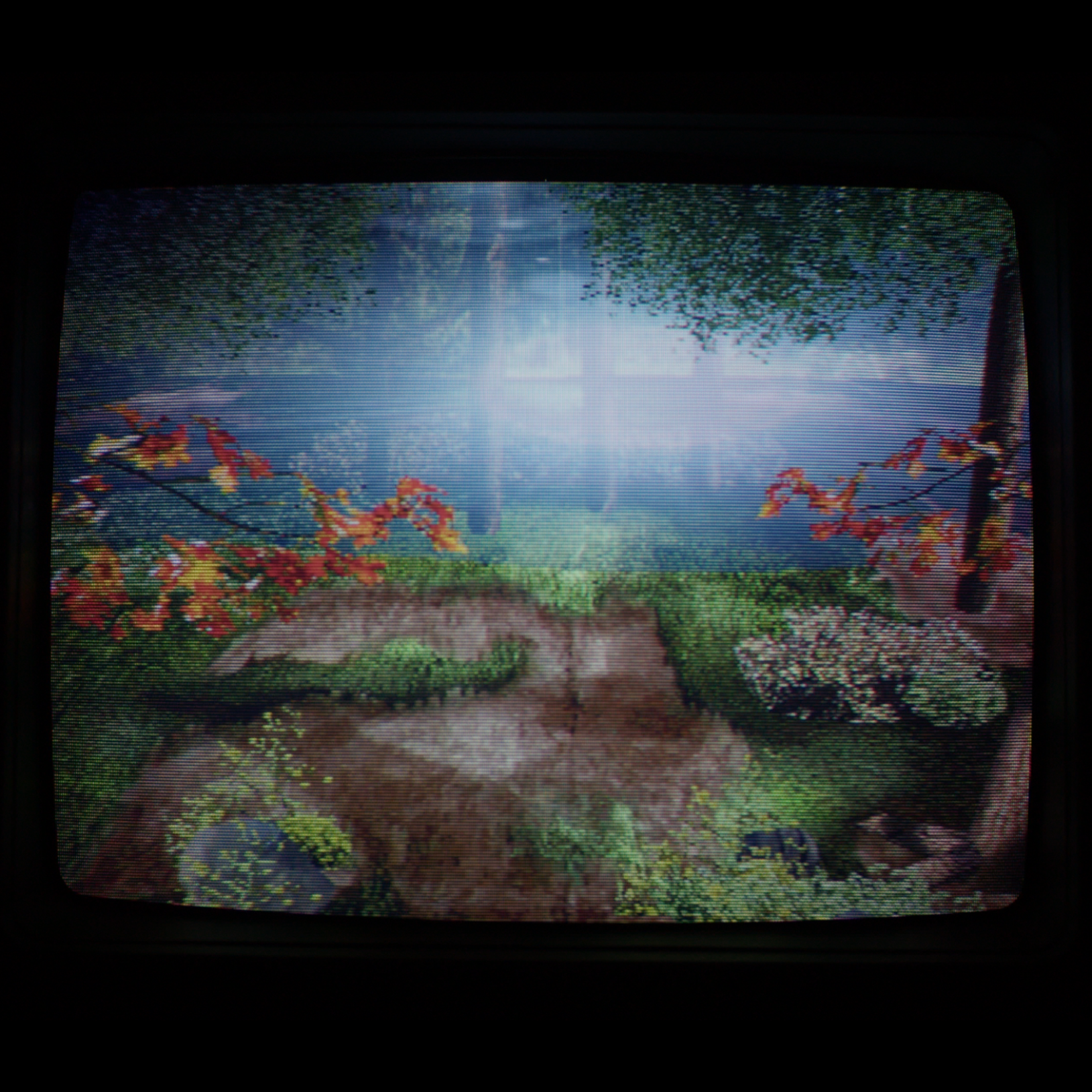
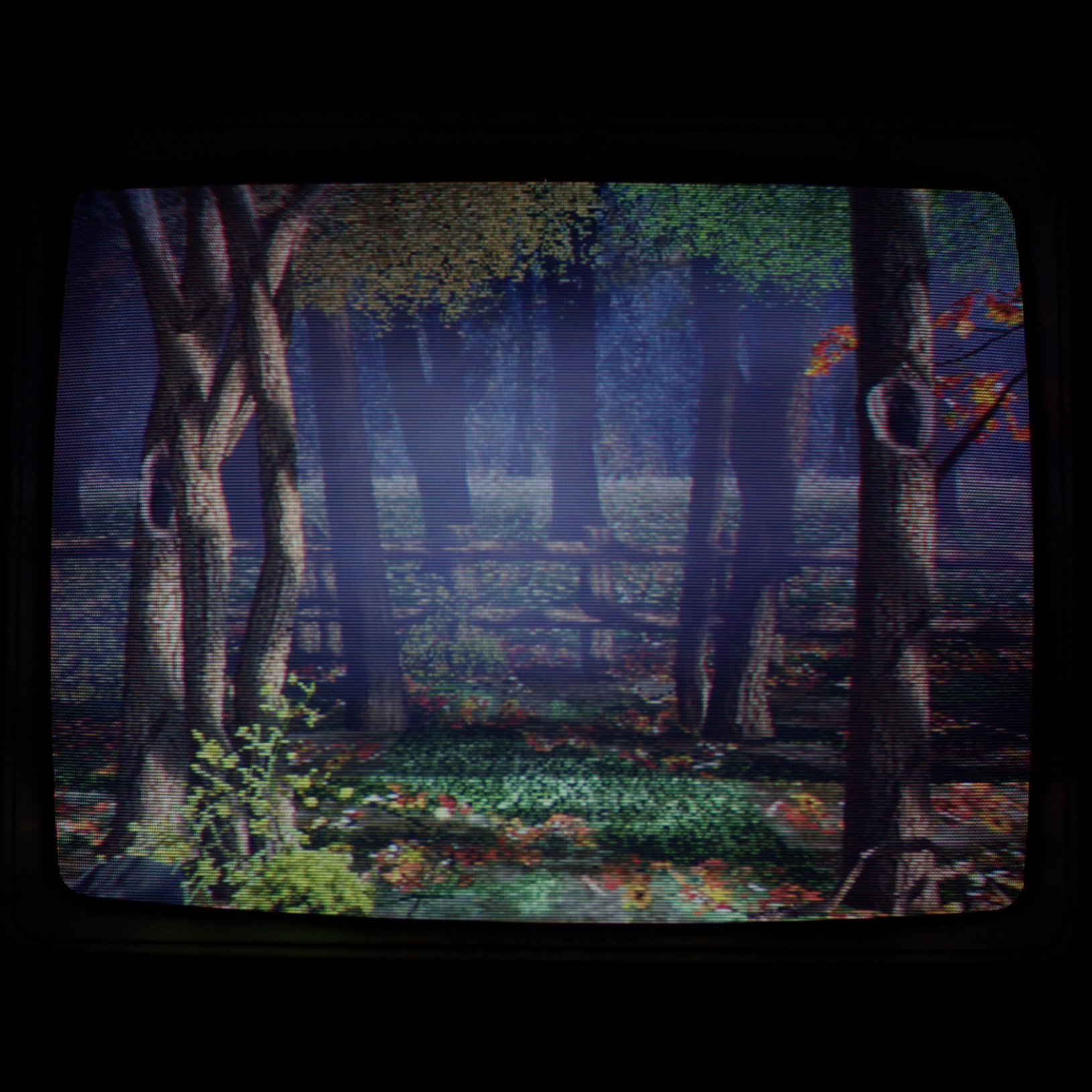
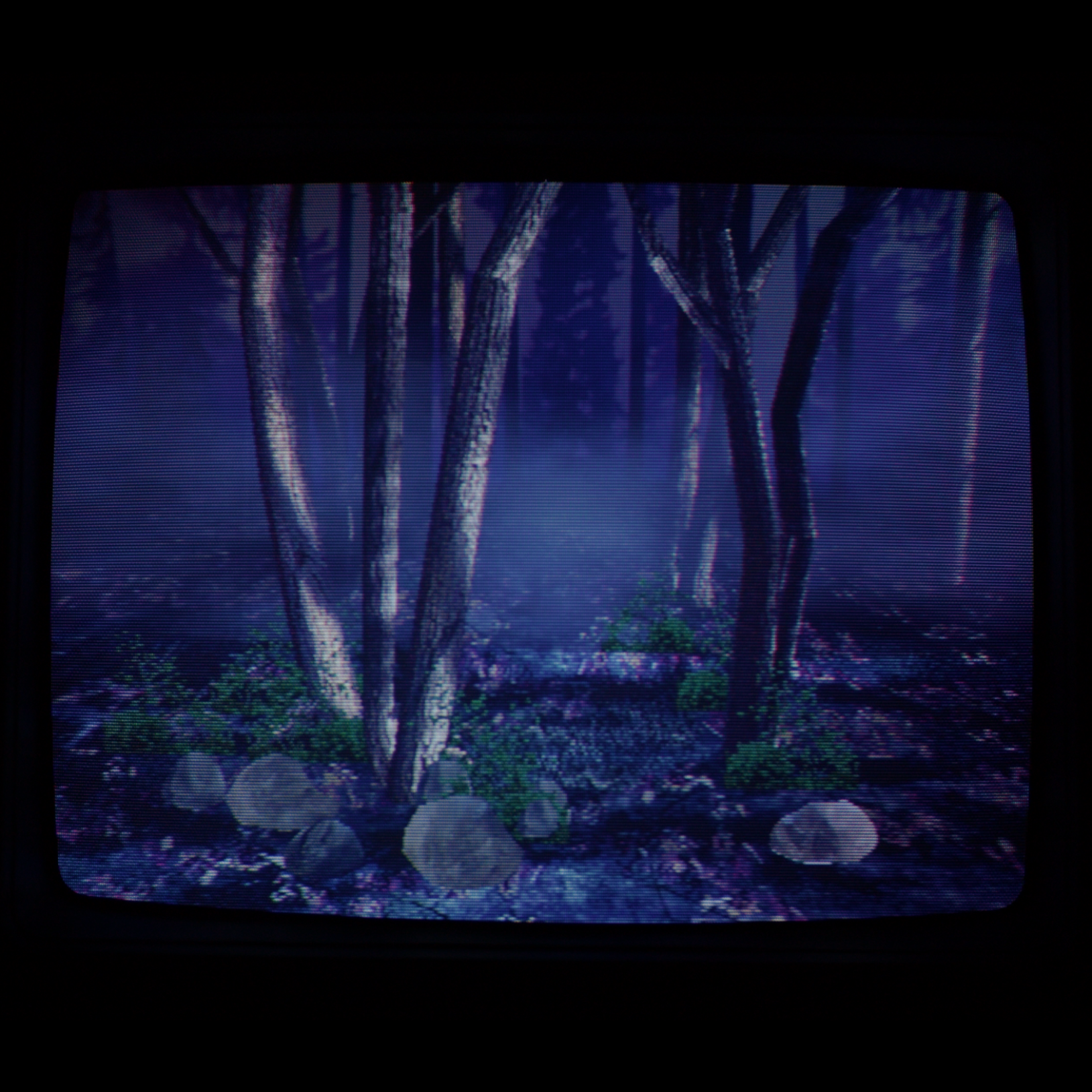
Below are some of the levels from the original (unmodified) game, grouped by the regions.
In the images below there is only one level shown for each time of day (top left is morning,
top right is mid-day, bottom left is evening, and bottom right is night), to give a quick
overview of each region's appearance.
The Midwest:
The Northeast:
The West
The West is a special case; I have chosen not to use it in the Big Buck Hunter: Restoration project.
It does not correspond to nature as well as the other areas of the game, instead it is very obviously
designed with gameplay/shooting in mind.
The South:
Big Buck Hunter: Restoration cannot use the same landscapes from the original game.
Big Buck Hunter: Restoration does not use any of the levels from the original game, it instead generates
new landscapes infinitely using the existing game assets. There are two main reasons for this. The first
is that the component of infinite generation is needed to capture the eternal quality of life before the fall.
The second reason is that every element of the original Big Buck Hunter game – including the trees,
rocks, and more – are precisely and meticulously arranged to serve a violent purpose. It is clear that
the gameworld in Big Buck Hunter was designed with hunting as the sole aim. This is evident not only
in the visual references to hunting (such as deer-stands / hunting cabins in some levels), but
also less visibly in the subtleties of the landscapes themselves. In the West region of the game
the rocks are slightly taller than the deer, allowing the deer to pass behind them while
running away causing the player to accidentally shoot a rock (there are dedicated voice-lines
to this that can play after every round, after shooting a tree there is a chance for the announcer
to say "You hit the tree..."). As the game progresses throughout the day, the levels get more
and more cluttered with ‘obstacles’ as a type of scaling difficulty. It's worth noting that also the day-night cycle itself is included
primarily to scale the difficulty of the shooting challenge (the darker levels are more difficult to pick out deer in) - and not to indicate the passage of time.
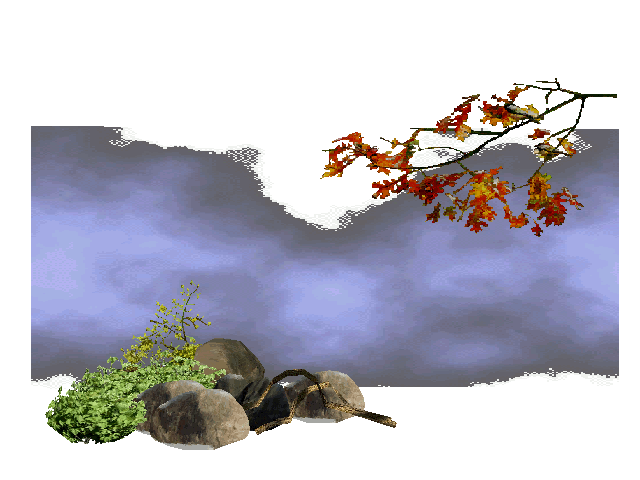
Fog is introduced in the
evening levels of most regions, it serves to enrich the visual quality of the levels in the game,
but also to obscure the bucks visually. Fog is implemented as a flat semi-transparent plane with
a fog texture on it; and when it is present, bucks almost exclusively spawn behind this fog
(even though it is located towards the rear of the level and there is often more space unobscured by fog).
Most of the time, the level will begin with bucks eating or standing in a position that conceals
their antlers from the camera - rendering them effectively identical to the does which the player
must avoid killing. Nothing in their grouping or positioning reflects the natural behavior of
wildlife. Every aspect is designed for the player to enjoy a shooting challenge; and this design
logic is built into the arrangement of nearly every landscape in the game. For these reasons,
in making Big Buck Hunter nonviolent, it is needed to change both the landscapes and the behaviors
of the deer, and to remove violence as the foundation of these things.
Hunting-stands, objects related to death (e.g. bone/skull decorations present in some levels),
and other larger structures like barns/tractors/etc have been removed. Smaller man-made objects
like fences remain infrequently in the modified game - these do not inherently reflect our broken
relationship with nature. Big Buck Hunter: Restoration does not seek a world devoid of human presence,
but one where our relationship and interaction with the rest of creation is not so distorted as it is
in the original title, and as it is in our real world today.
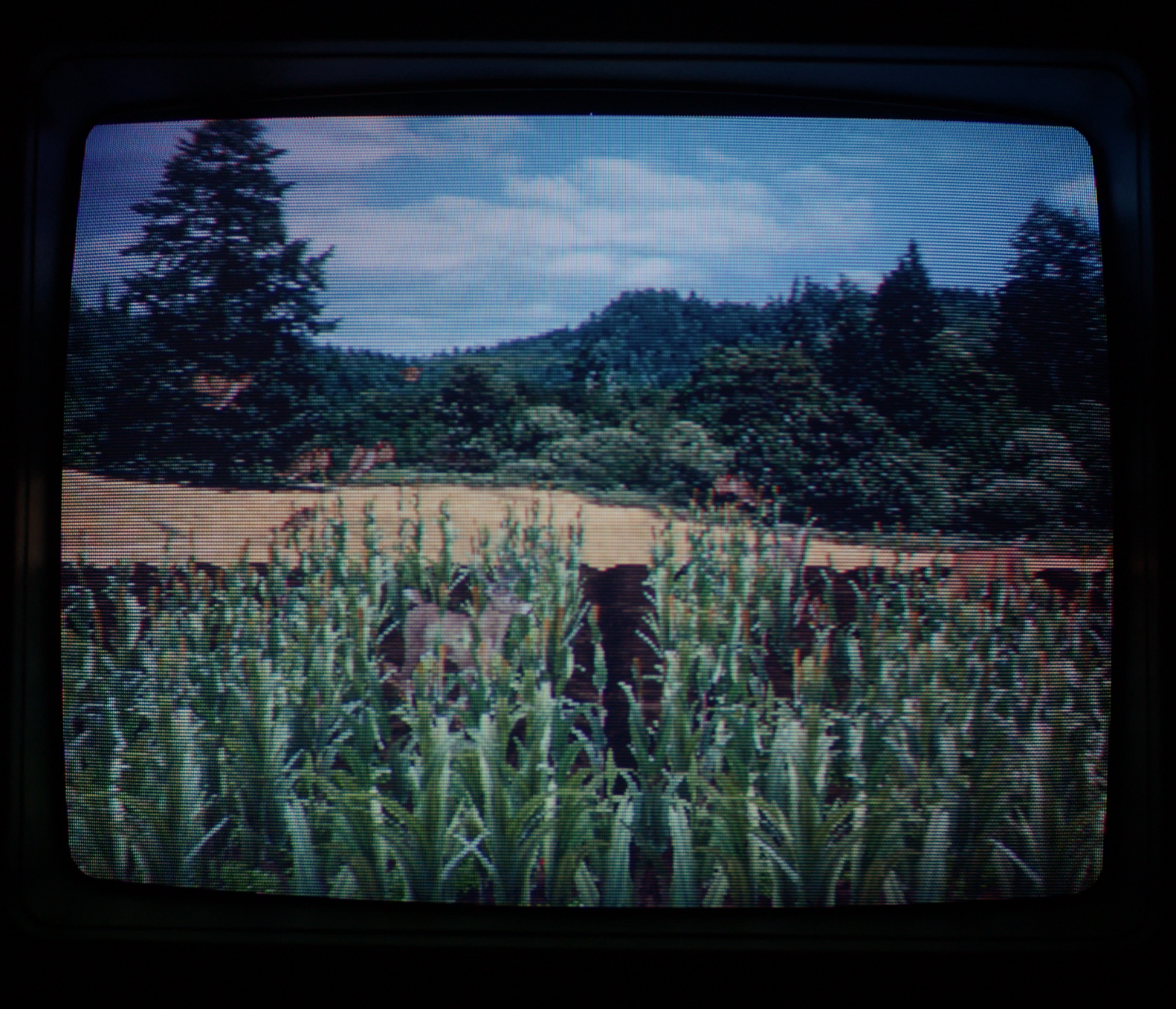
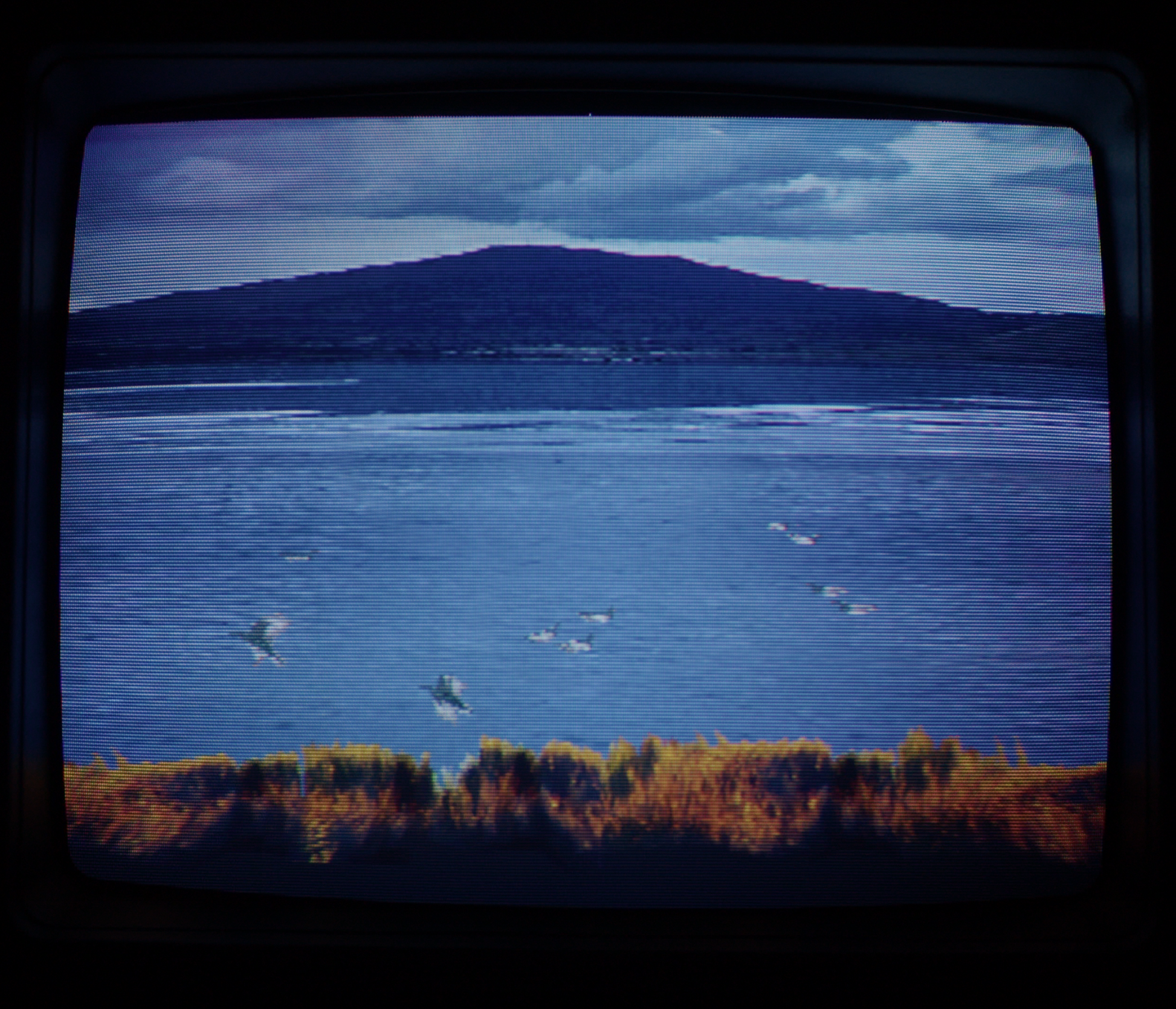
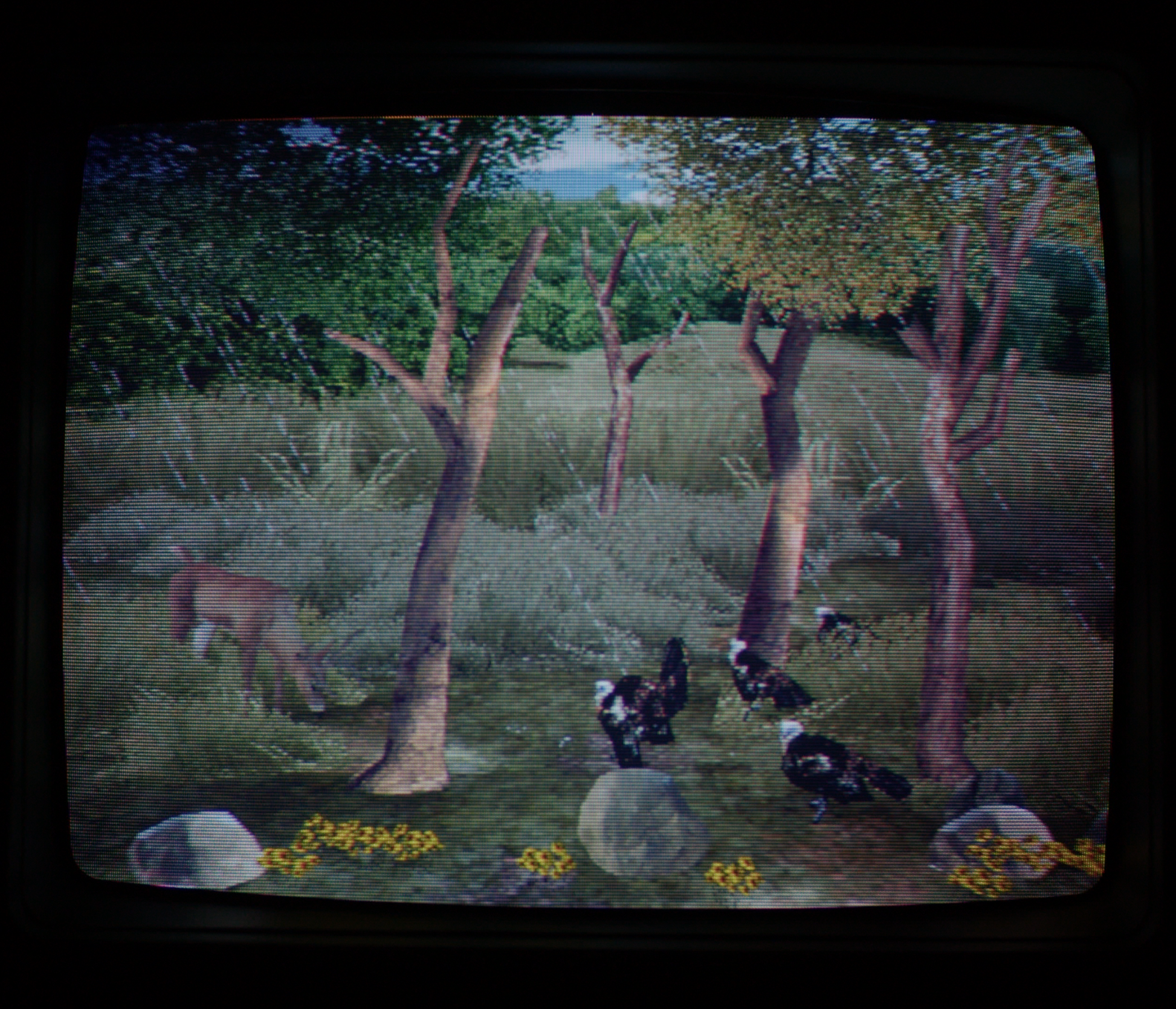
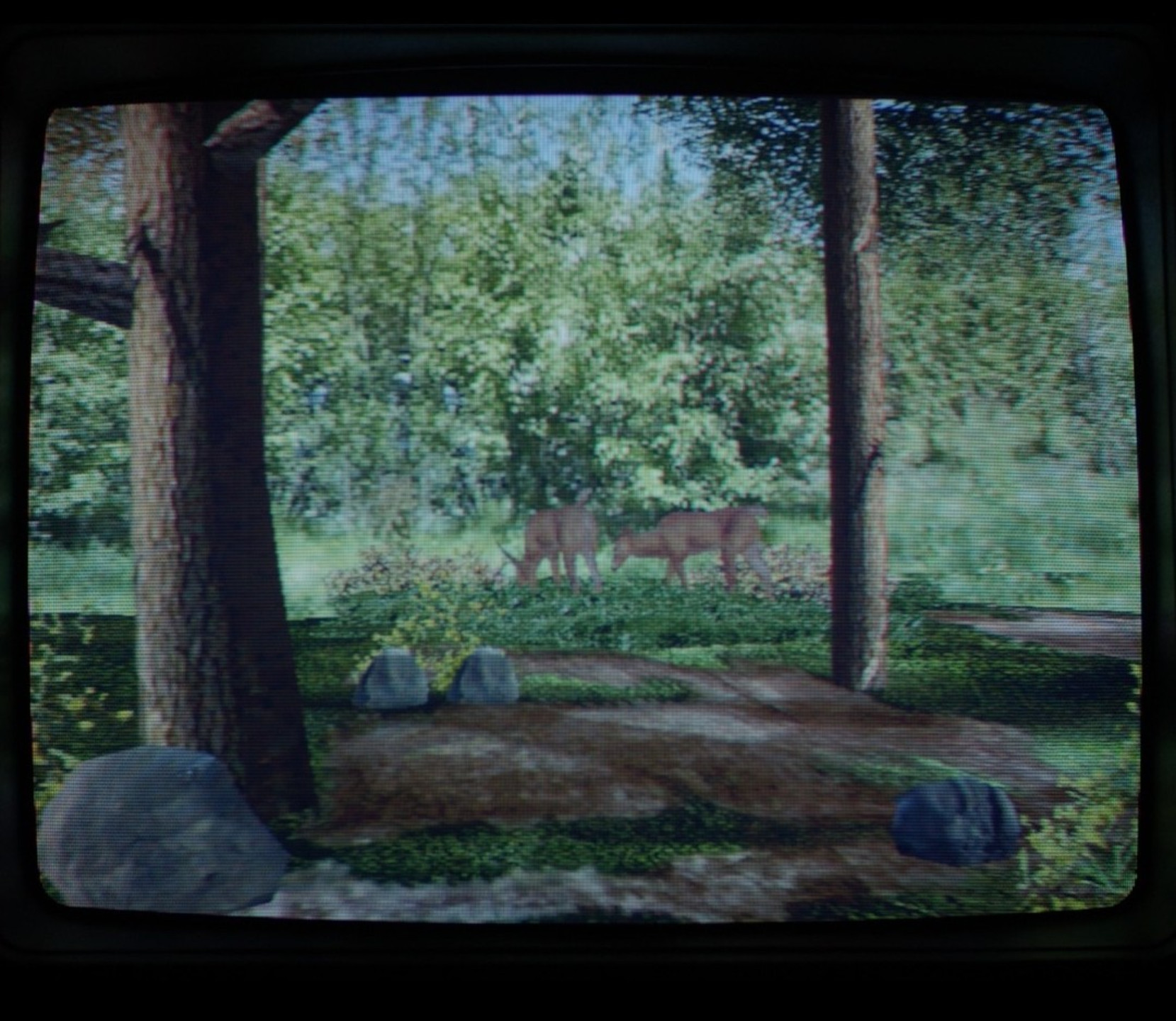
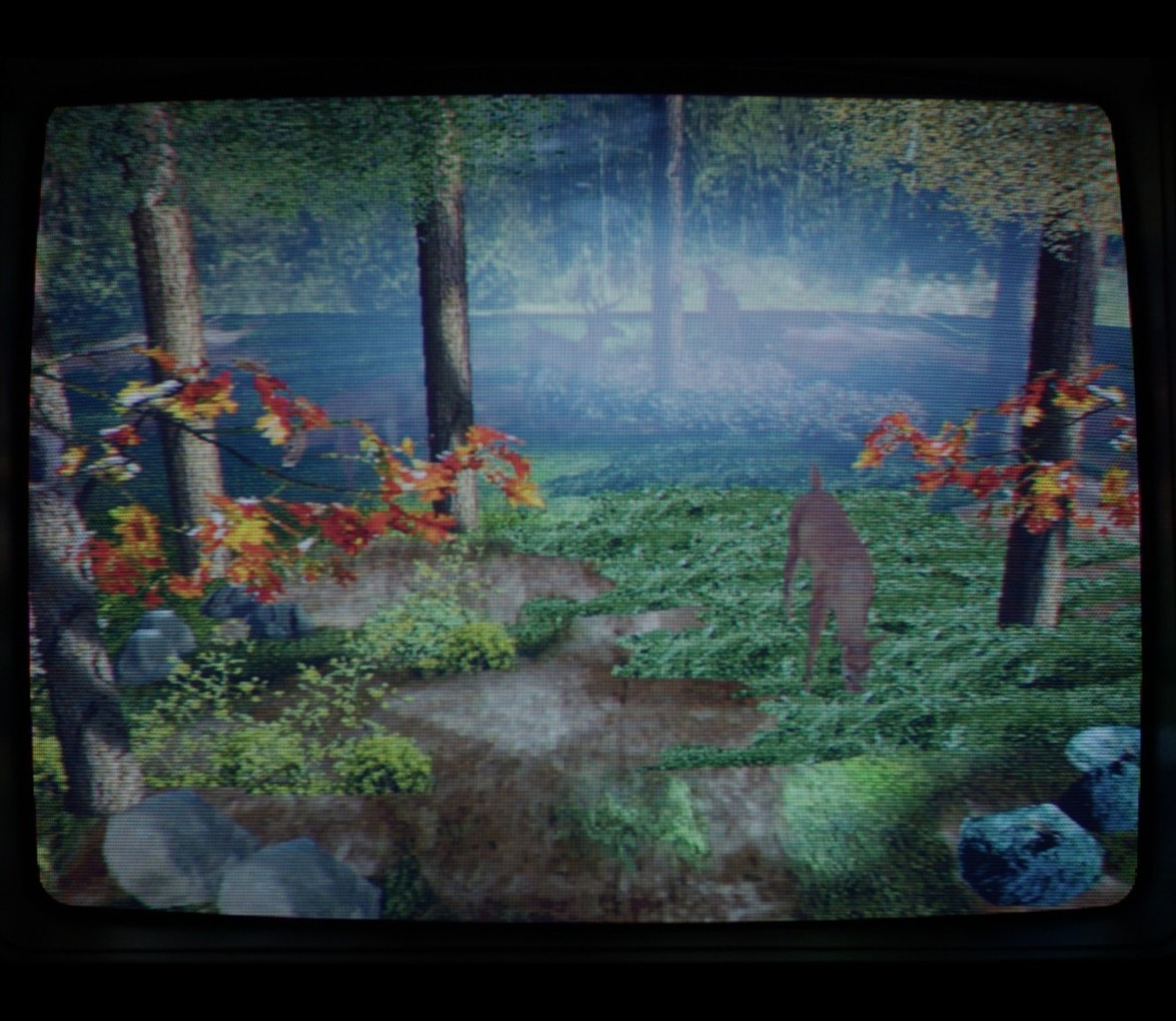
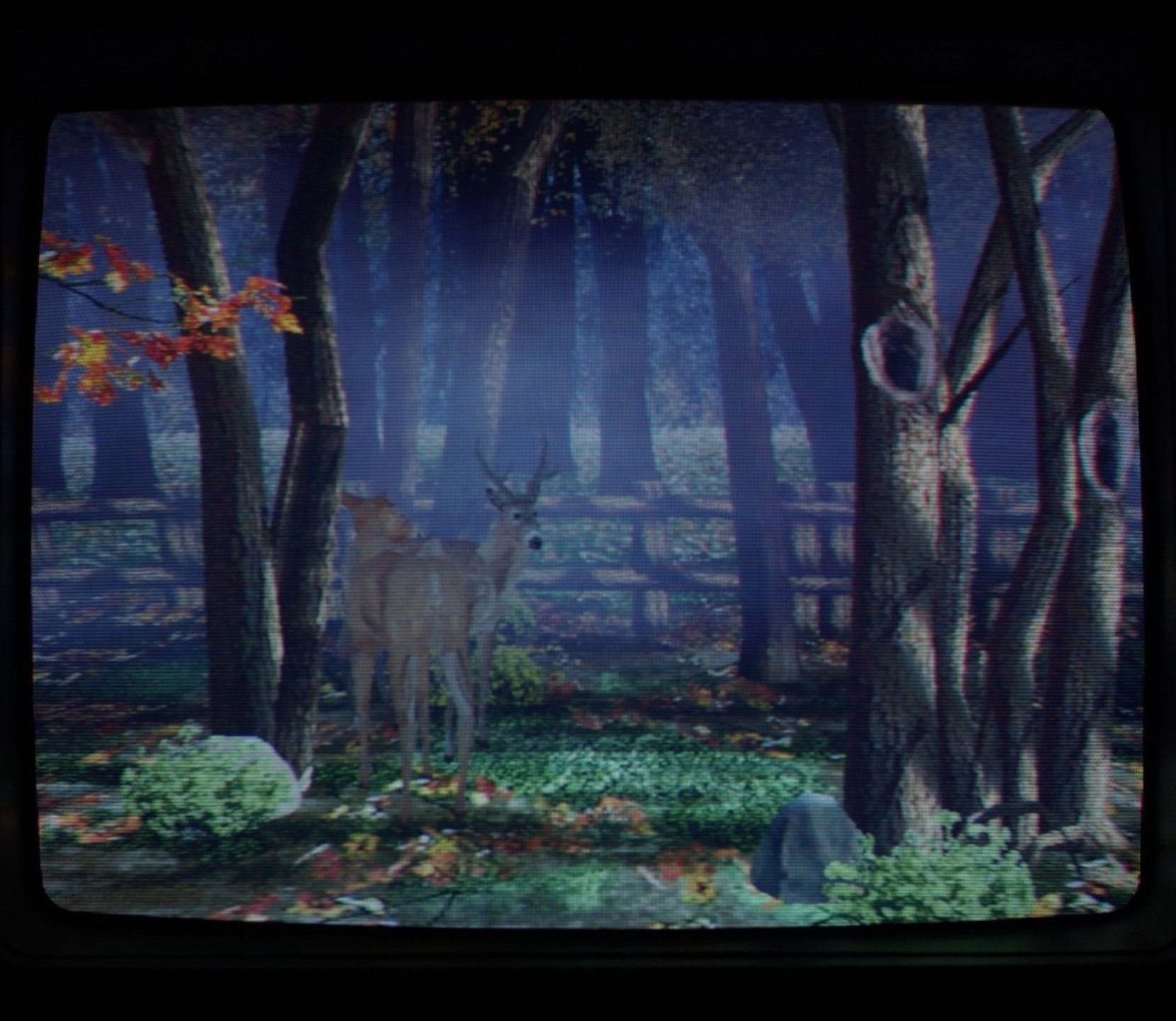
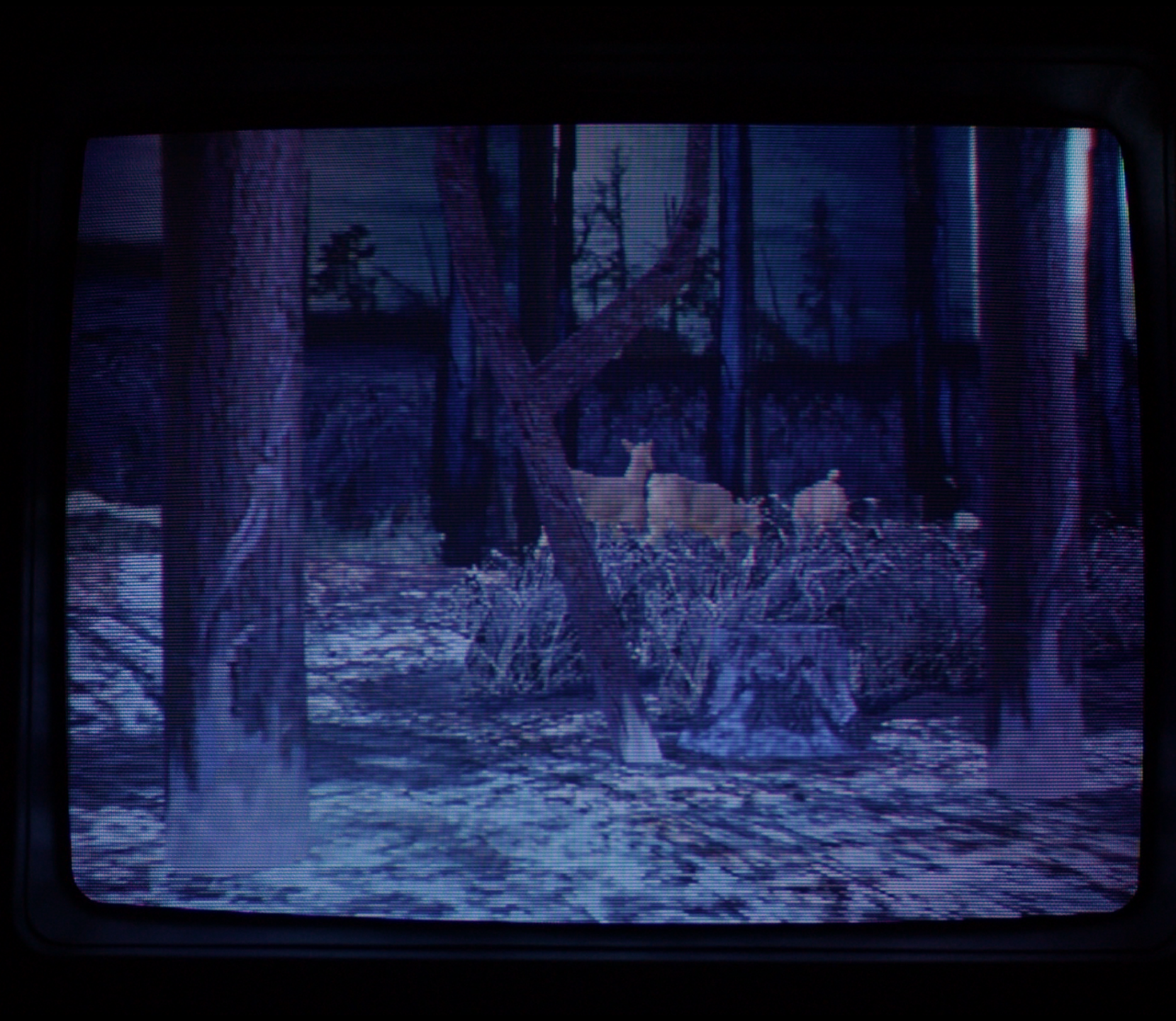
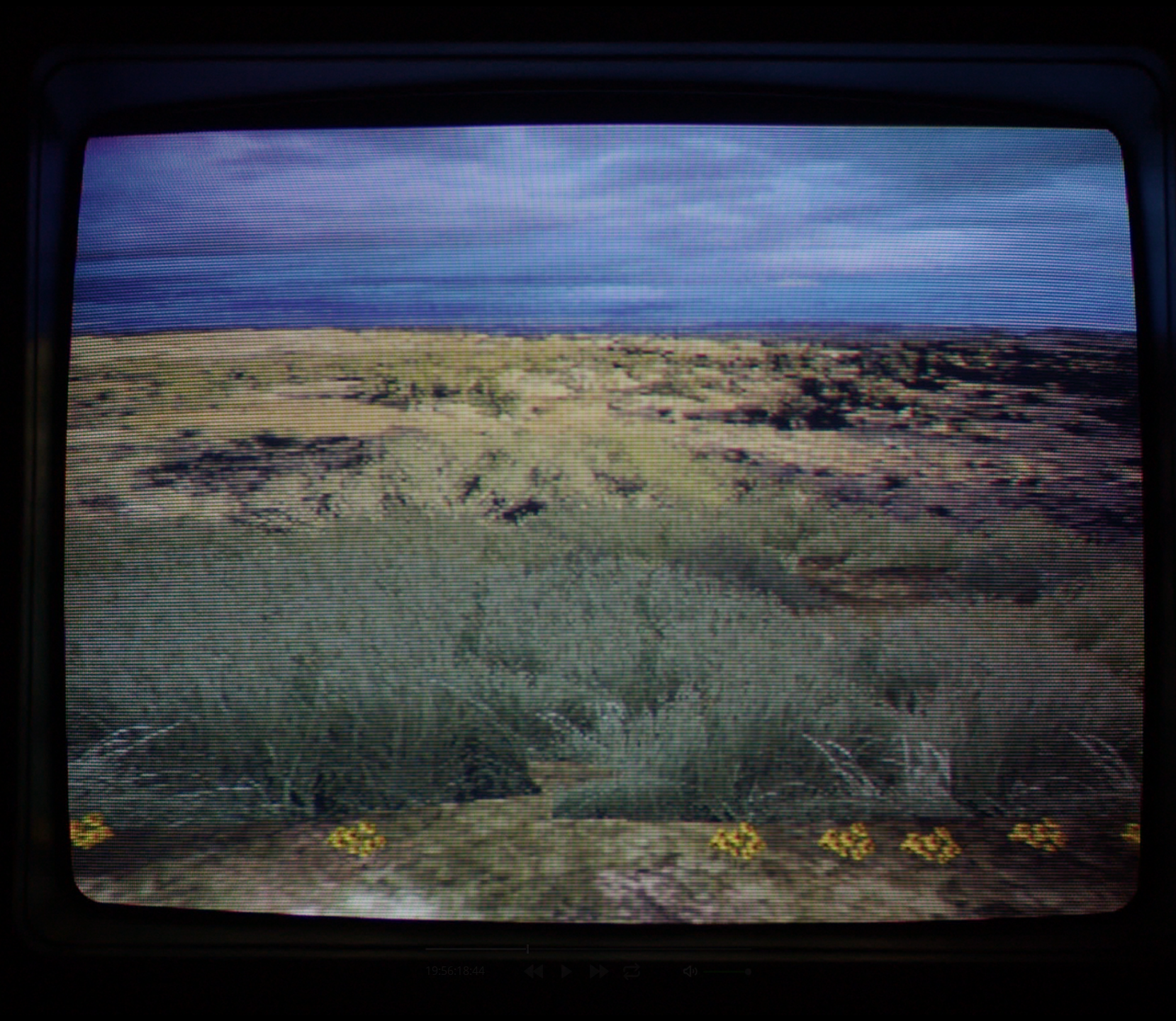
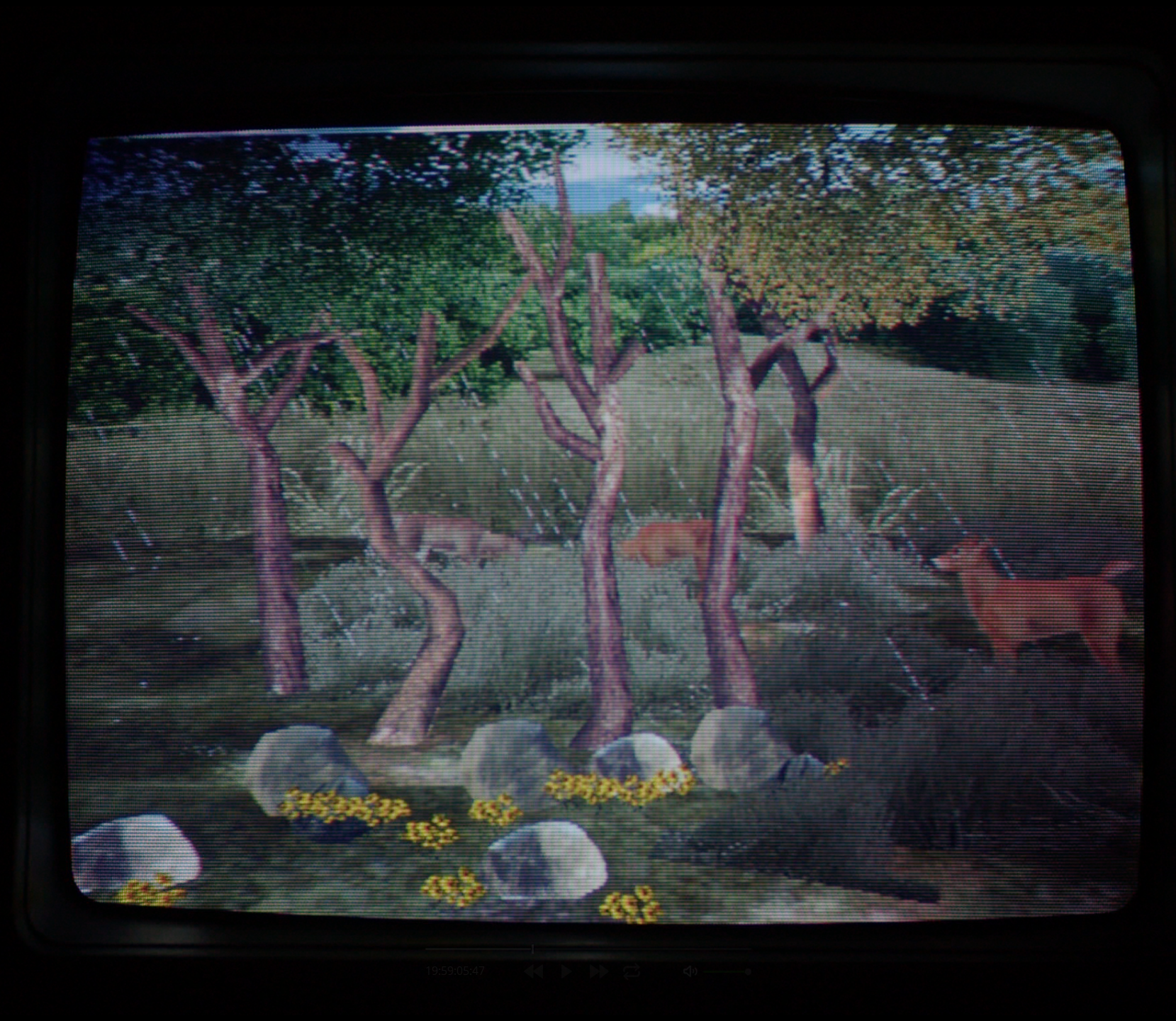
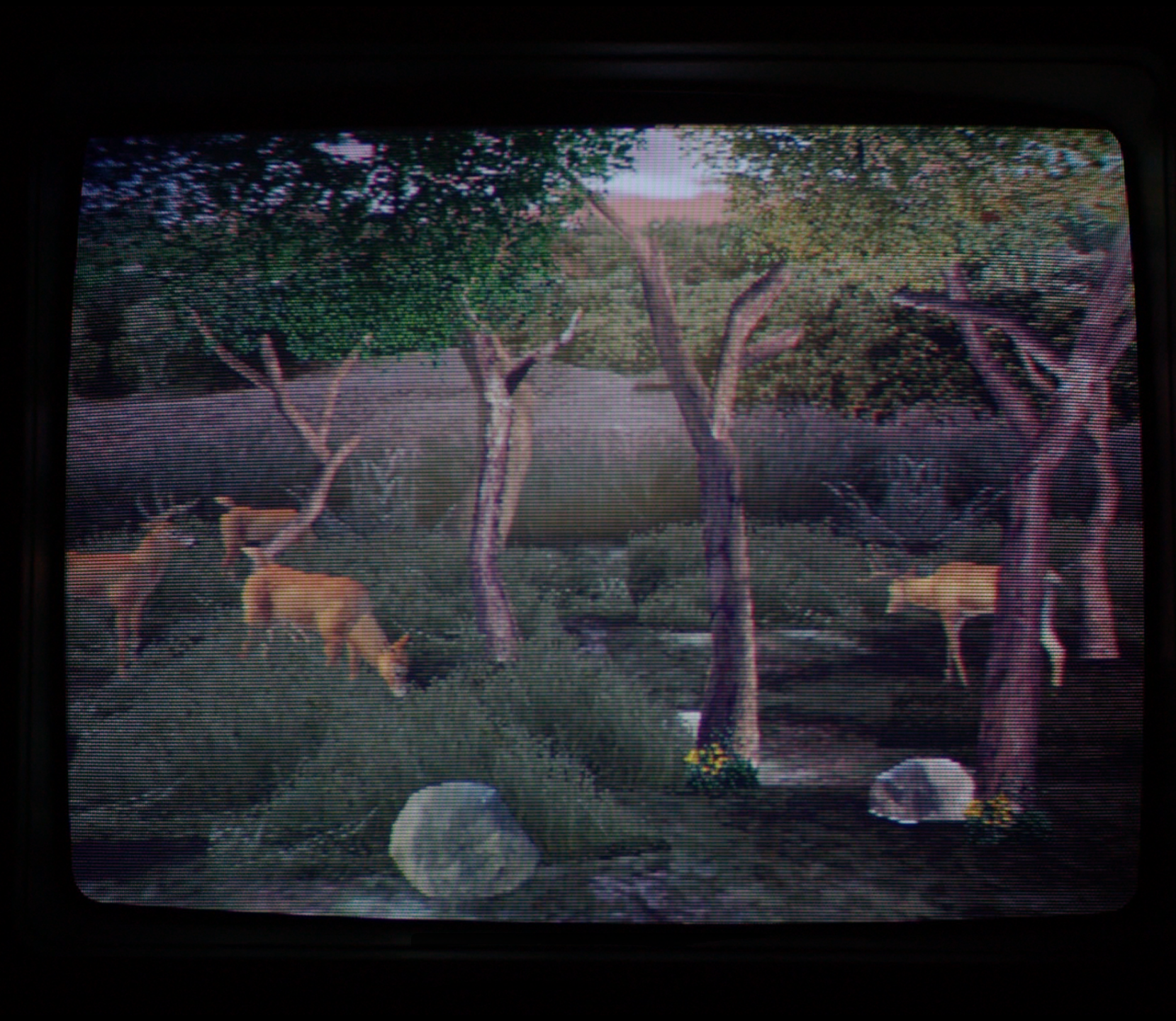
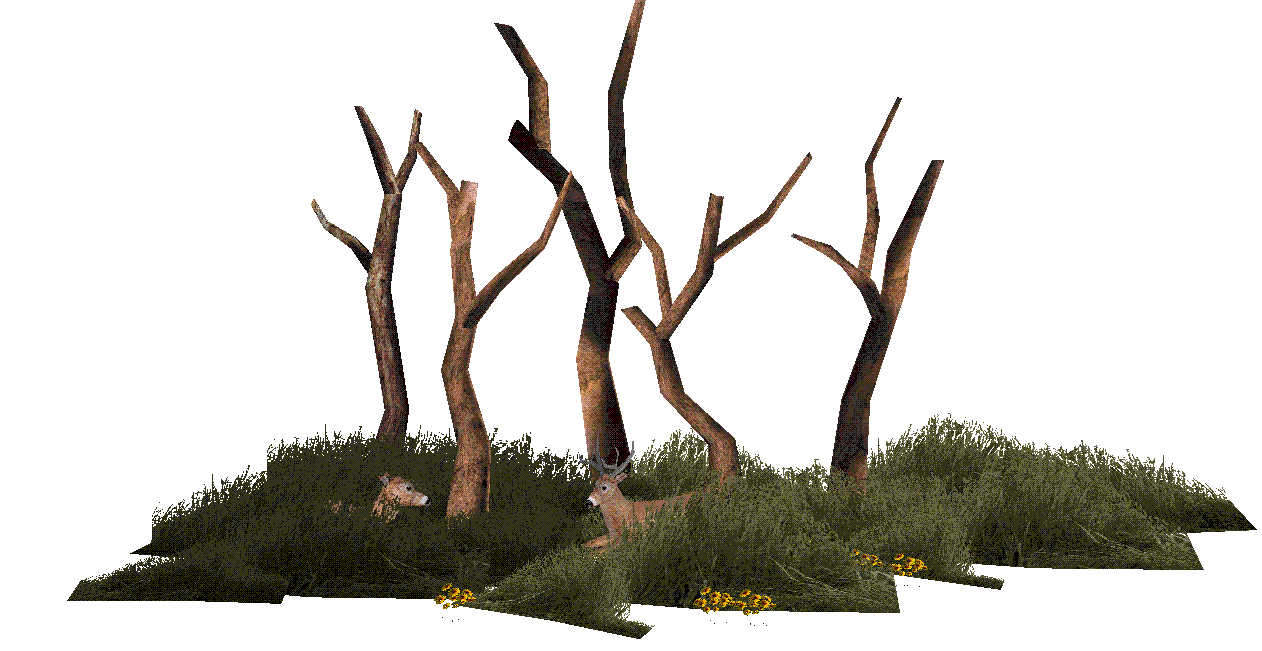
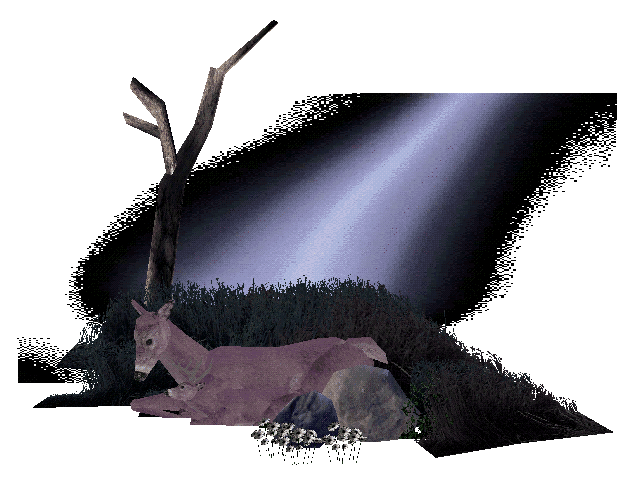
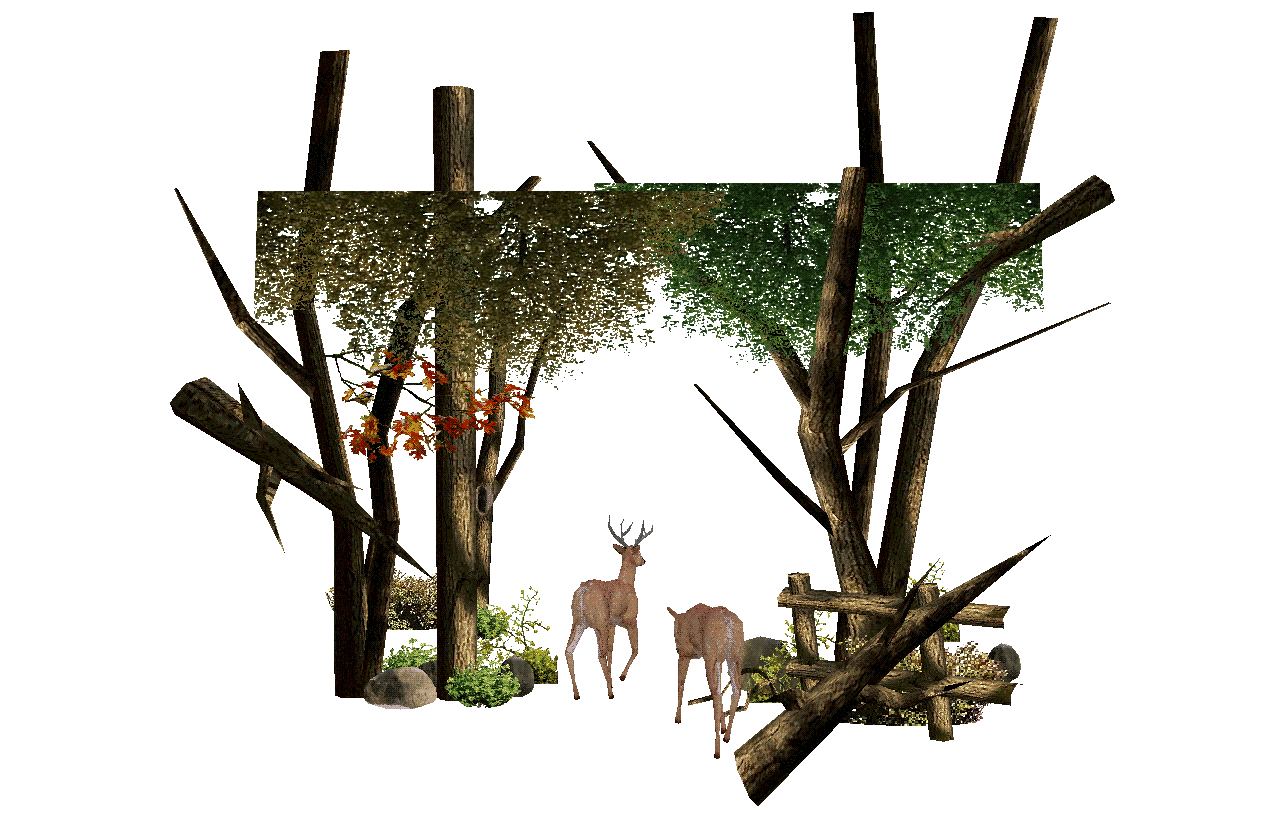
Below are a few images of procedurally generated landscapes from a recording of Big Buck Hunter: Restoration - however
you can see more on the section dedicated to Photos of the modified arcade cabinet.
The animals in Big Buck Hunter
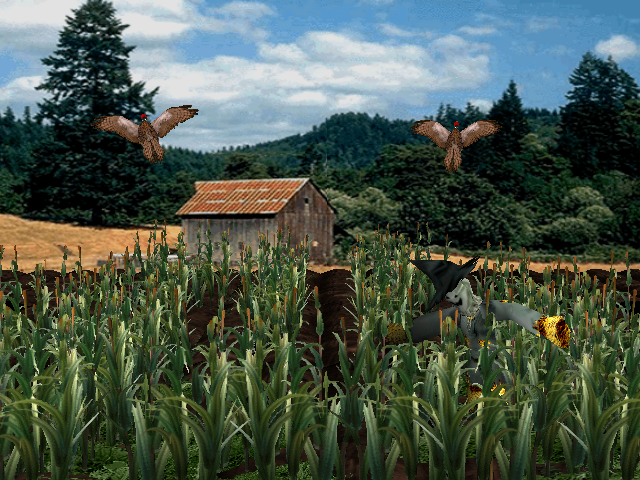
Of course, deer are present, both does and bucks. Other animals appear in “bonus rounds,” including turkeys,
ducks, fish, mosquitos, pheasants, and quail.
Never in the original game do two different types of animals see or interact with each other; it's either a deer
shooting level or a bonus level. Some of the bonus levels are designed specifically to accommodate one animal
(for example, ducks inhabit a level set on a lake) - while other bonus levels are made with repurposed deer-level
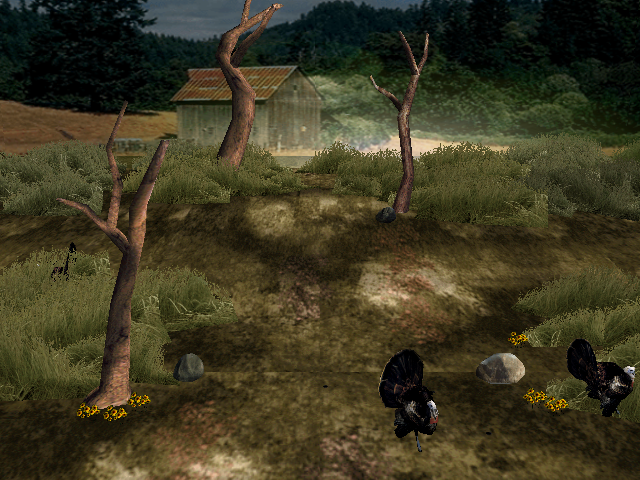
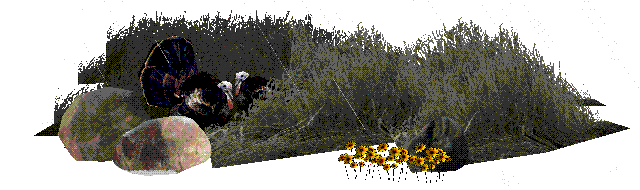
assets (the turkey shooting bonus level is built out of assets from the 'morning' levels in the south region).
All animal behavior in the original Big Buck Hunter conveys fear: deer have animations only for being startled,
fleeing, or dying, and they lack even a simple walking animation. The turkeys likewise also only have a fleeing
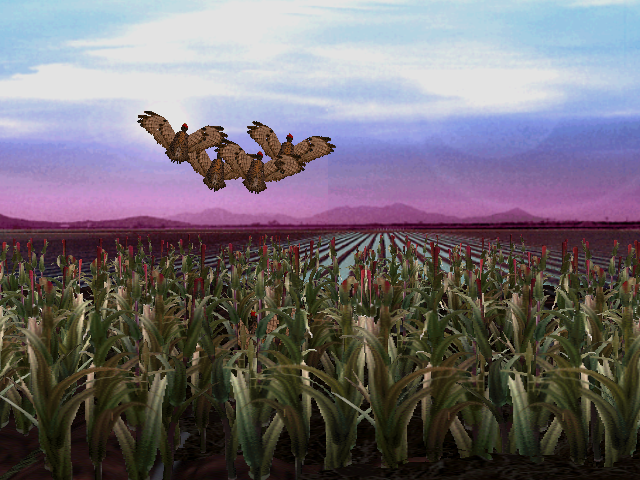
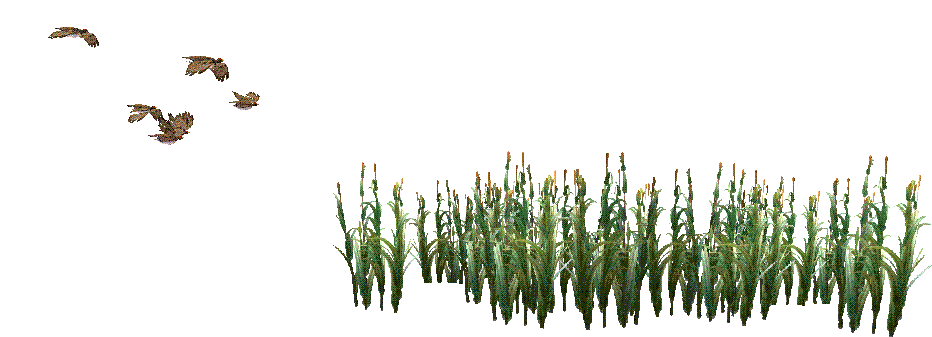
animation and a death animation. The pheasants, quail, and ducks have death and flying animations, but the only
time they are seen flying is straight up out of grass/cover - which is how they fly in real life when they are
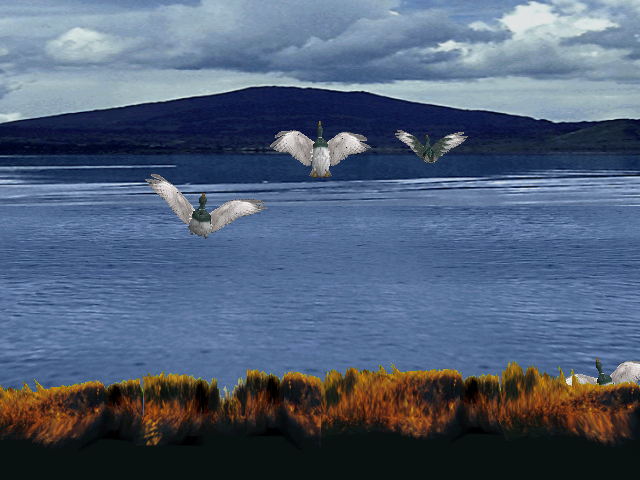
suddenly startled. It's worth noting that the duck level is a full 3d scene of a lake (even with animated water!)
- and the ducks (as well as the pheasants and quail) have fully modeled legs that would allow them to swim
or walk, but these behaviors are never seen and their legs are never utilized in the original game.
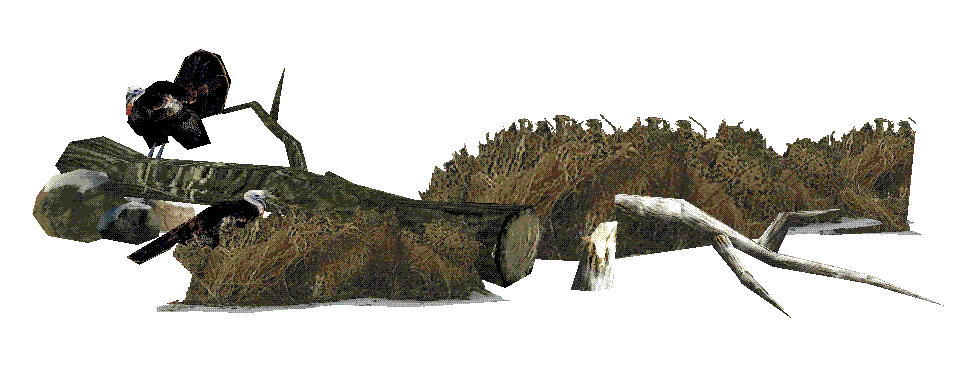
Above: Pheasants, Ducks, Quail, and Turkeys; how they appear + behave in the original game (its not apparent in the screenshot, but the Turkeys are all running quickly in different directions)
The animals in Big Buck Hunter: Restoration
Above: Pheasants, Ducks, and Turkeys as they appear + behave in Big Buck Hunter: Restoration
To reflect the unity of creation before the fall, different types of animals now coexist and interact
with each other; eliminating the fragmentation present in the original game. Their behaviors and animations
have been entirely rewritten to correspond with peace, rest, and lack of death. Ducks can now swim and eat;
pheasants and quail now can land, walk, and eat. Their movement corresponds to one another’s positions;
just as birds flock in air and on the ground, as opposed to the original game where birds followed predetermined
fleeing routes. Additionally, because no female turkey model existed in the original game, the default tom
turkey model has been modified to create a hen. This was especially crucial since so much turkey behavior
I've observed in real life revolves around the interactions between toms and their hens. Apart from ducks
- who live on water where the other animals can't follow them, all the animals can now walk, eat, and rest
in the same landscapes alongside one another.
Wild Deer Photographs + Videos
Trail-Cam Videos Recorded At My Home In West Virginia
Click a video to go fullscreen
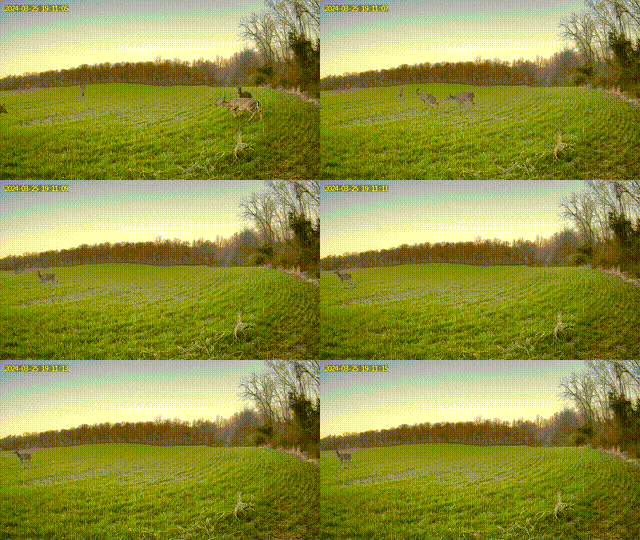
Younger deer playing and chasing each other
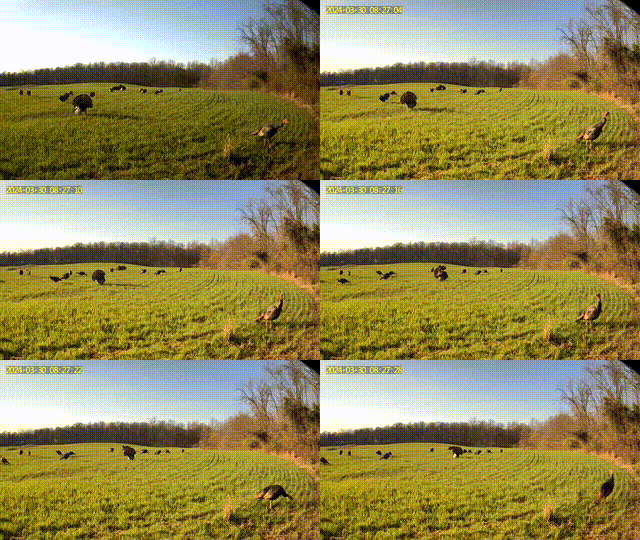
Two toms bring their hens out to graze
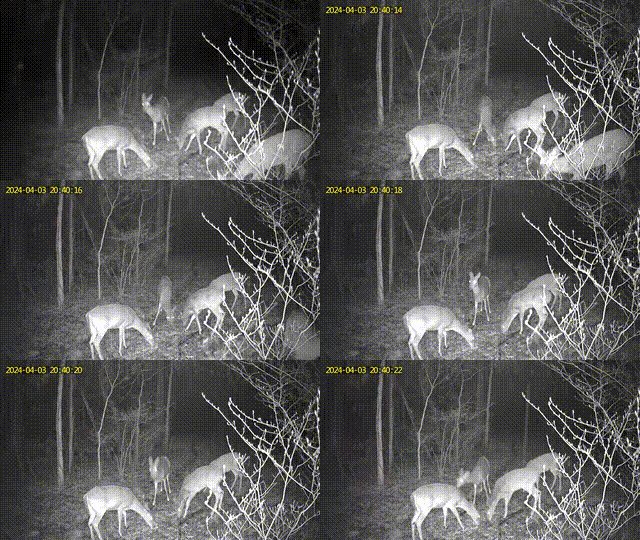
Deer eating cracked corn at night
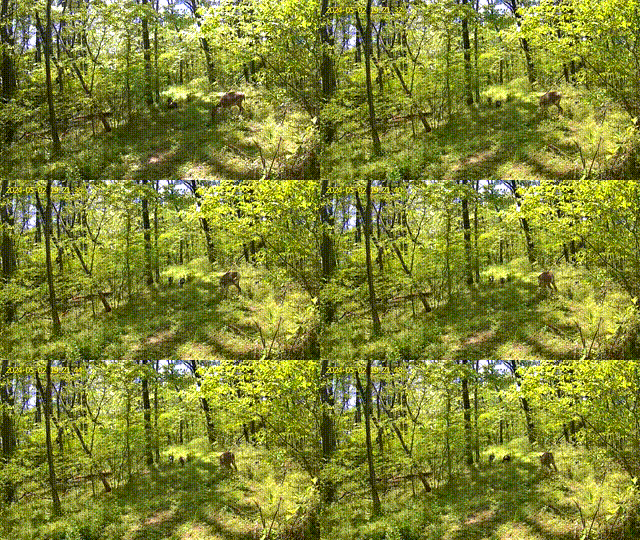
A doe and two turkeys together in the woods
More videos coming soon! Click the animated GIF previews to download a copy of the video with sound!
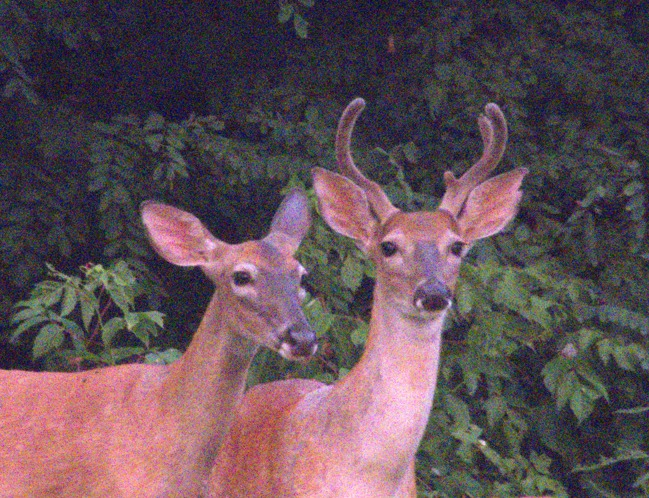
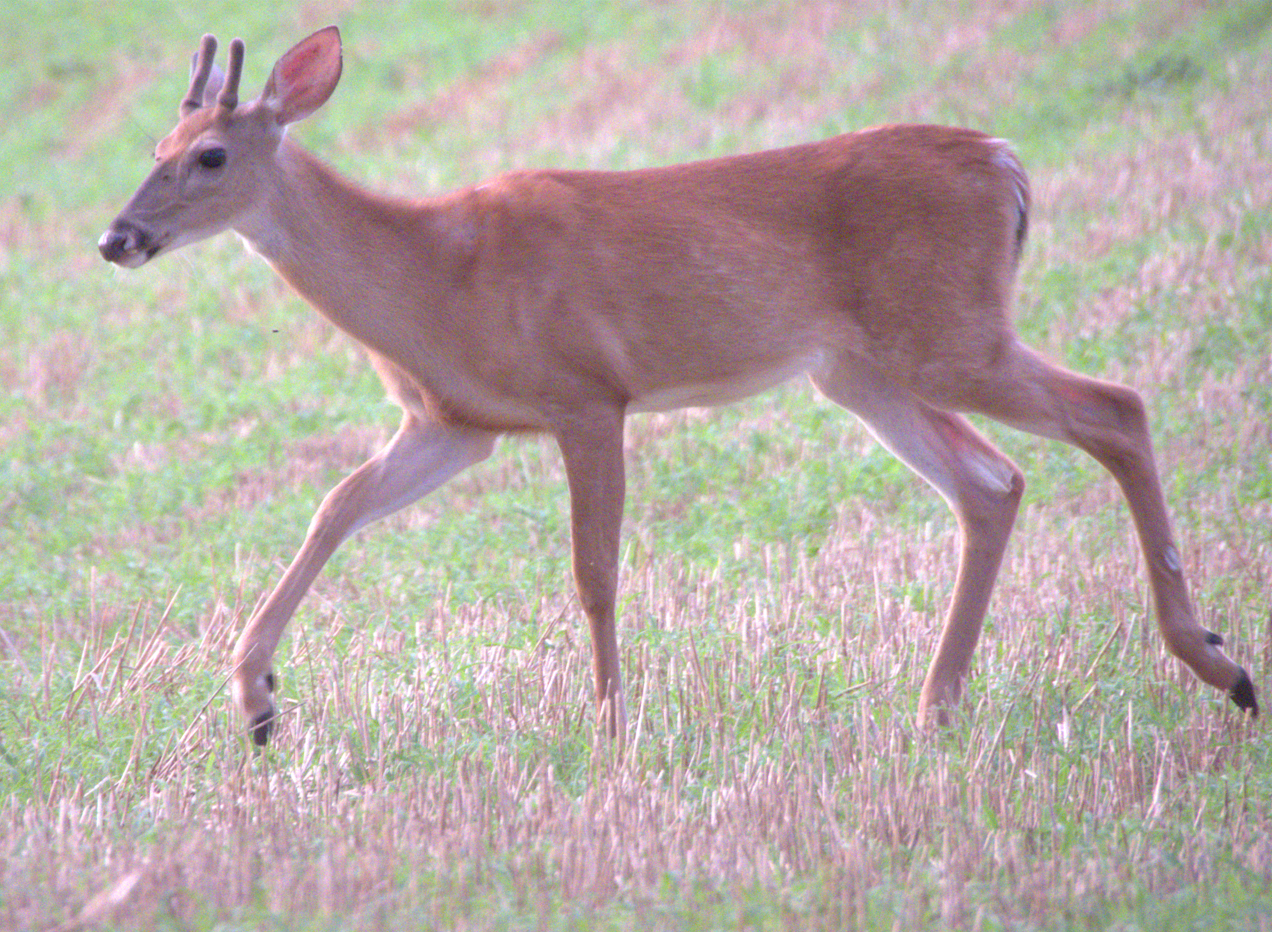
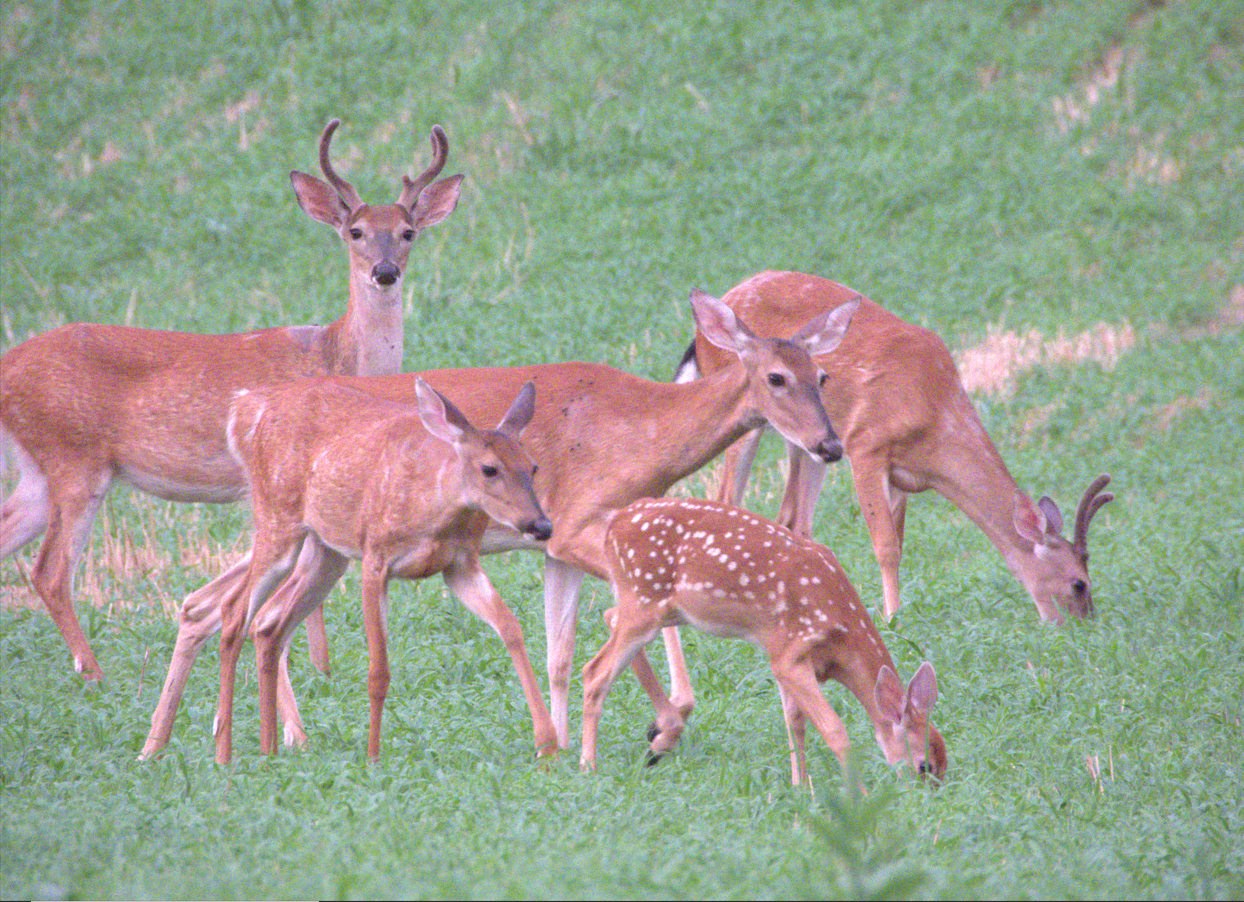
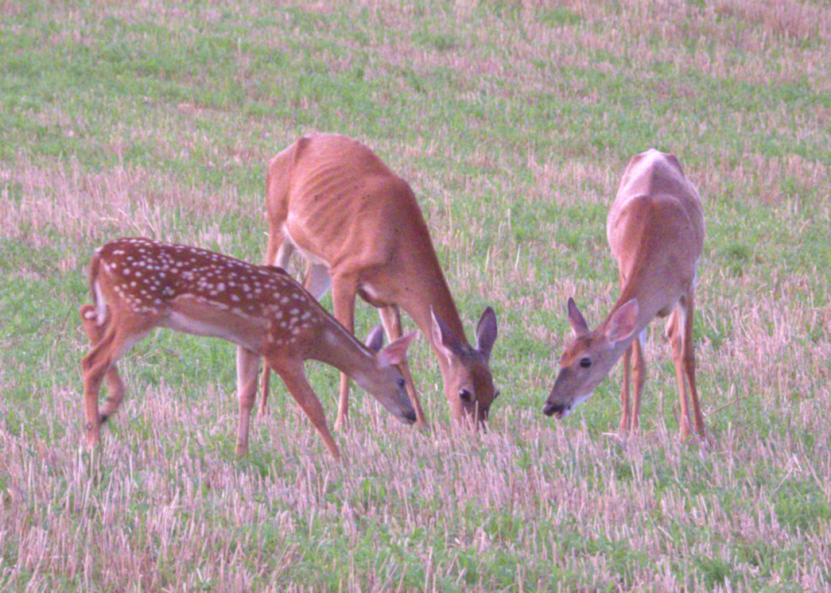
One of the most fruitful aspects of working on the project was spending time with real deer, I spent a lot of
time in a deer blind (a camoflauge tent) trying to get good photographs of them, and a lot of time checking
or repositioning trail-cams. The initial aim of this was to study the behavior of the deer so that I could
better translate this to the programming of the deer in Big Buck Hunter: Restoration - as the deer in the
original Big Buck Hunter game can only become startled and run away, they never lay down, rest, or even
walk slowly around. I enjoyed this greatly and got much more out of it than a study of behavior. I hope
that I will keep being able to do this even though the project is finished now.
Photos taken with a handheld camera, either from a blind or from 'stalking'
Next steps for Big Buck Hunter: Restoration
Big Buck Hunter: Restoration took a long time to finish. Ideally, now that it is complete, I would like to see it
permanently placed in a local bar or small restaurant in West Virginia—the exact type of environment where I
encountered the original game while growing up.
It was on display at l'Avant Galerie Vossen, in Paris, from January 23rd, 2025, until early March, as
part of my first solo show. Hopefully at some point in Autumn 2026, it will be on display in the United States.
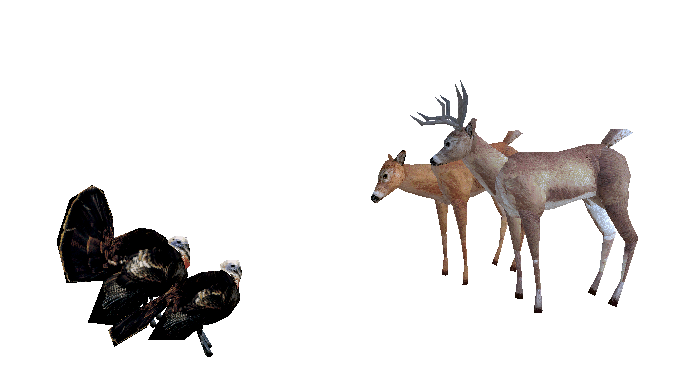
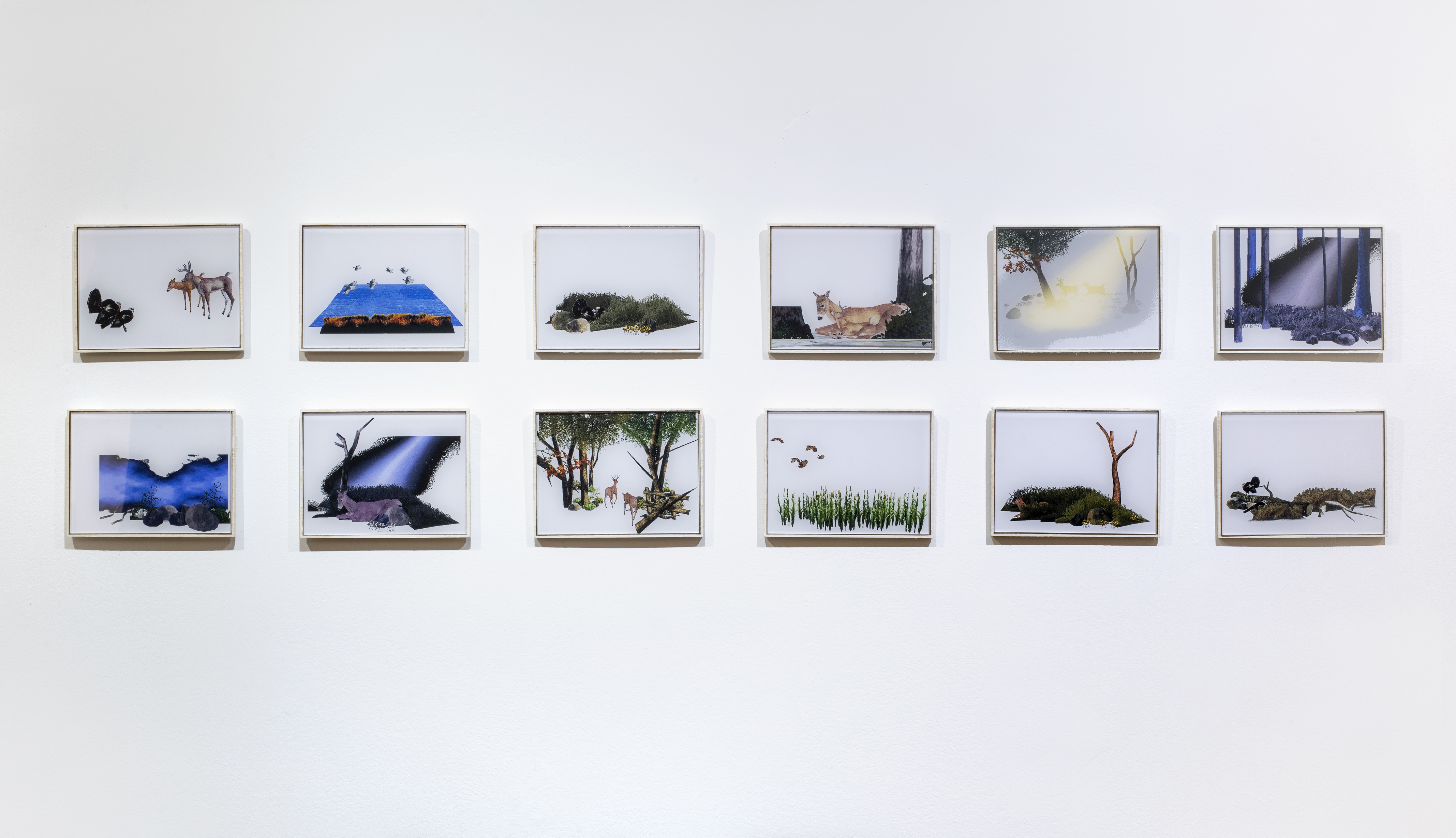
Since it is a monumental work, and an edition of 1, I also produced some "postcards"/souvenirs, small
plexiglass prints in wooden frames, of small studies/scenes I made during the development of Big Buck Hunter: Restoration.
These postcards are made using different models from the original game, and are affordable so that everyone who liked the
project can take a part of it home if they want to. If you want one,
contact the gallery: https://avant-galerie.com/en/contact.
Other Reading
- "Amazing Whitetails" by Mike Biggs, 1994
- "The Whitetail Chronicles" by Mike Biggs, 1998
- "Whitetails in Action" by Mike Biggs, 1996
- "The First Created Man" by St. Symeon the New Theologian (+1022) (translated by Fr. Seraphim Rose)
- "The Resurrection and the Icon" by Michel Quenot, 1998
- "Hexameron" by St. Basil the Great (+379)
- "Genesis, Creation, and Early Man" by Fr. Seraphim Rose
- "Touching the Wild: Living with the Mule Deer of Deadman Gulch" by Joe Hutto, 2014
- "Illumination in the Flatwoods: A Season Living Among the Wild Turkey" by Joe Hutto, 2011
- *PBS has produced two episodes of "Natural World" based on the above two books by Joe Hutto. They are absolutely worth watching, titled "Touching the Wild" and "My Life as a Turkey".
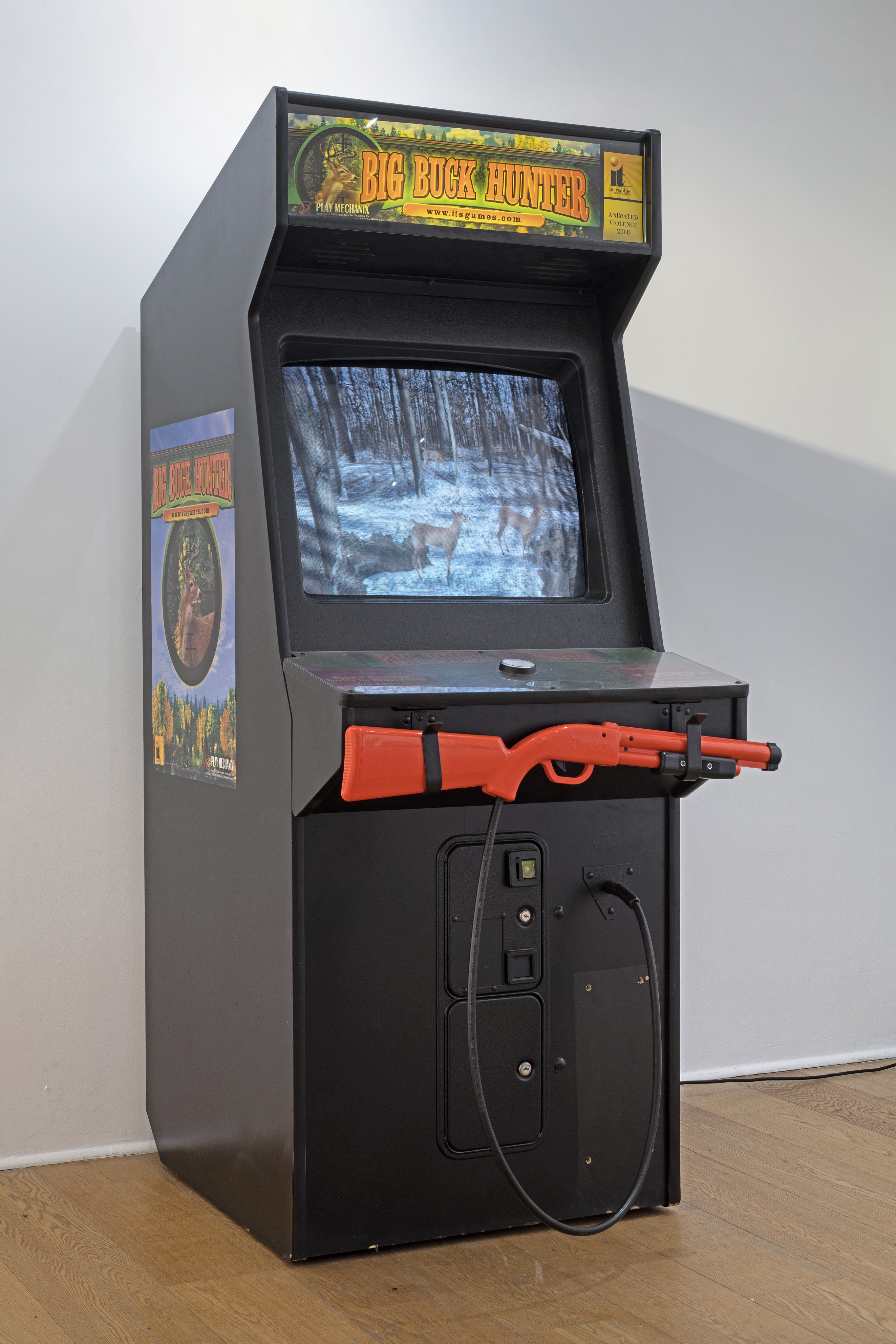 Above: Big Buck Hunter: Restoration at l'Avant Galerie Vossen in 2025.

.jpg)
.jpg)
.jpg)
.jpg)