← Return to the index page
A Visit to the Church of Our Lady Of Kazan in Moisenay
In the spring of this year, 2026, I had the great privilege to go and attend liturgy and see the frescoes at the Church of Our Lady Of Kazan (Eglise de Notre Dame de Kazan) in Moisenay, France - an Eastern Orthodox church.
The church building itself was designed and built solely by Archimandrite Euthyme (Wendt) (+1973),
constructed using stones from the surrounding farmland. The church was consecrated in 1964,
and has celebrating the divine liturgy regularly ever since. Fr. Gregory Kroug (+1969), a monastic iconographer, painted the frescoes in the early 1960's. He is an incredibly important
figure in iconography (associated with the 'rediscovery of the icon' that happened in the 20th century), and, painted towards the end of his life, many consider
these frescoes to be some of his best work.
It's incredibly unique that such a high point in Church art has been reached so recently, usually when speaking about the 'height of iconography', discussion is focused
almost entirely on icons and frescoes which were painted in or before the 16th century, before the western influence of the renaissance infiltrated the iconography/liturgical art of the eastern church, helping lead to its disorientation.
More information about the Church and it's history is available on the Church's website (in French):
https://skite-notredame-de-kazan.blogspot.com/p/histoire-de-lermitage.html
This page is currently under construction, but at the bottom of the page, there will be more examples of Fr. Gregory Kroug's work, as well as some other contemporary / historical icons, and other examples of exceptional frescoes.
All images may be clicked to enlarge.
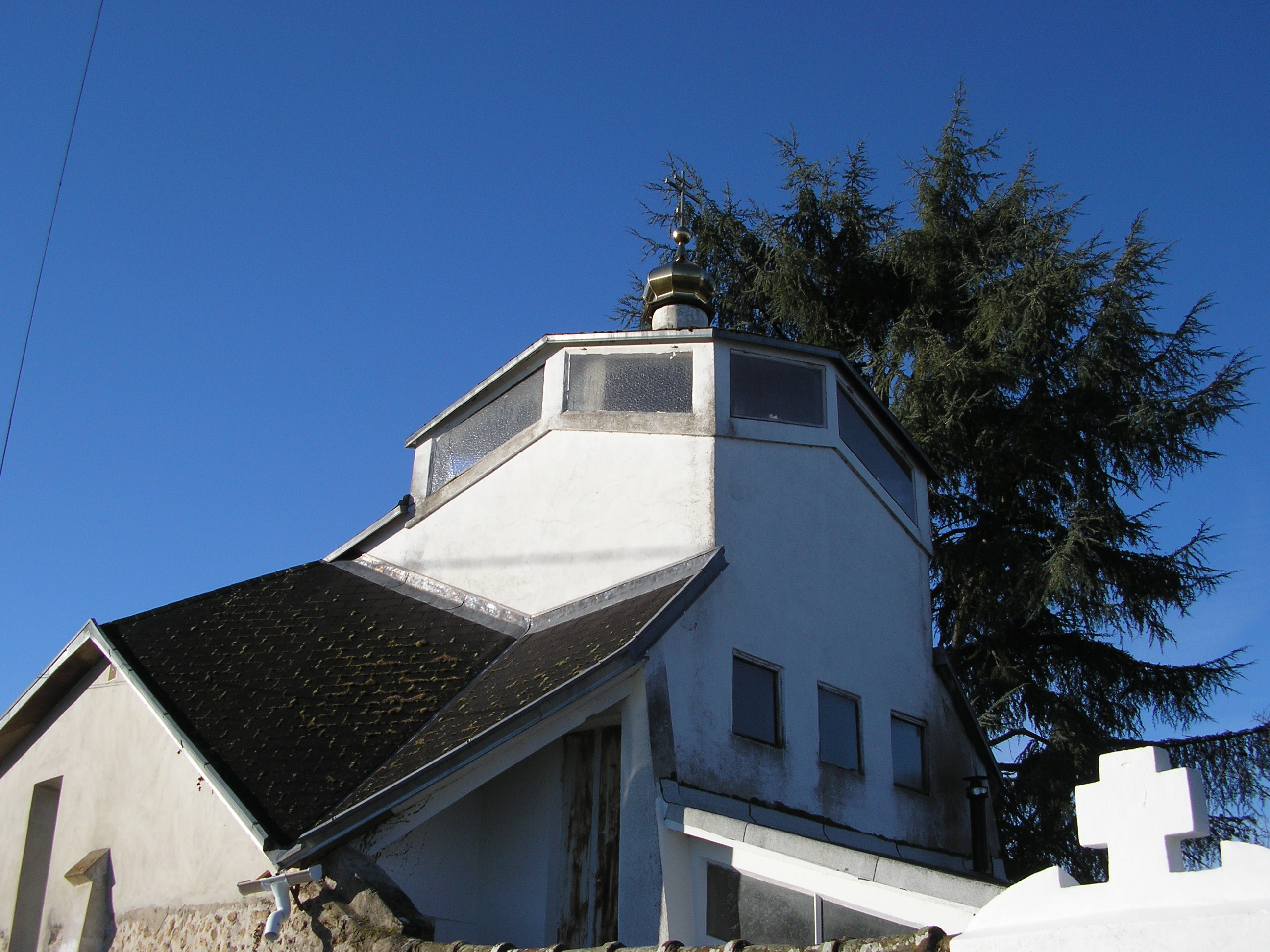
An exterior view of the church from my visit, as it stands today
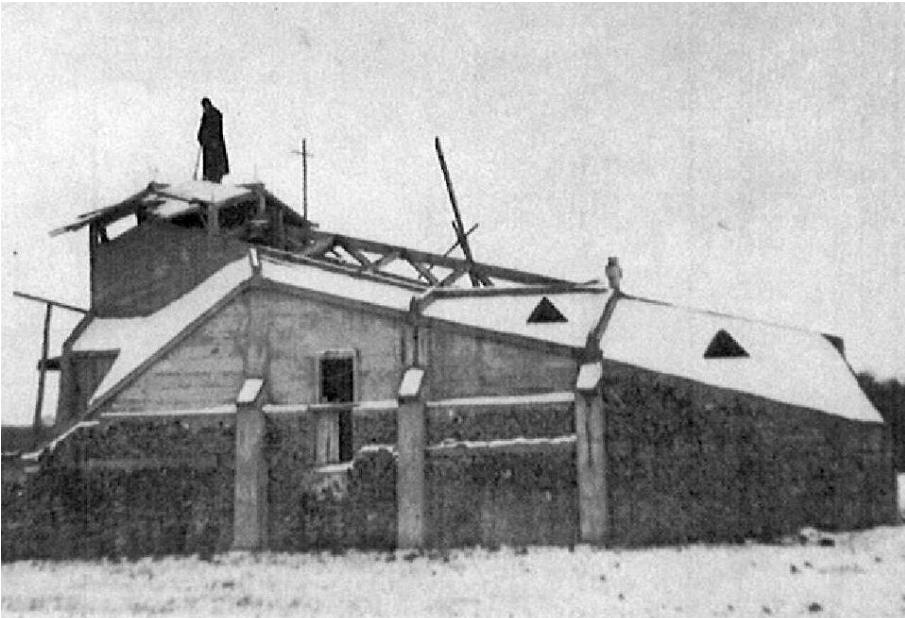
Father Euthyme on the roof of the church during construction (photo from the archive of V.N. Platonova)
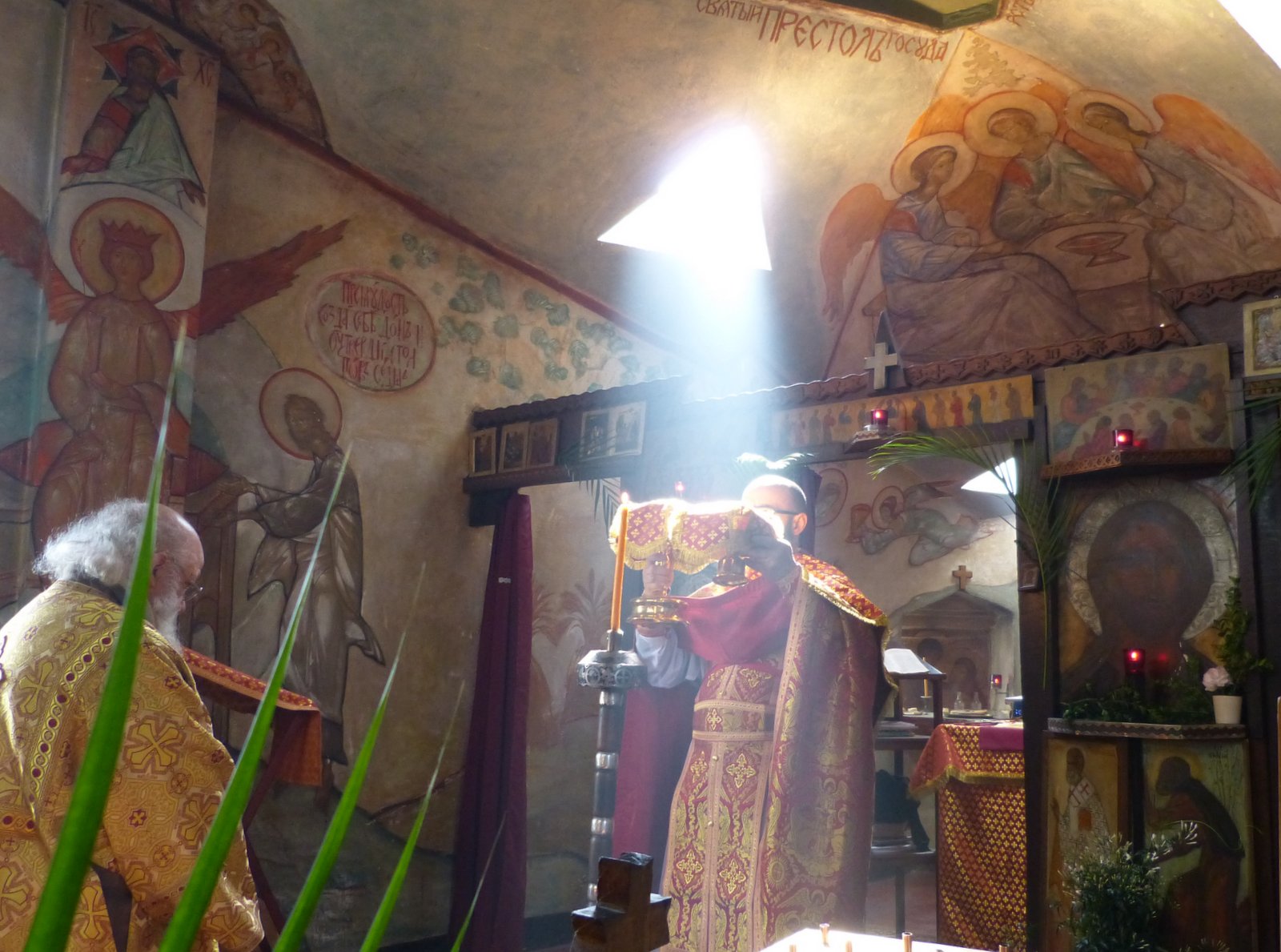
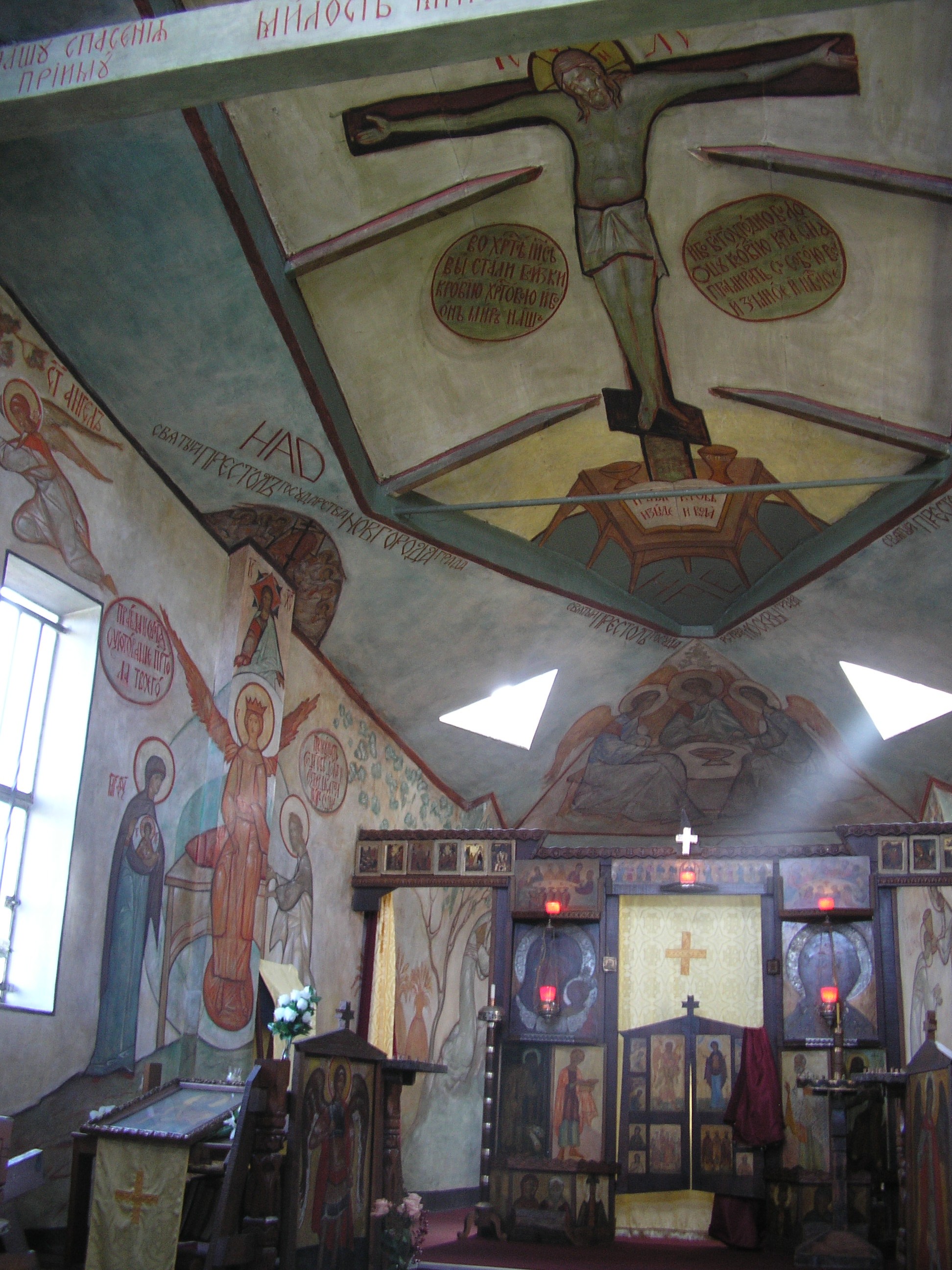
The interior view of the church, it's an unusual construction for an Orthodox church since there is no dome (usually orthodox churches feature a central dome, usually containing a fresco of the icon "Christ Pantocrator". In this case, it was structurally impossible, given the weak cement used, to make a dome like this), the ceiling is more flat, and where the icon of Christ crucified is, is actually constructed from wood).
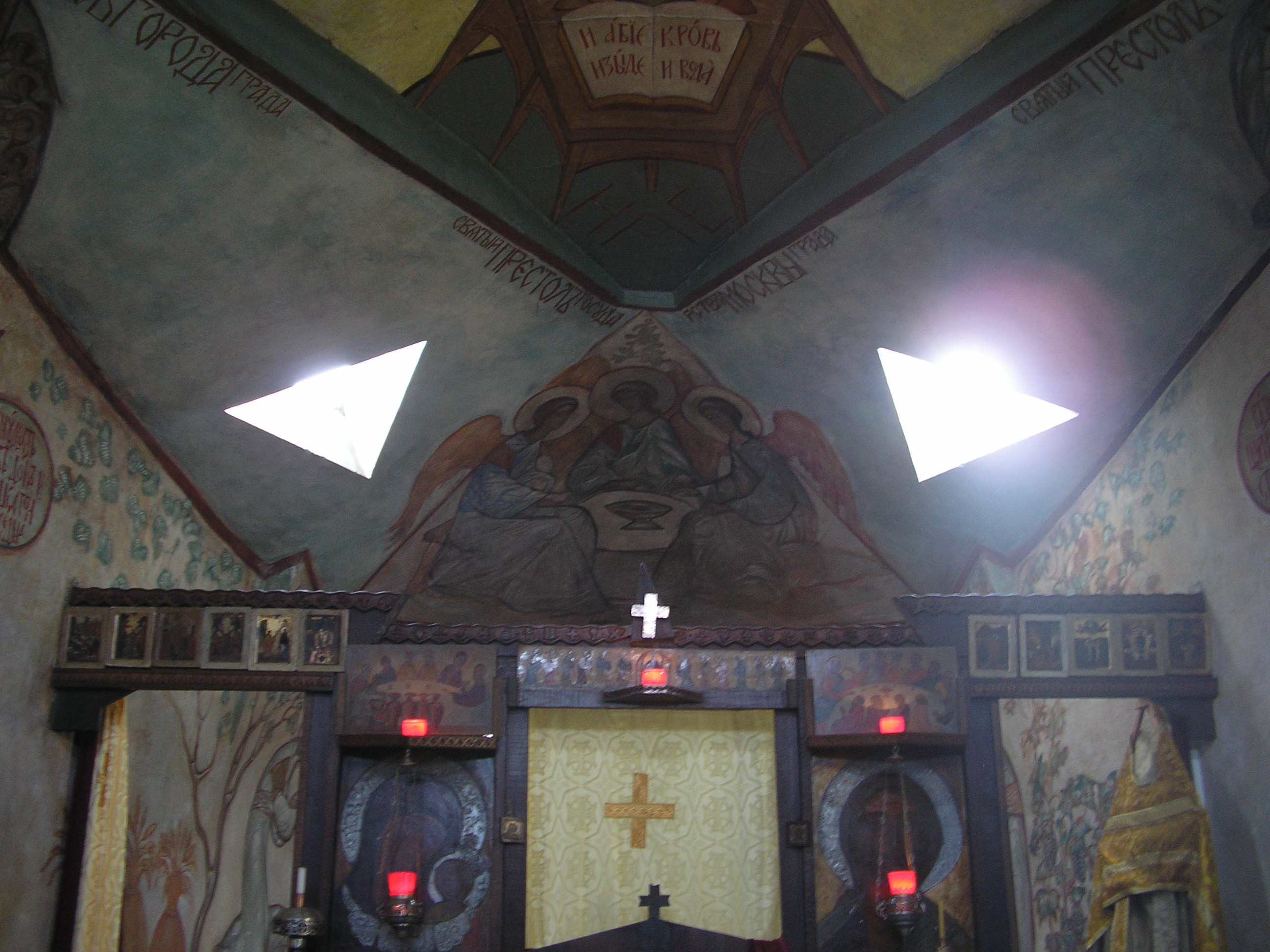
The triangular composition on the ceiling behind the iconostasis (the wooden screen of icons visible in the bottom third of the picture) is the "Old Testament Trinity", after Rublev's Trinity icon; one of the most celebrated/famous icons/prototypes in Church history.
It's worth noting that there is not a single right angle present anywhere in the design of the building.
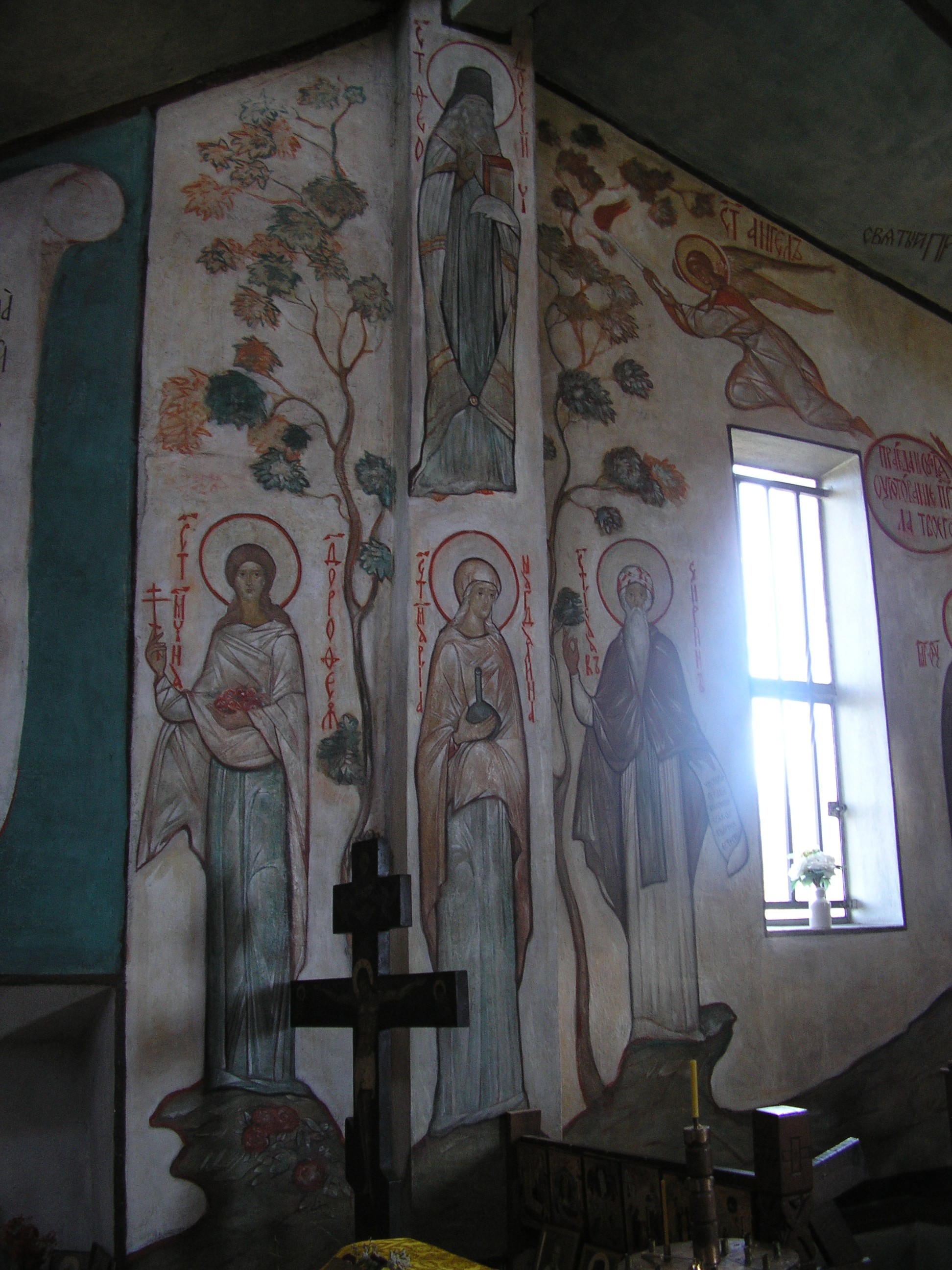
Above: Saints on the eastern wall of the church, on the top is St. Theodosius, and below from left to right are St. Dorothea, St. Equal-to-the-Apostles Mary Magdalene (she is holding a vessel with myrrh), and St. Isaac the Syrian.
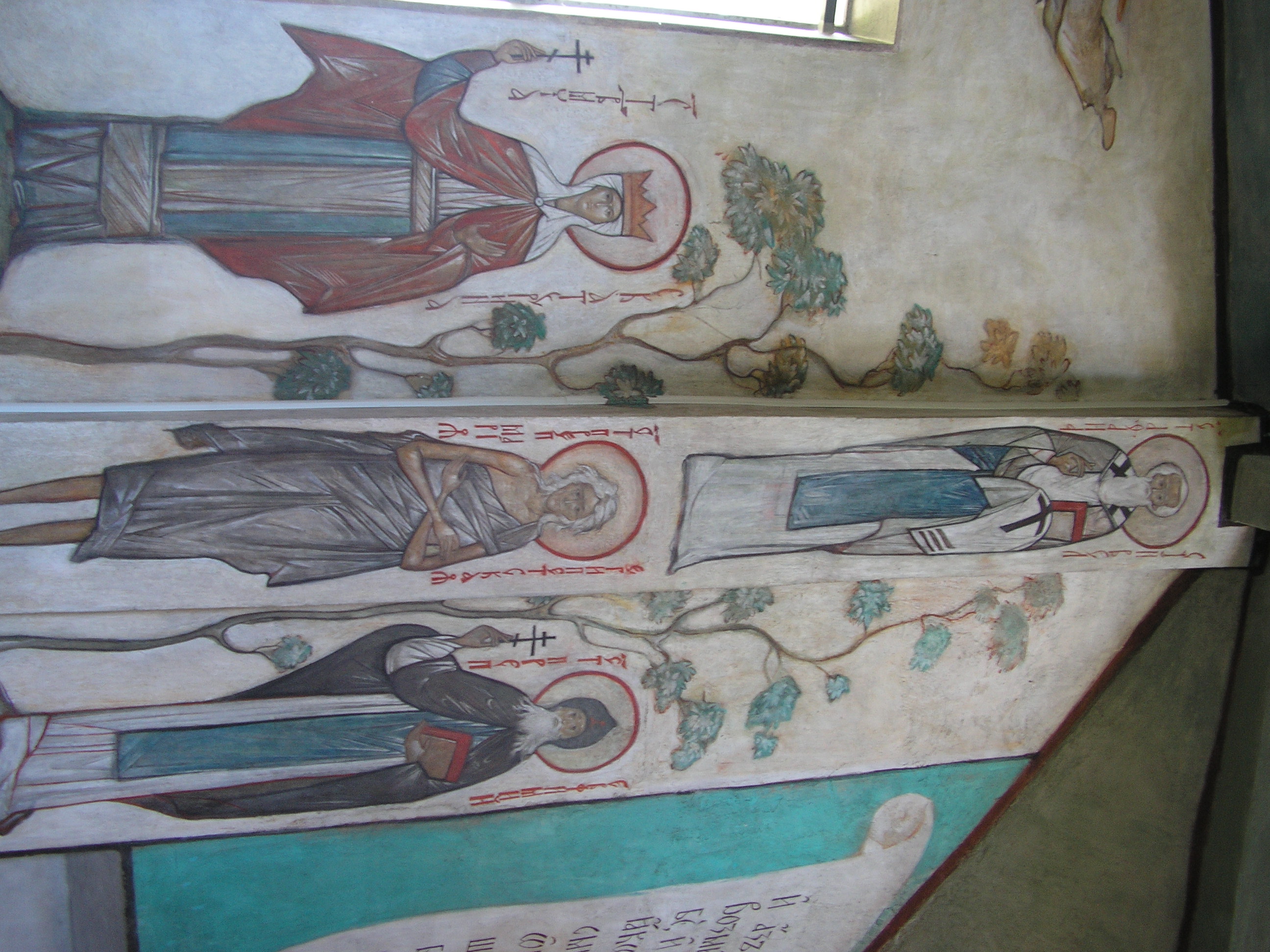
Above: Saints on the western wall of the church, on the top is St. Athanasius the Great, and below from left to right are St. Great Martyr Catherine, St. Mary of Egypt, and St. Euthymius.
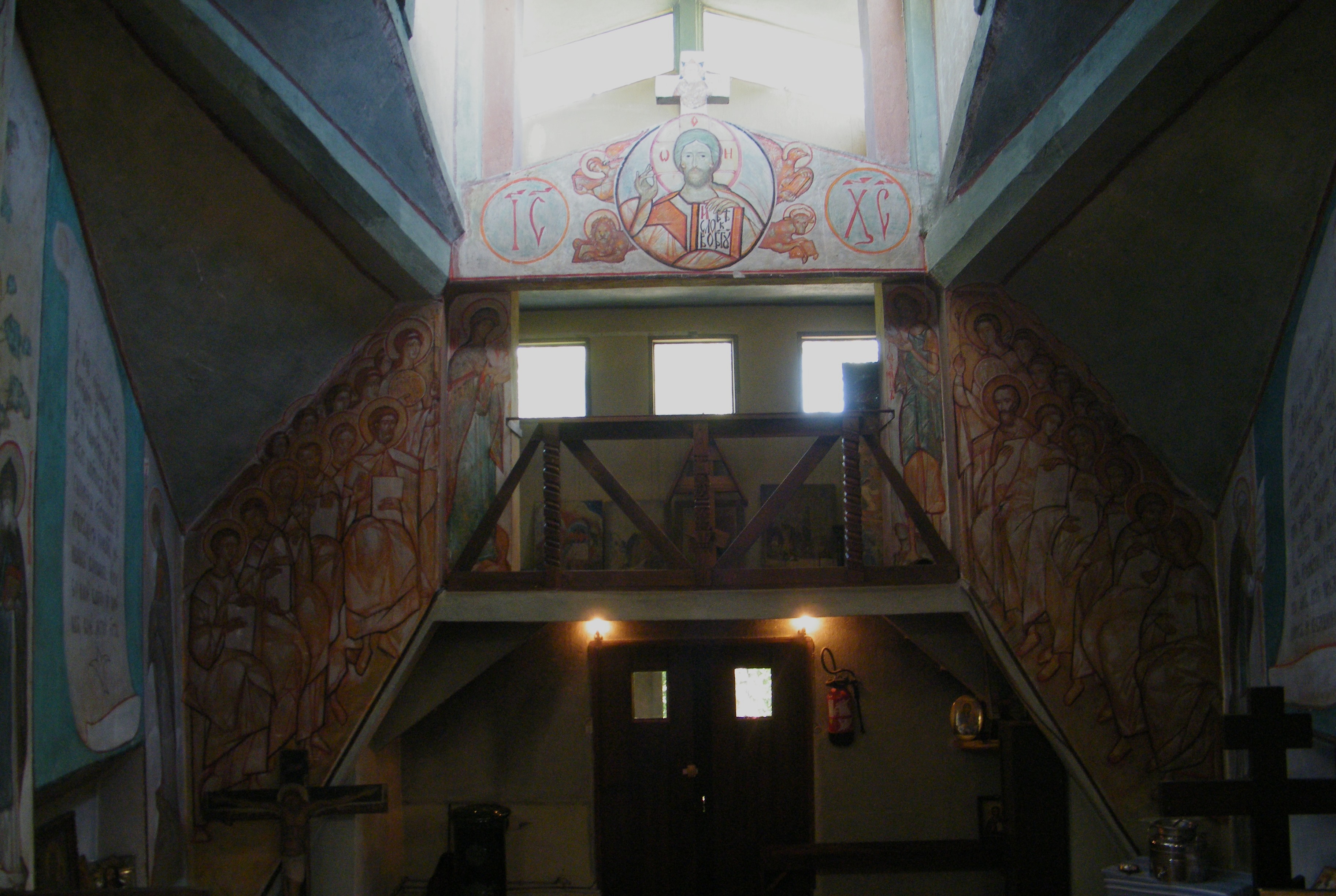
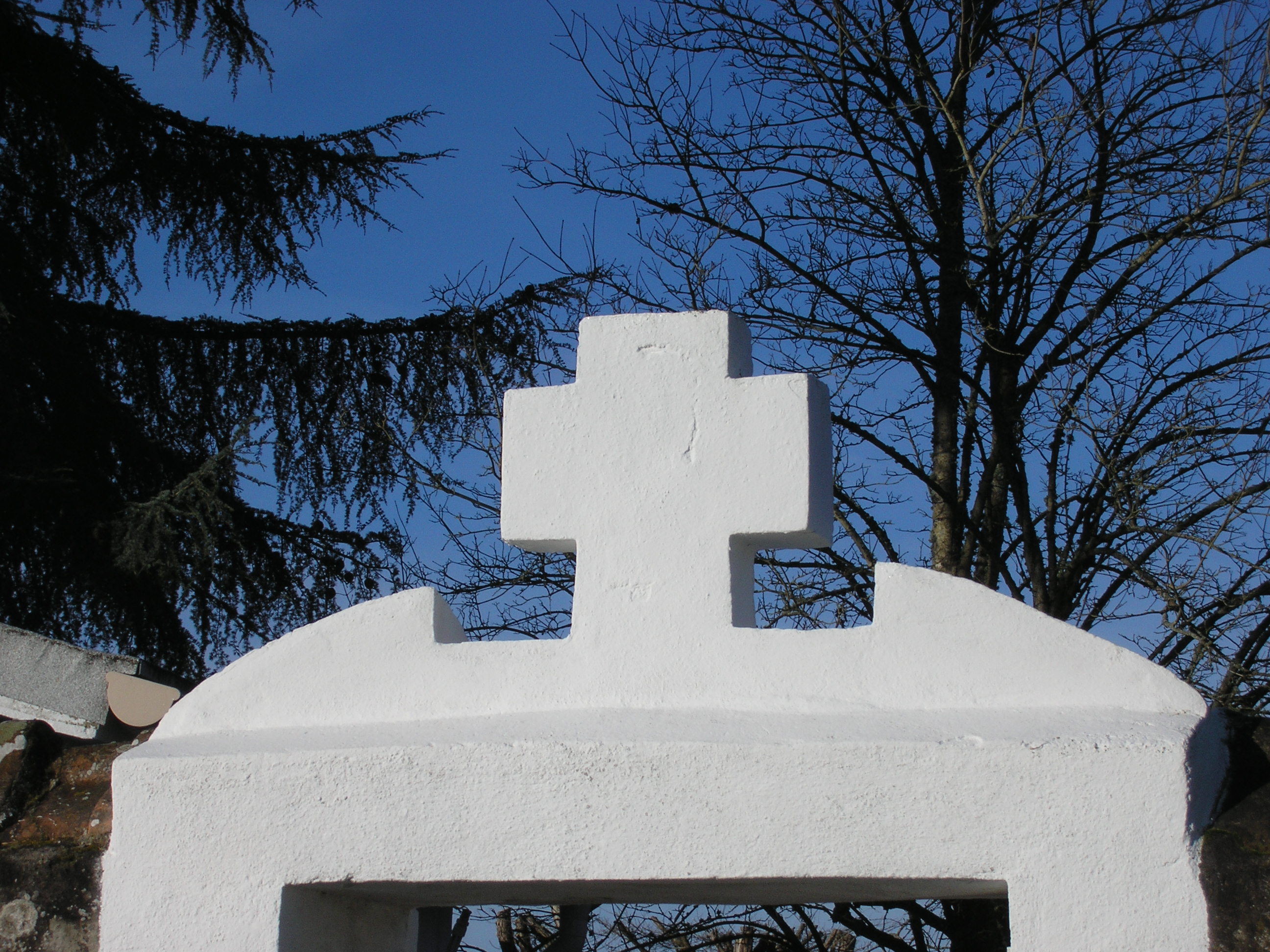
Above: Immediately above the entrance of the church is a fresco of Christ, holding an open book with John 1:1 "And the Word was With God". Surrounding him are the symbols of the four evangelists, an angel, an eagle, a lion, and a bull. Above him, on the simple four-pointed cross, is the icon "The Ancient of Days". On the pillar/wall on the left is the Mother of God, and on the right St. John the Baptist. The small space above the door is for the choir. (Photo Credit Mikhail Bogatyrev).
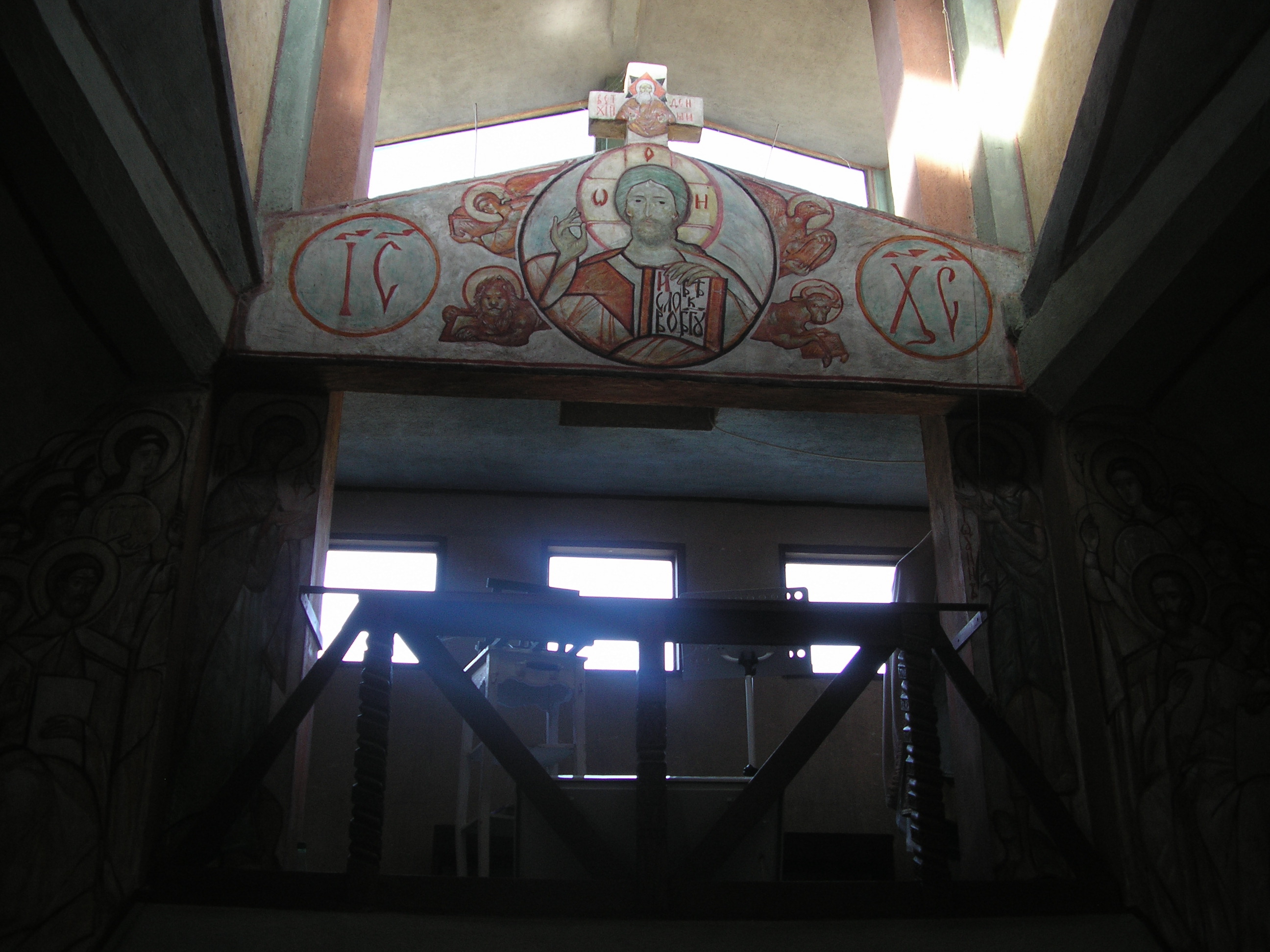
Detail of the fresco mentioned on the left.
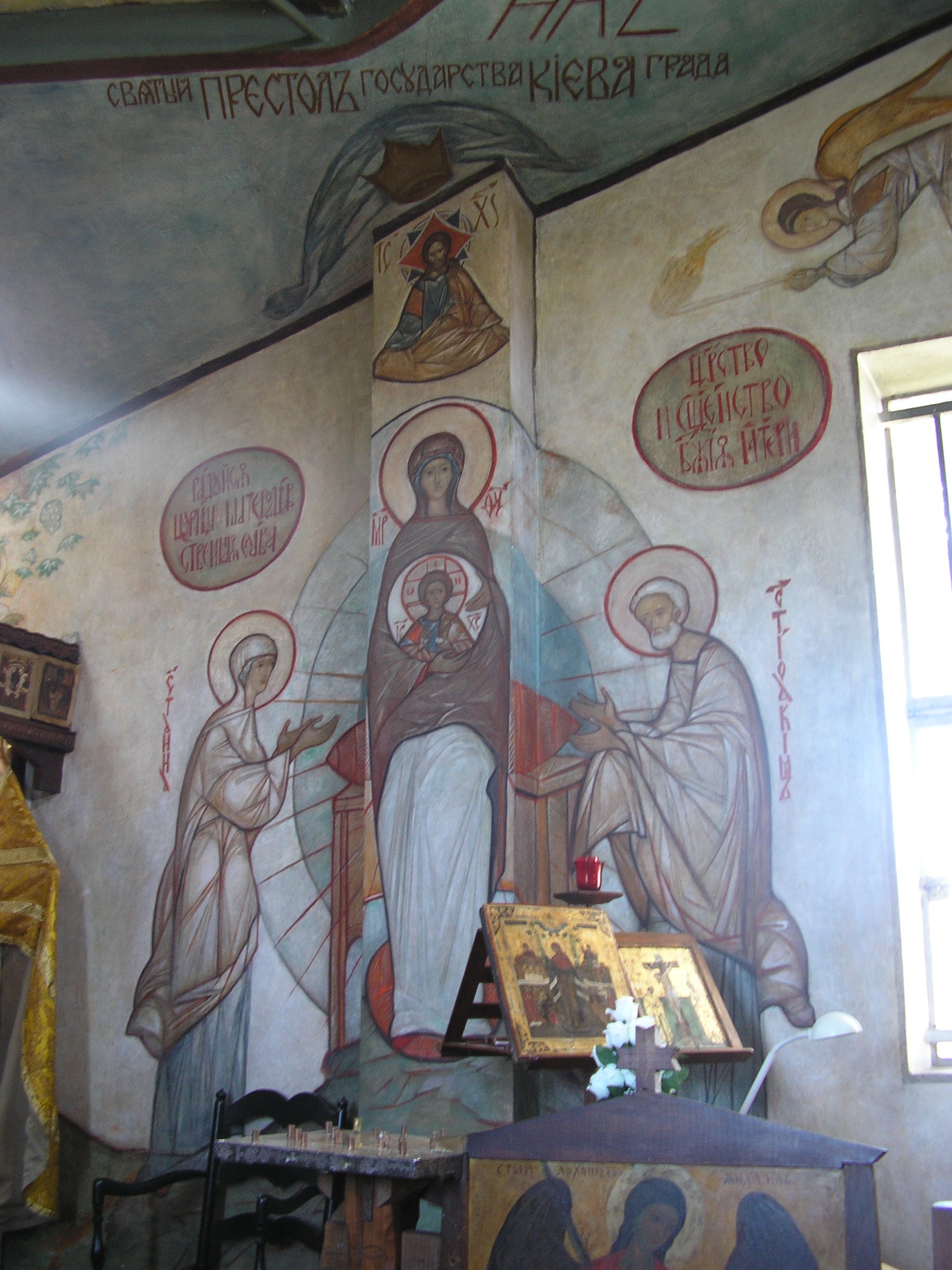
Above: on the western wall, a composition based on the Kiev icon of the Mother of God of the Sign. Surrounding her are her parents, St. Joachim and St. Anna.
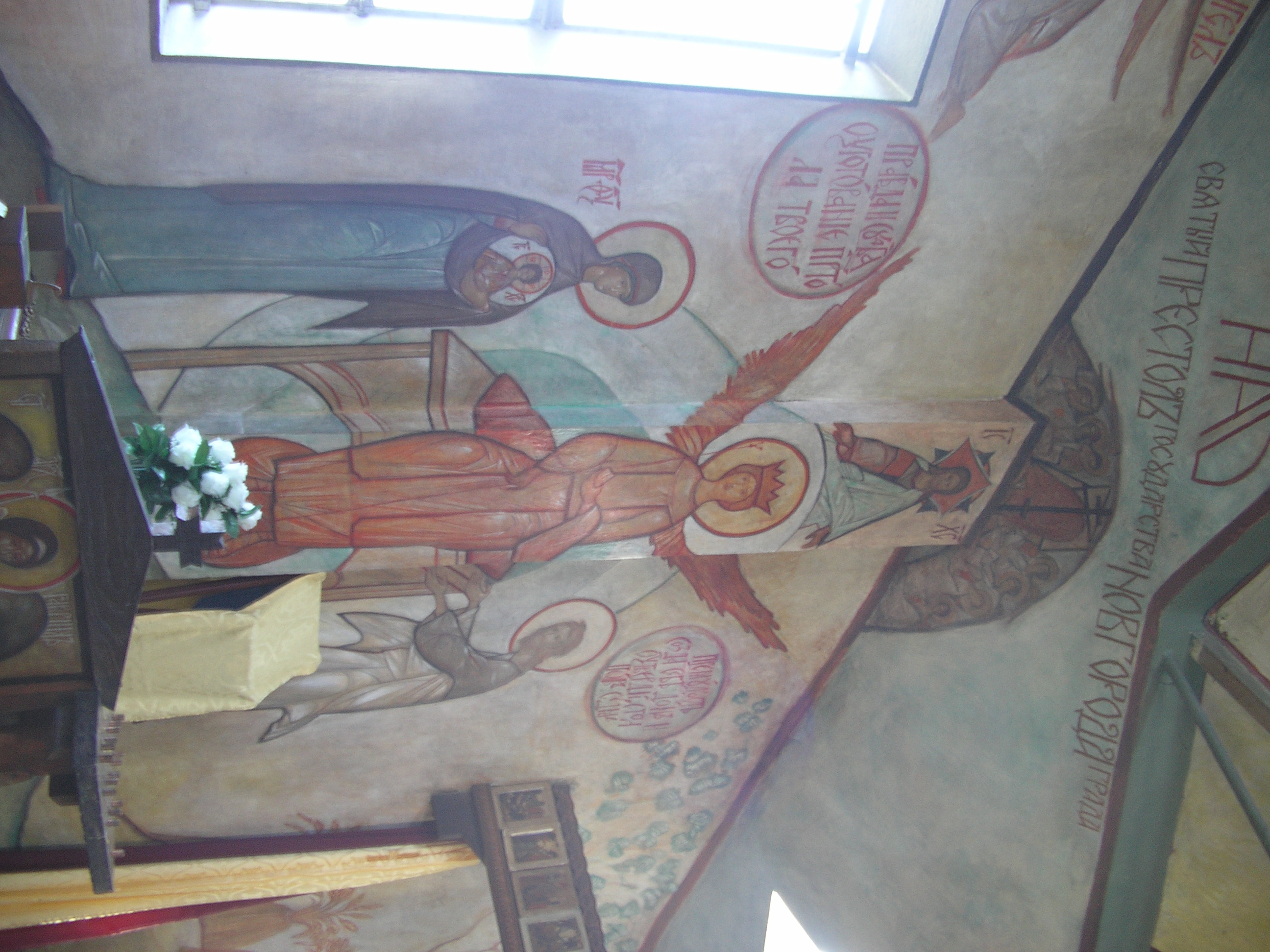
Above: On the eastern wall, Sophia, the Wisdom of God (a more symbolic image of Christ), with the Mother of God and Saint John the Baptist surrounding.
Left: The iconostasis (the two larger icons on wood were painted by Sister Joanna (Reitlinger)), and above it the Fresco of the old-testament Trinity. Due to it's placement, it's hard to photograph (and reportedly was uncomfortable/hard for Fr. Gregory to paint on the ceiling here). Architecturally, it's worth noting the triangular windows, Fr. Euthyme placed them so that sunlight shines onto the Chalice when the Priest lifts it up towards the congregation
(Photo below credit to the Church's website).
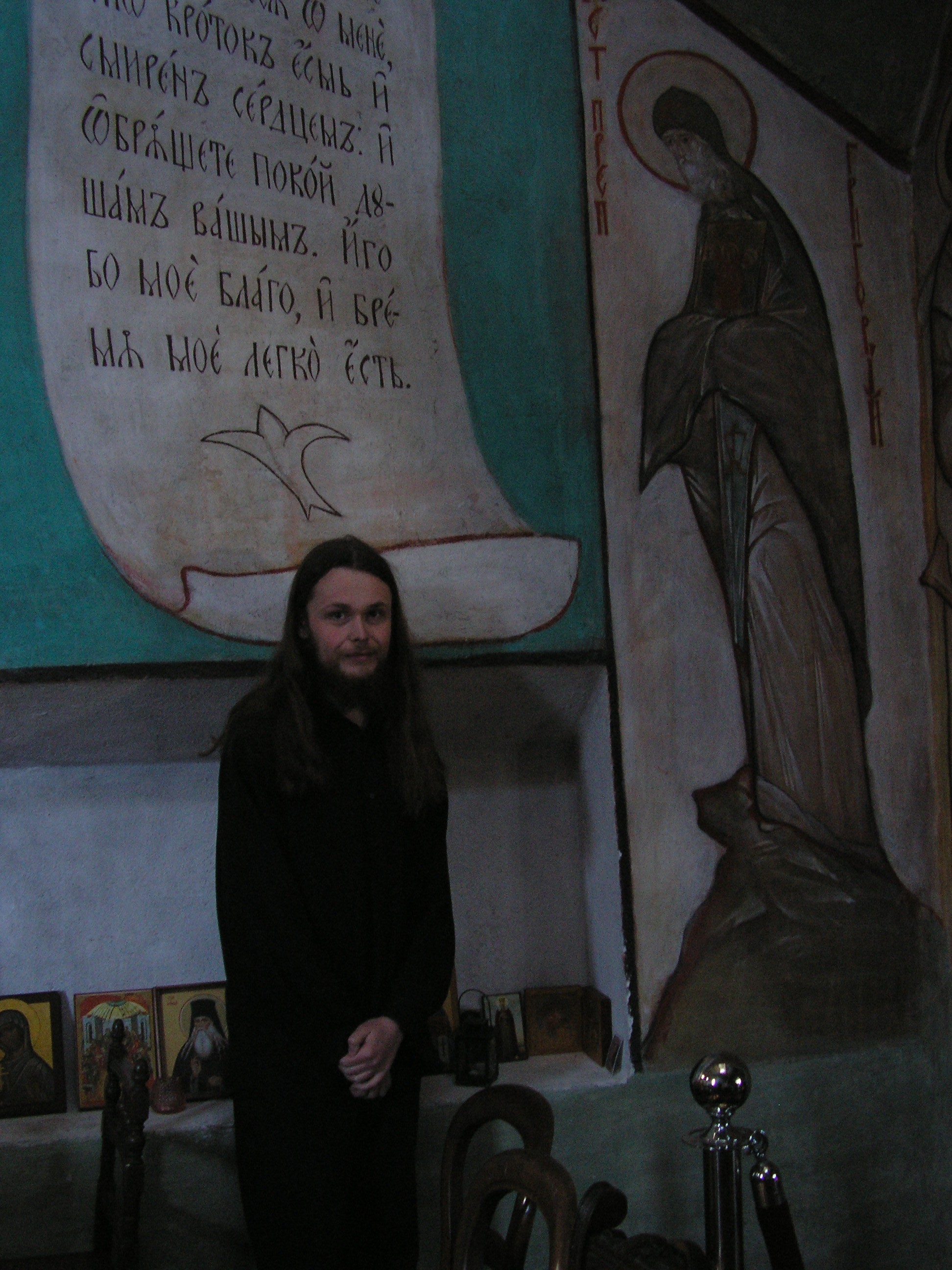
Left: Me next to an icon of my patron saint, Saint Gregory the Iconographer of the Kiev Caves (12th century). It was my first time seeing a real/painted icon of him in person. Since he is not a very popular saint, it's hard to find icons of him, and even more difficult to find a fresco of him ! I only know of about four icons of him that exist.
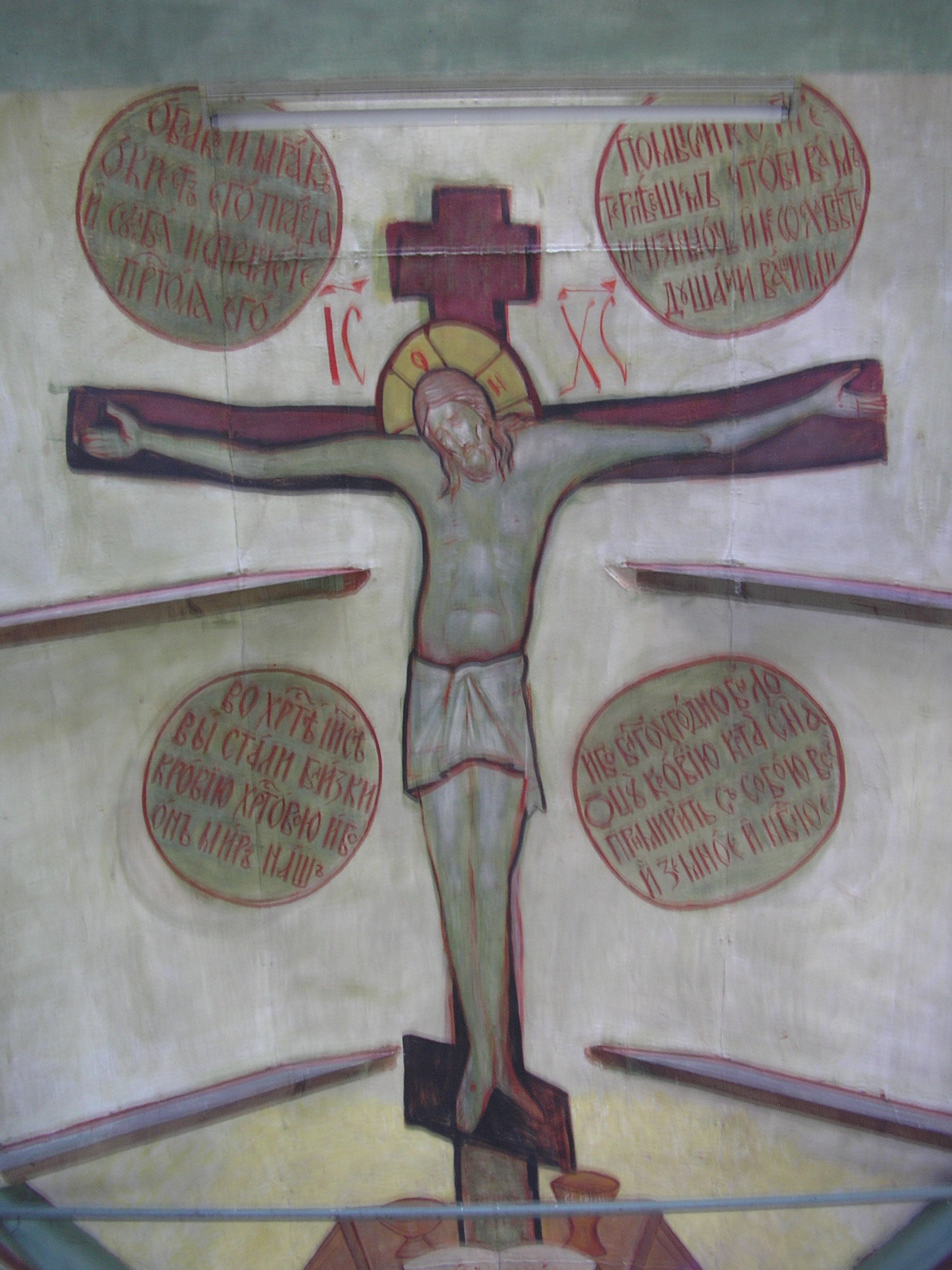
Right: Detail of the crucifixion icon on the ceiling.
Orthodox Icons
Icons are one of my life interests. It didn't feel correct to put them on the page of my favorite artwork, since they are not strictly artwork.
When first seeing icons, I was really surprised by how a lot of them employ a reversed perspective, even hundreds of years before linear perspective was 'invented' in Italy during the renaissance. A great essay to read, from Pavel Florensky's "Beyond Vision: Essays on the Perception of Art", is the chapter on Reverse Perspective: https://monoskop.org/images/1/11/Florensky_Pavel_1967_2002_Reverse_Perspective.pdf
Below are images of exceptional historical icons. All images may be clicked to enlarge.
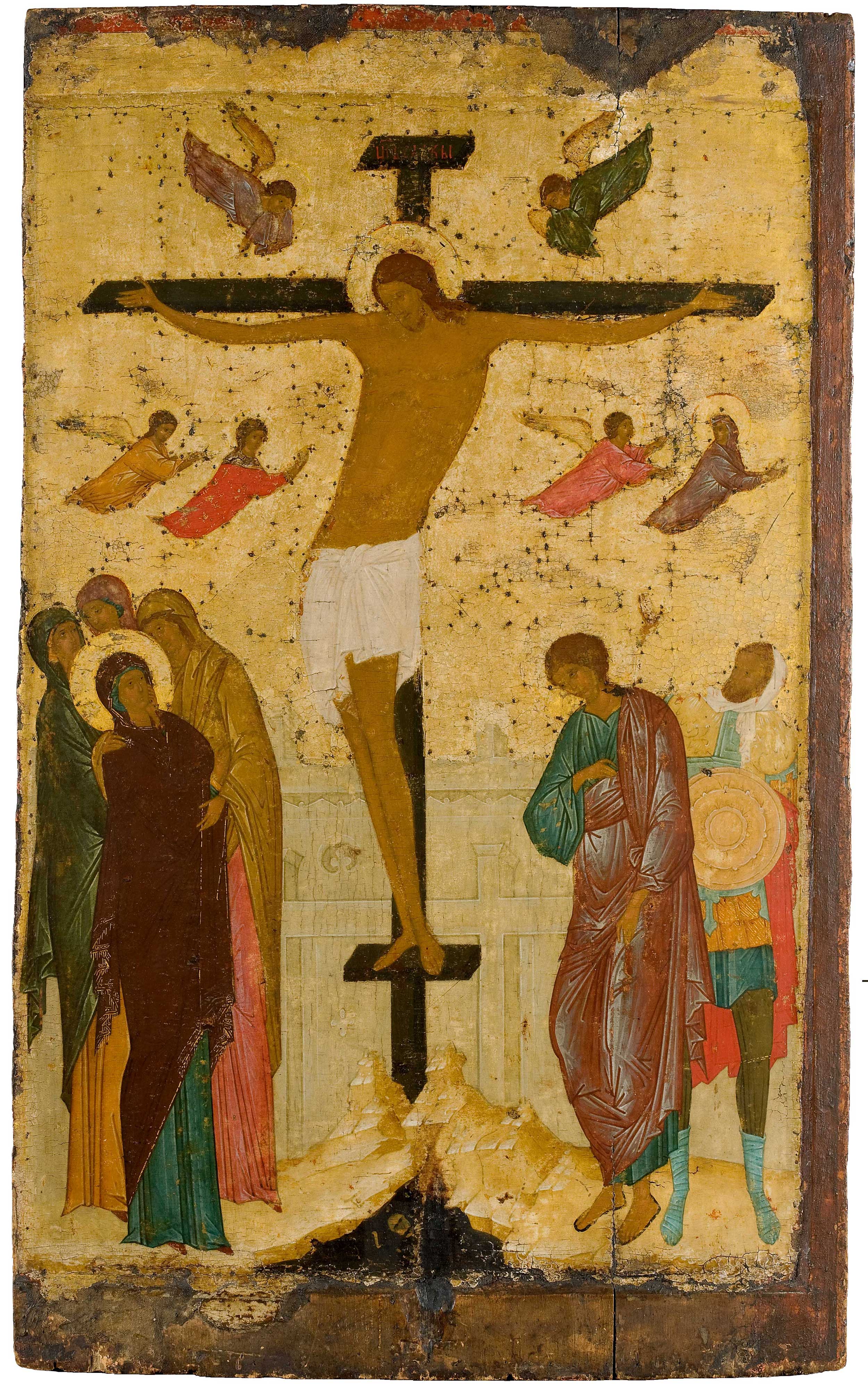
Crucifixion; Painted by Dionysius in ~1500 A.D. - From the festive rite of the Trinity Cathedral of the Pavlo-Obnorsky Monastery
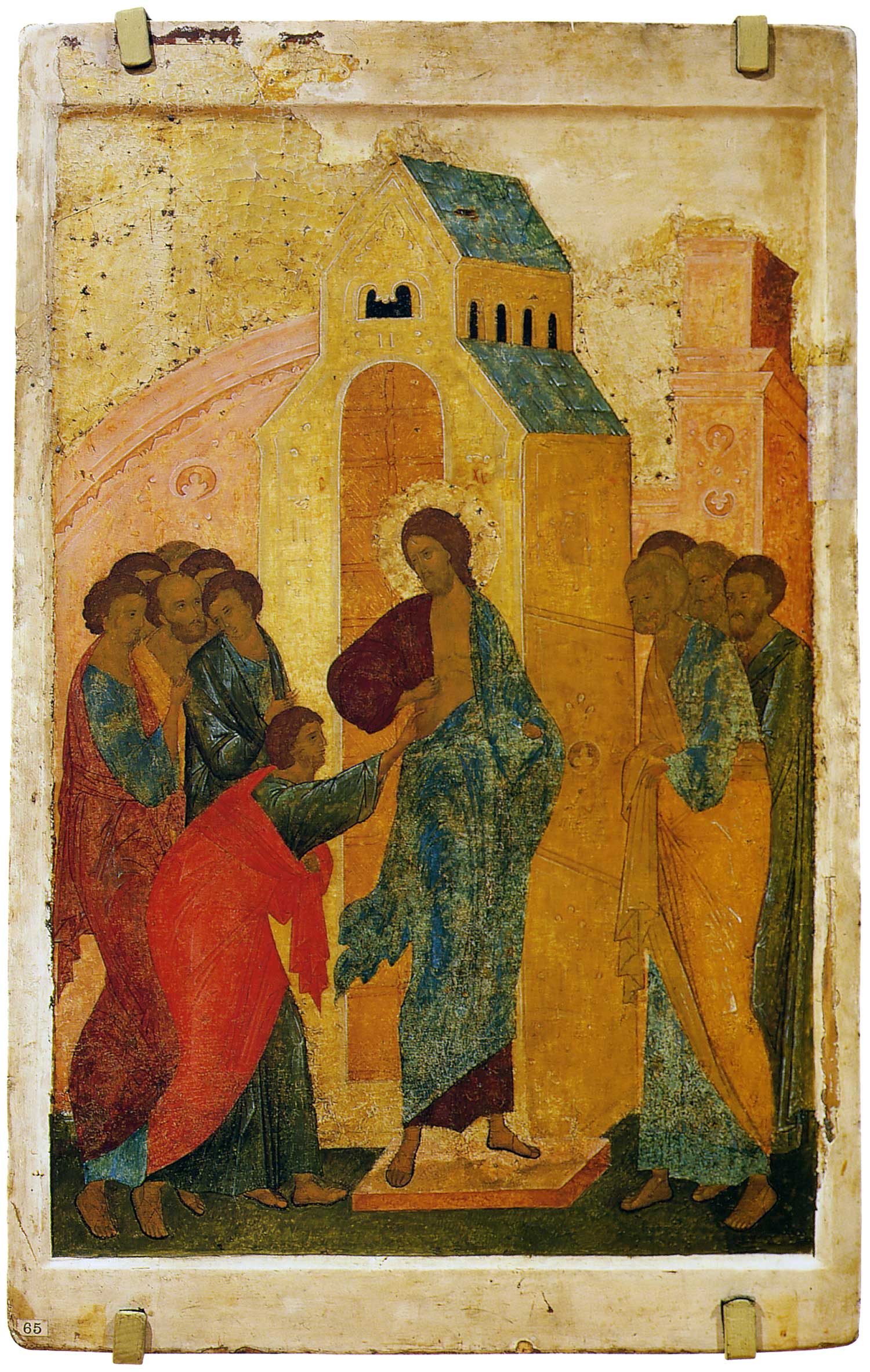
Thomas's Doubt; From the same festive rite as the crucifixion icon on the left. These two icons are the only surviving ones from this specific iconostasis.
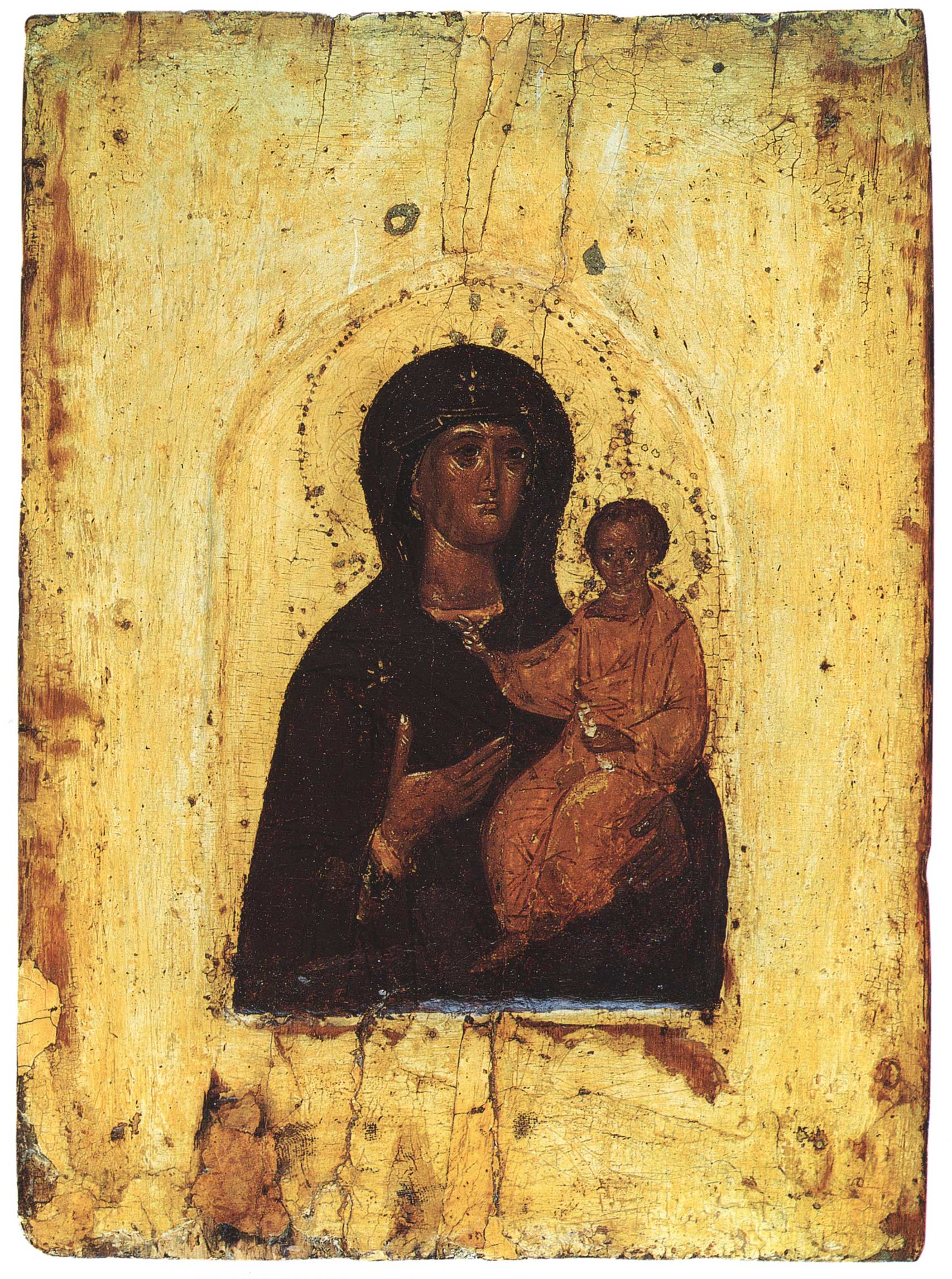
Theotokos Hodegetria; ~1400-1433, Moscow school. An exceptionally simple/humble icon. The silhouette of the Mother of God's maphorion (garment) on the right side of her face is incredible to me.
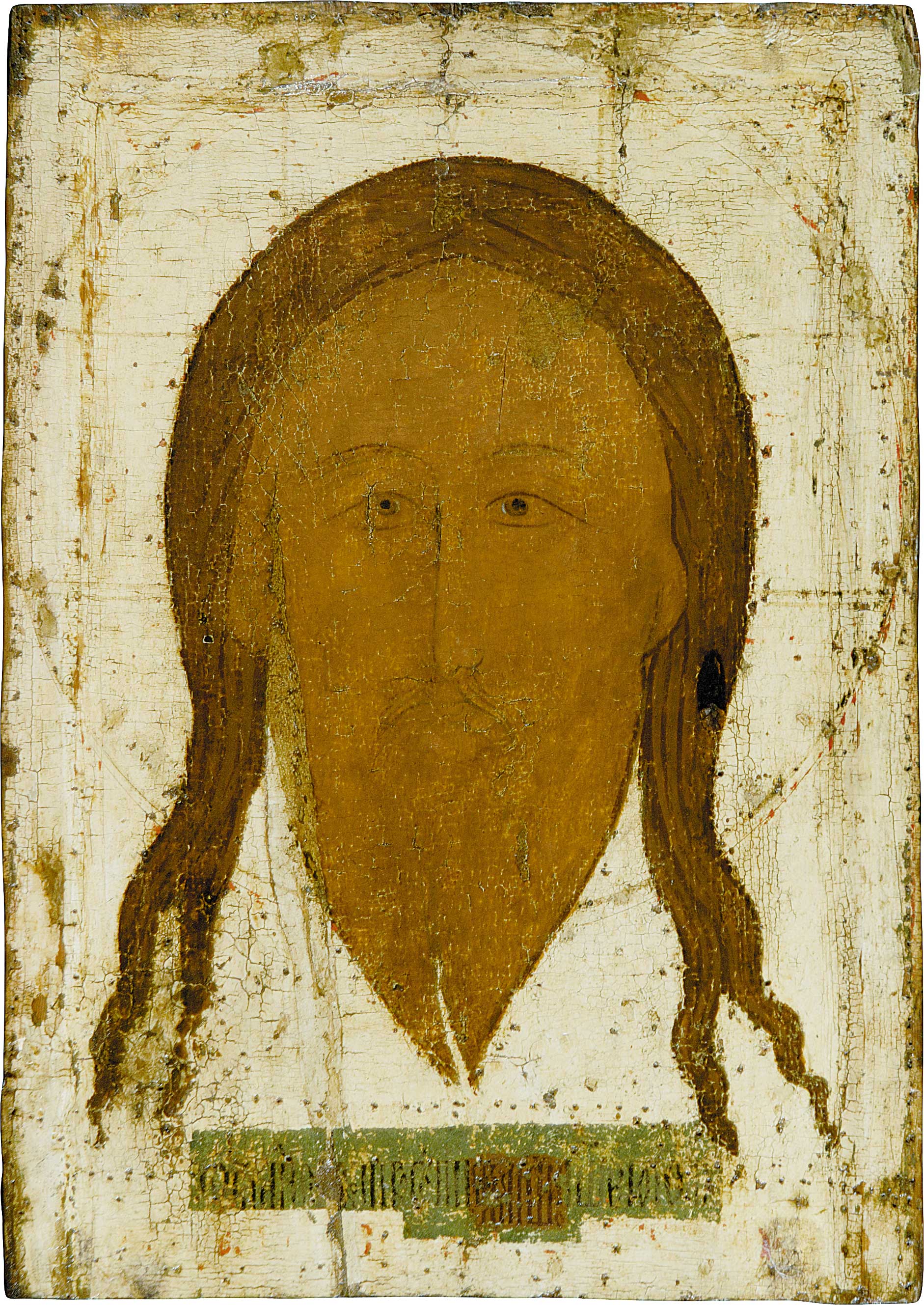
Icon of the Savior Not Made by Hands; Late 1400s, Northern Russia (Arkhangelsk)
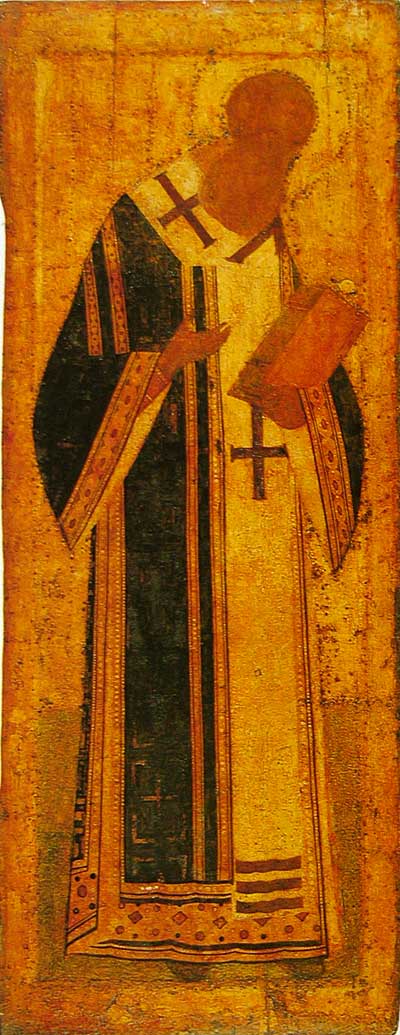
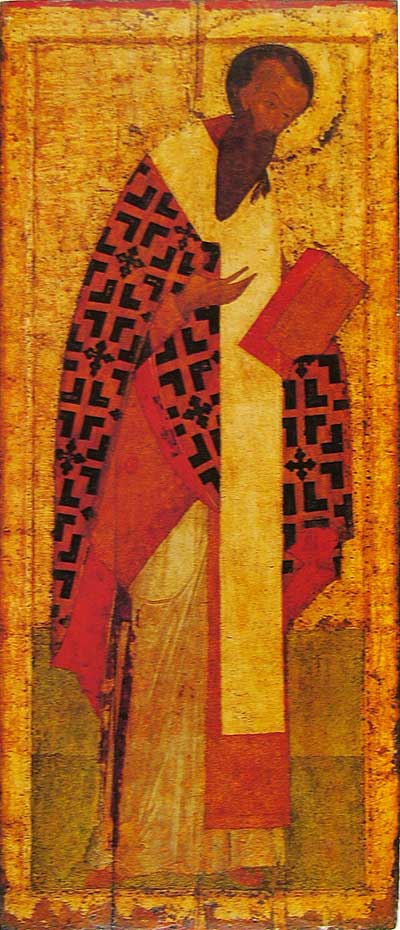
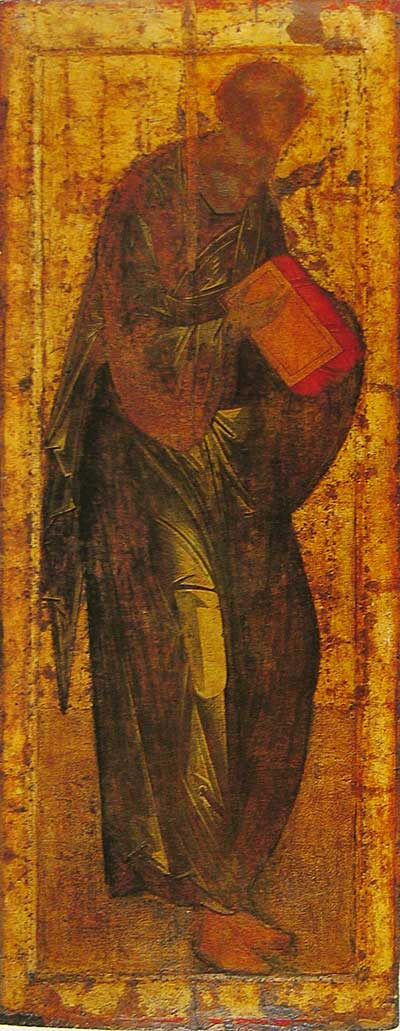
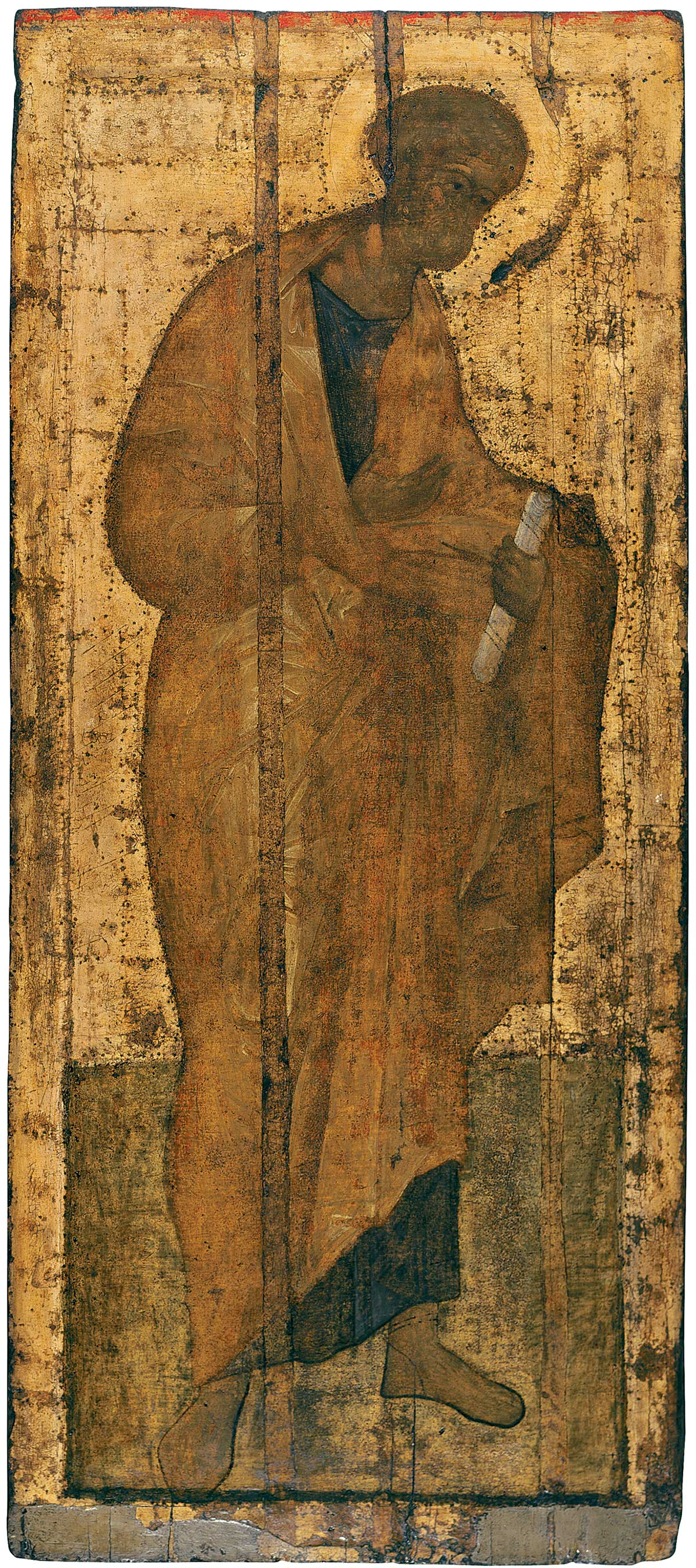
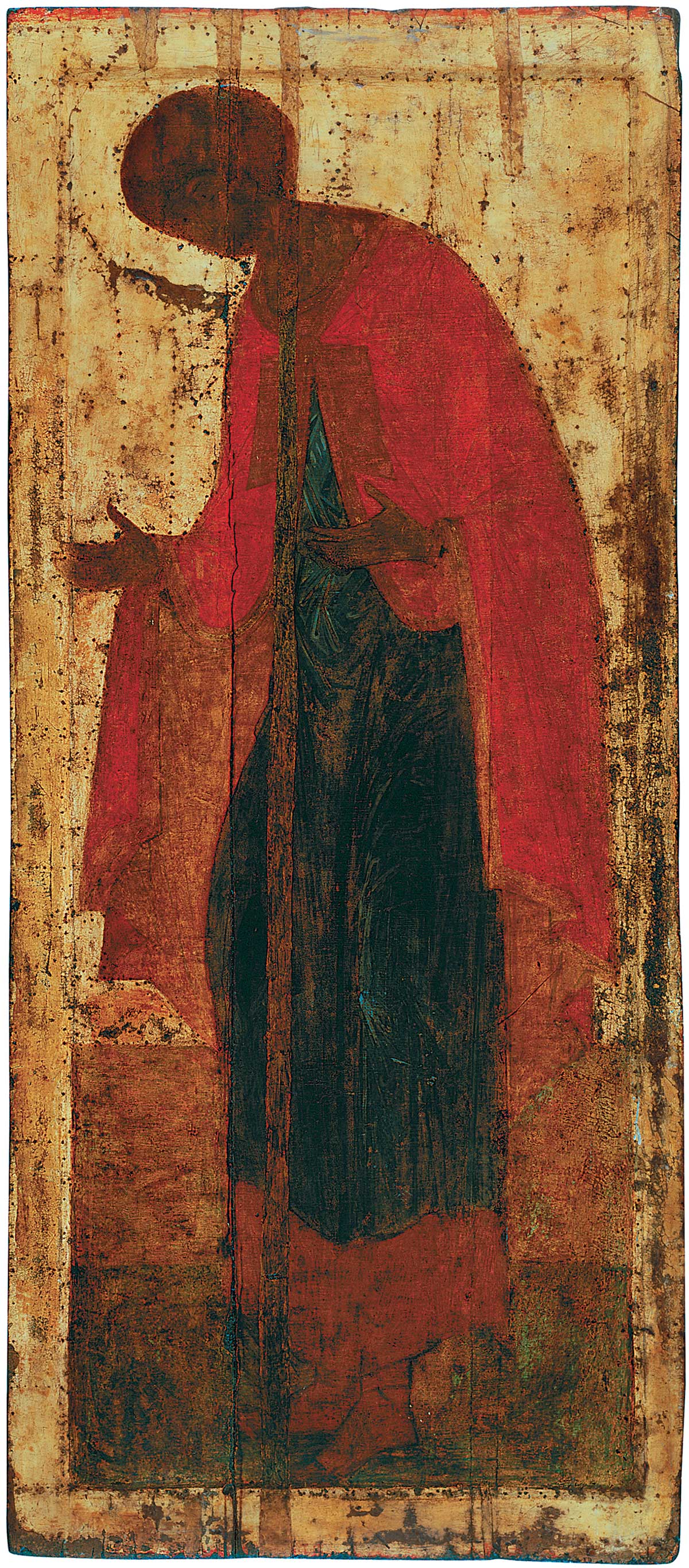
Below is the Deesis tier of icons at the Trinity Cathedral of the Trinity Lavra of St. Sergius. Painted sometime between 1425 and 1427, by Andrei Rublev and his followers.
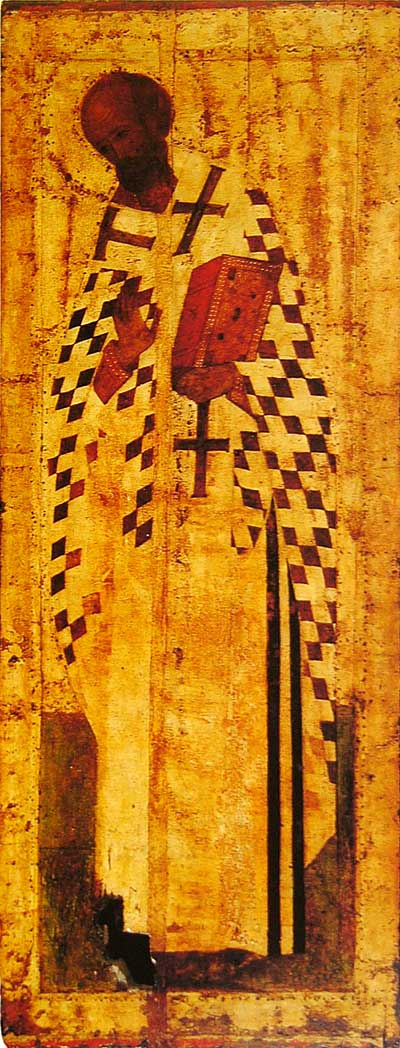
Personally, I find the icon of St. Nicholas (the 2nd to last image, with the checkered bishop's garment) to be exceptional.
You can see more about this group of icons here (in russian) : https://www.icon-art.info/group.php?lng=ru&grp_id=8
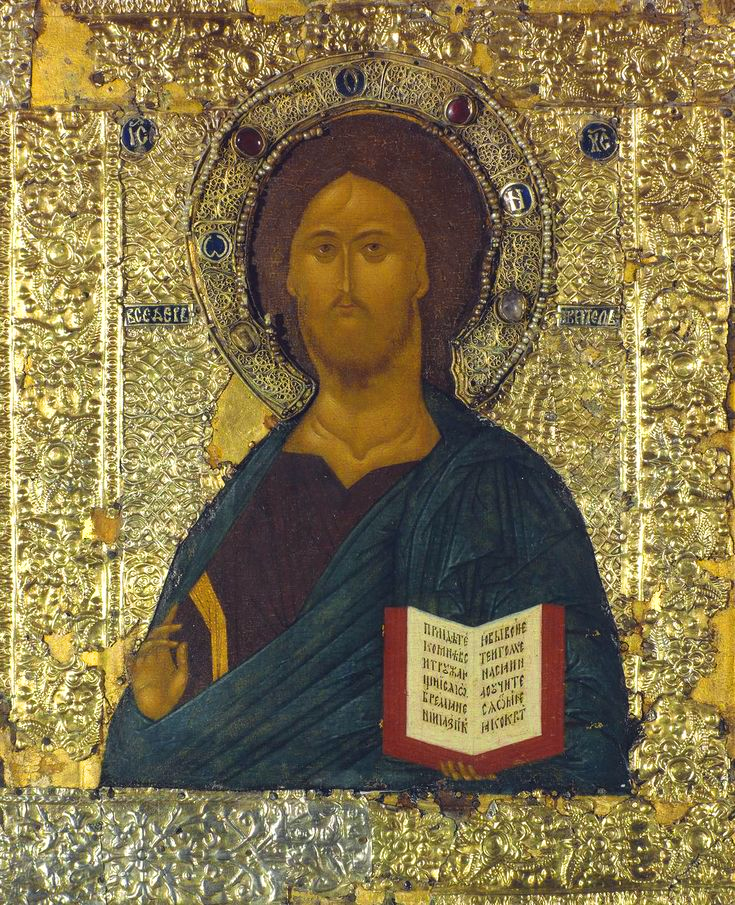
Christ Pantocrator; painted sometime between 1425-1450, Moscow; from one of Rublev's followers
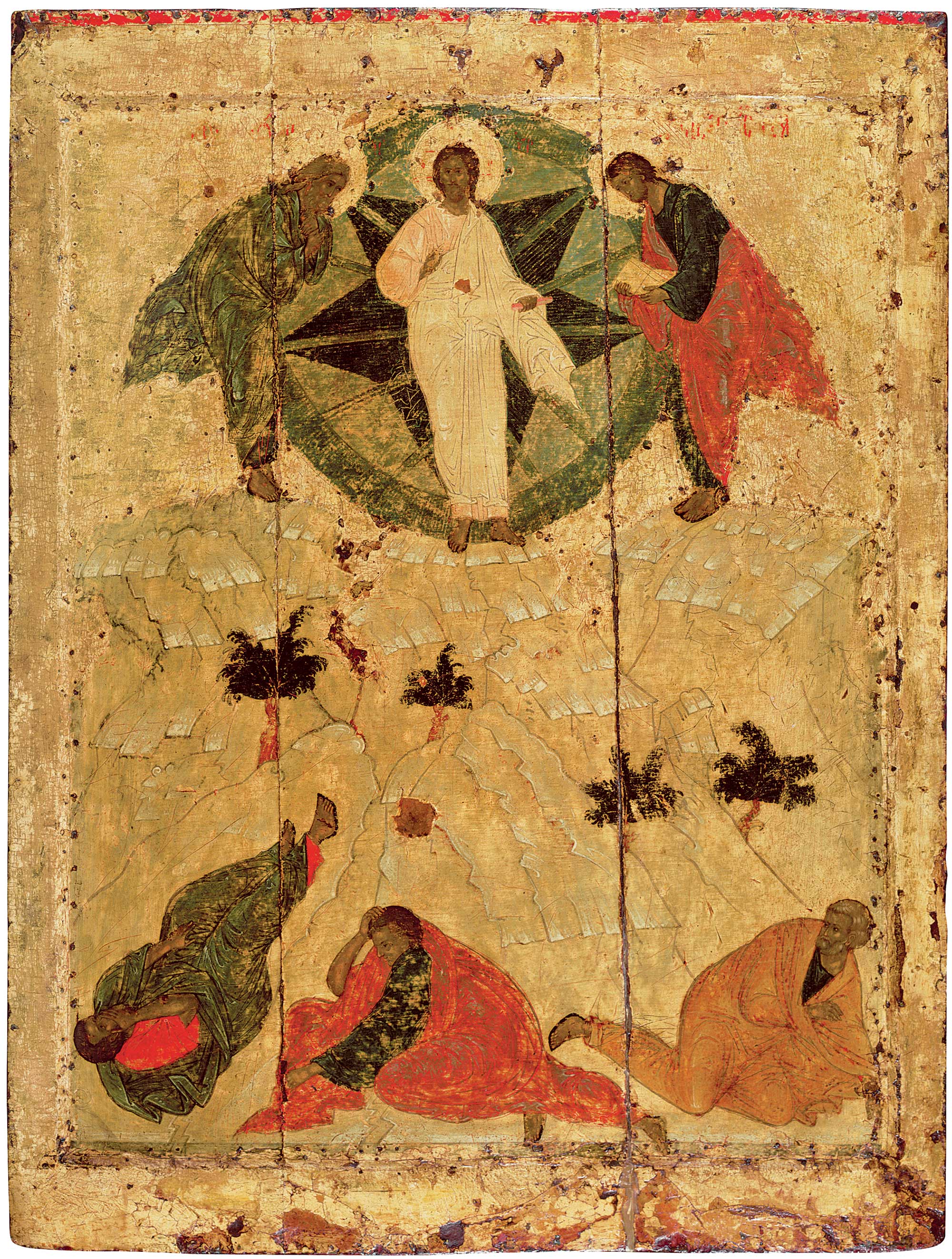
Transfiguration; Rublev
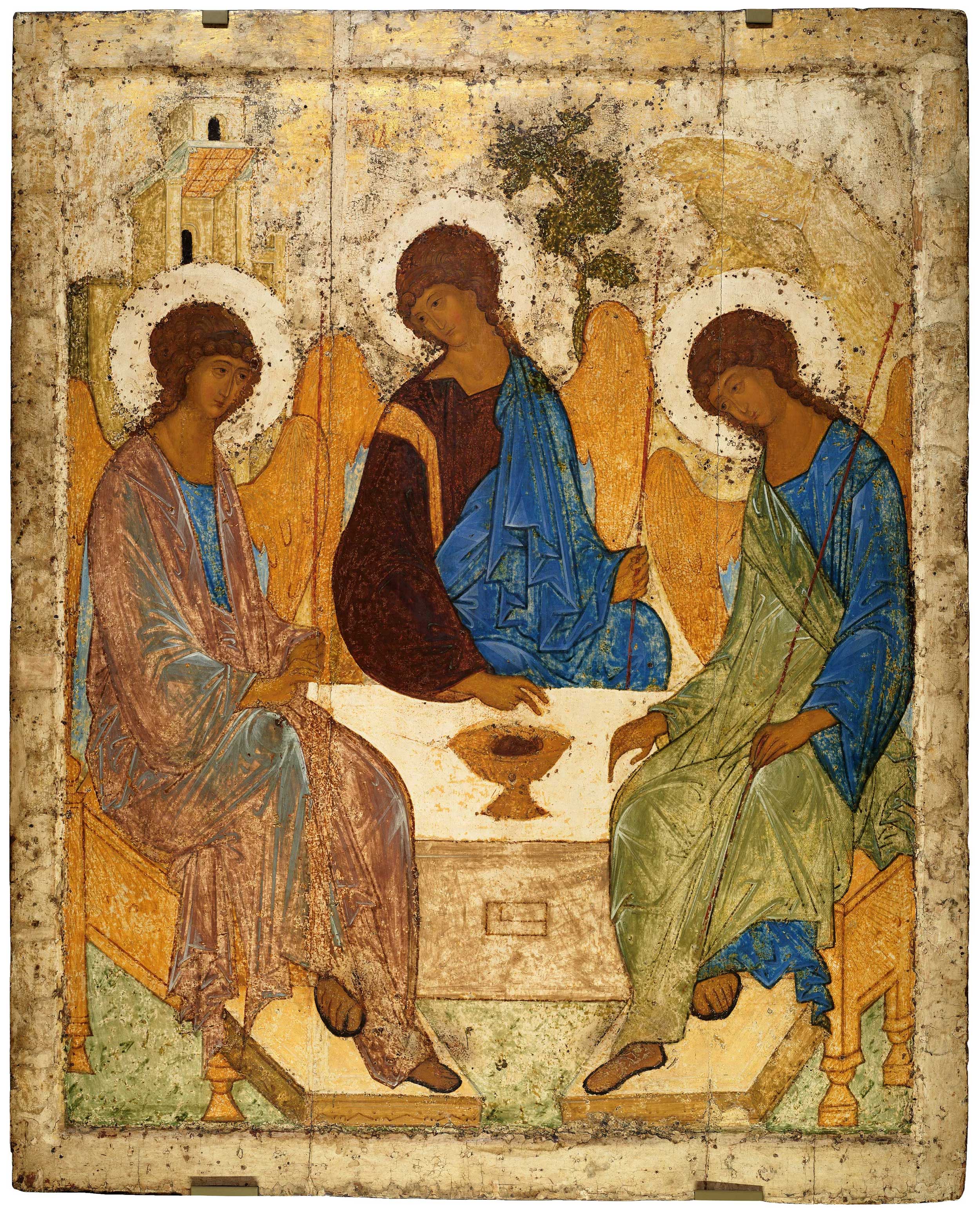
Trinity; Andrei Rublev, ~1411 A.D. - arguably the most famous icon
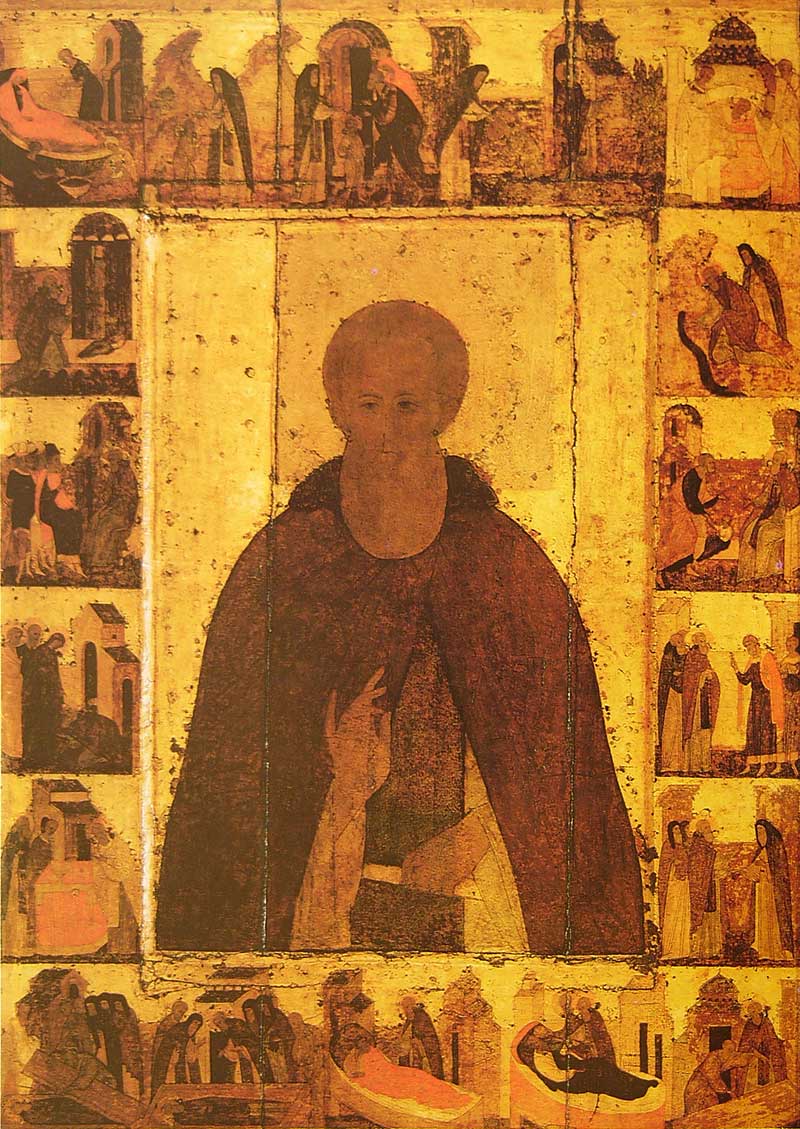
St. Sergius of Radonezh with scenes from his life; end of the 1400s, Moscow school
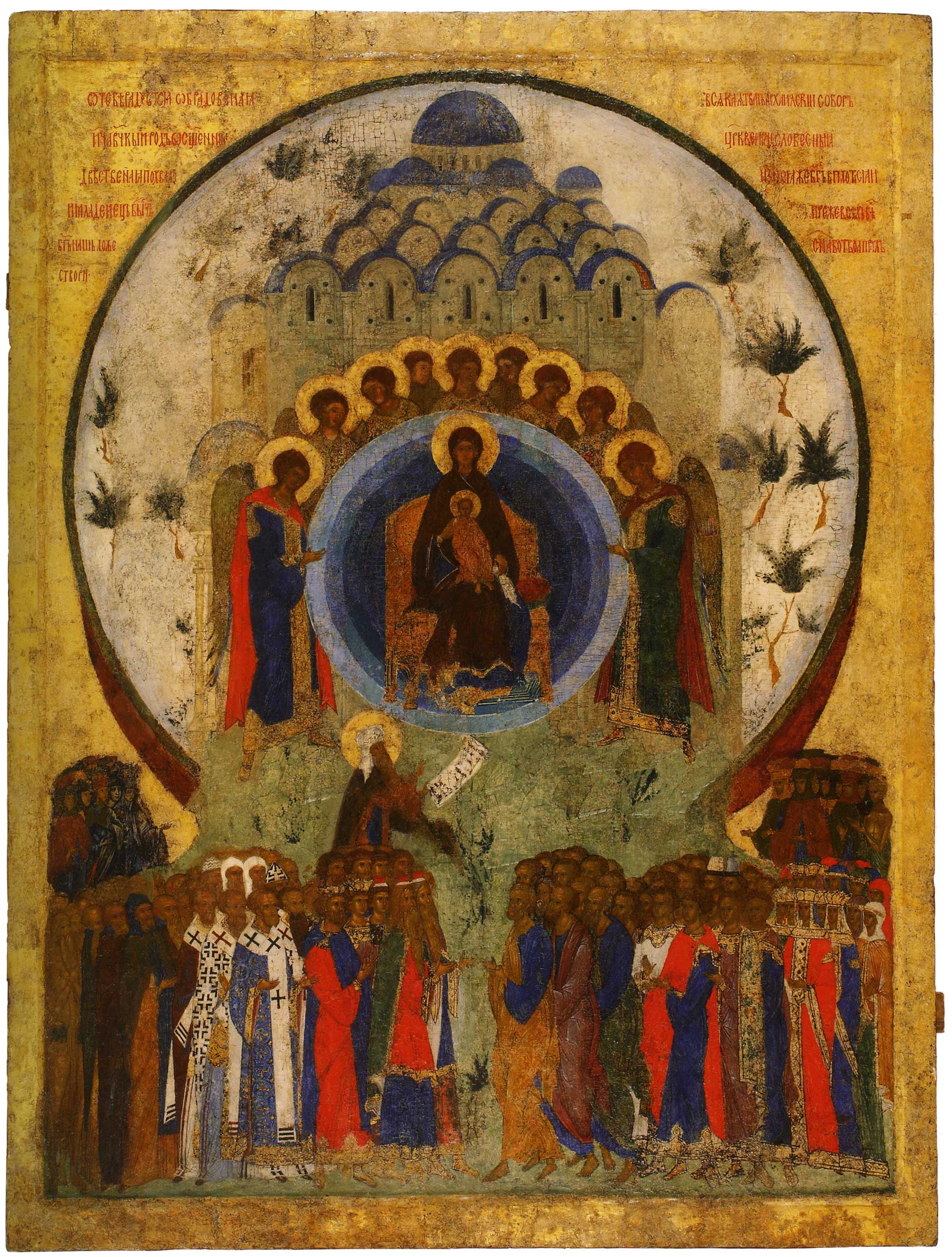
All Creation Rejoiceth in Thee; ~1497, From the local row of the iconostasis of the Dormition Cathedral of the Kirillo-Belozersky Monastery. After a Hymn written by St. John of Damascus
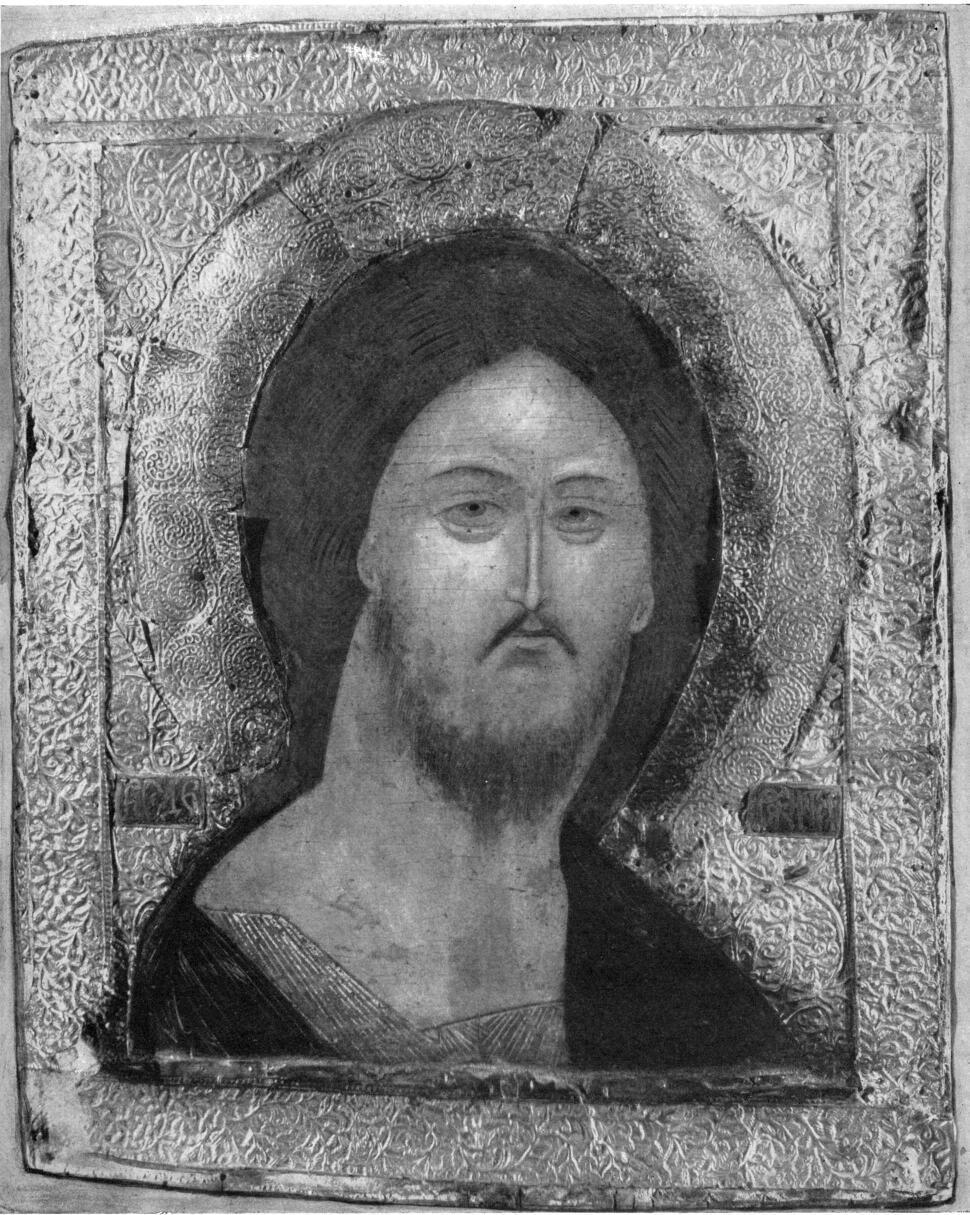
Shoulder image of Christ; ~1450, Moscow (school of Andrei Rublev)
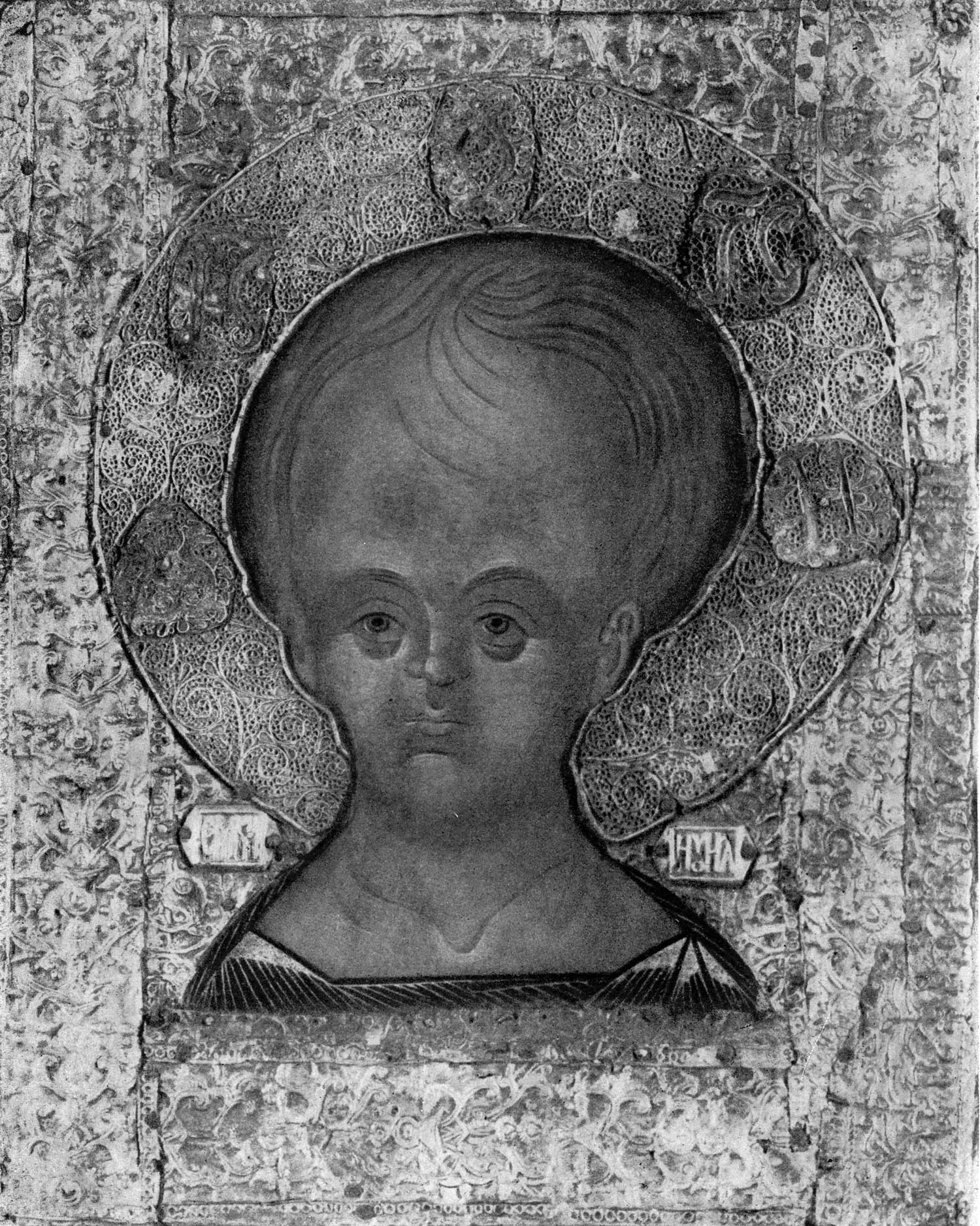
Christ Emmanuel; (young Christ), ~1400-1450, (school of Andrei Rublev)
It seems to me that even icons which are not painted with the best techniques or skill can still have very special and unique visual qualities:
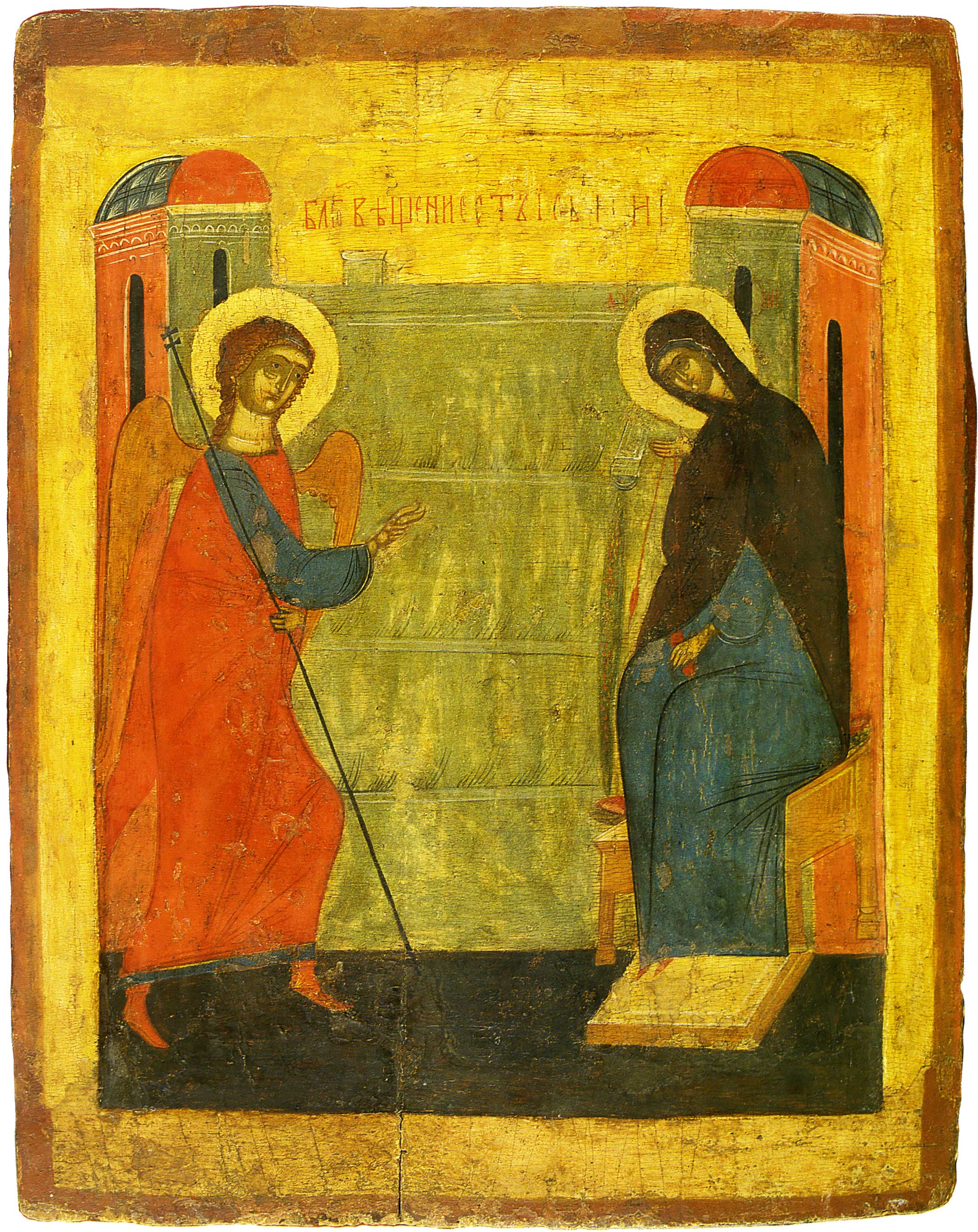
Annunciation; late 1300s, Rostov-Sudzal school
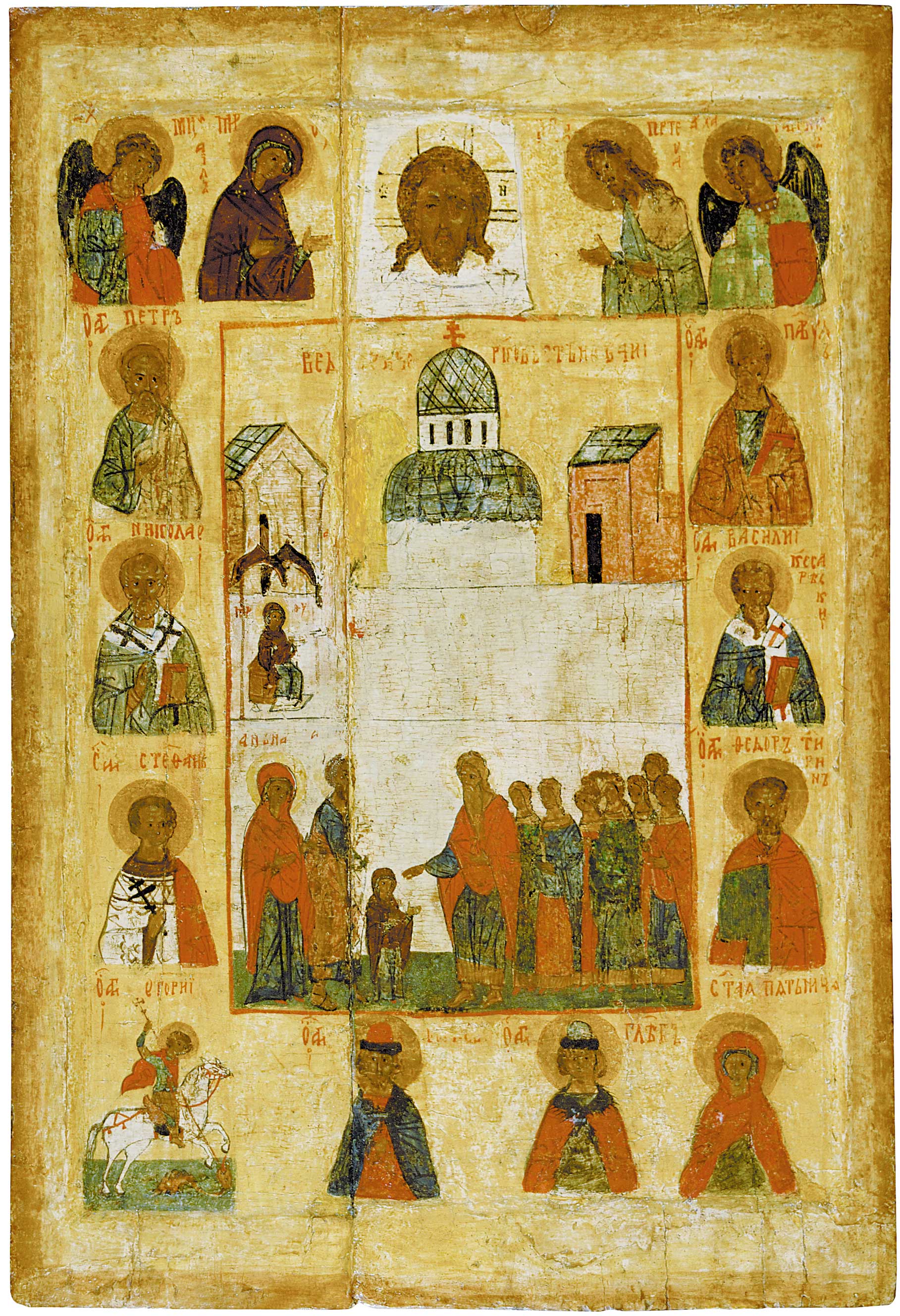
Presentation of the Theotokos in the Temple; ~1450-1500, Northern Russia (Arkhangelsk)
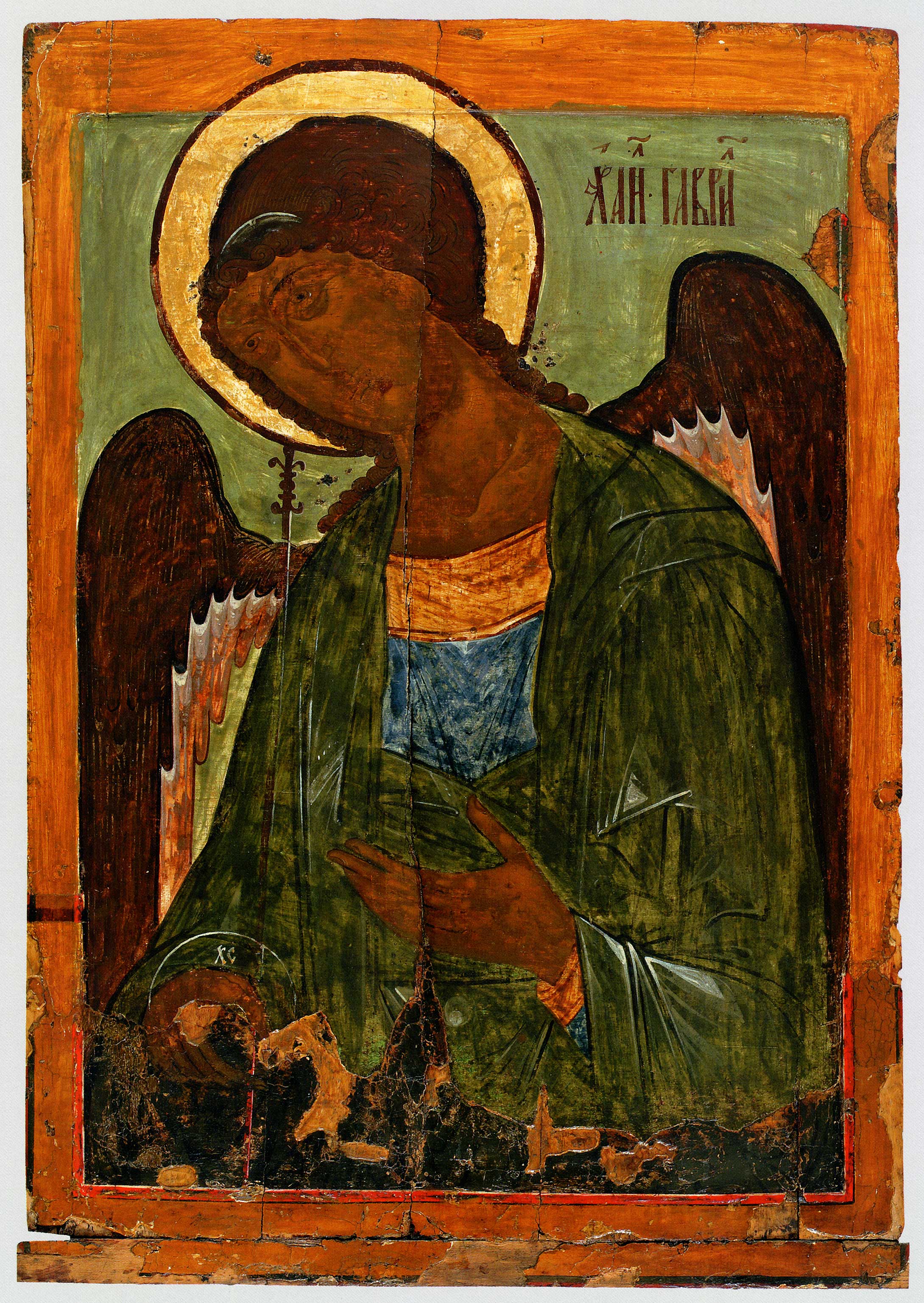
Archangel Gabriel; ~1550-1560, Moscow
There are only so many icons I can put on this website, to see more, a great book with good range of historical icons is Ouspensky and Lossky's "The Meaning of Icons". Also, anything by V. N. Lazarev is great ("Novgorodian Icon Painting", "Moscow School of Icon Painting", "Rublev", and "Pages from the History of Novgorodian Painting. The Double-Faced Tablets from the St. Sophia Cathedral in Novgorod." are all excellent books - mostly containing images). For books which cover the interior part of the icon, Michel Quenot's "The Resurrection and the Icon", is great, as well as Ouspensky's 2 part series "The Theology of the Icon" (best to read this one after "The Meaning of Icons" as it is a bit heavy).
There are also sites like https://www.icon-art.info/ - which have a huge collection of images in their gallery page (in russian), and they even have a bulletin board page with a "book review" forum, that is great to get PDFs from: https://www.icon-art.info/phpBB2/viewforum.php?f=10
Notable Frescoes
Ferapontov Monastery (Northern Russia)
Painted by Dionisy and a team (his sons ?) over the course of two or three summers in 1500-1502 (some sources say the frescoes were completed in just over one month). This is probably the best example of an entire program of frescoes from the 16th century being so perfectly preserved.
More info and pictures can be seen here: http://www.dionisy.com/eng/museum/ - and here: https://www.icon-art.info/location.php?lng=ru&loc_id=272&mode=mur&page=1
Church of the Transfiguration of Our Savior on Ilyin Street, Veliky Novgorod
These frescoes are attributed to Theophanes the Greek (the teacher of Andrei Rublev), and were executed in 1378. They are the only surviving examples of Theophanes the Greek's frescoes, despite him painting over 40 churches during his life. These specific frescoes are highly unique for the restricted colors (lots of fire/red and sharp light to correspond with the fact that these frescoes are in a church consecrated and dedicated to the Transfiguration.
More pictures can be seen here: https://www.icon-art.info/location.php?&loc_id=10&mode=mur&page=1
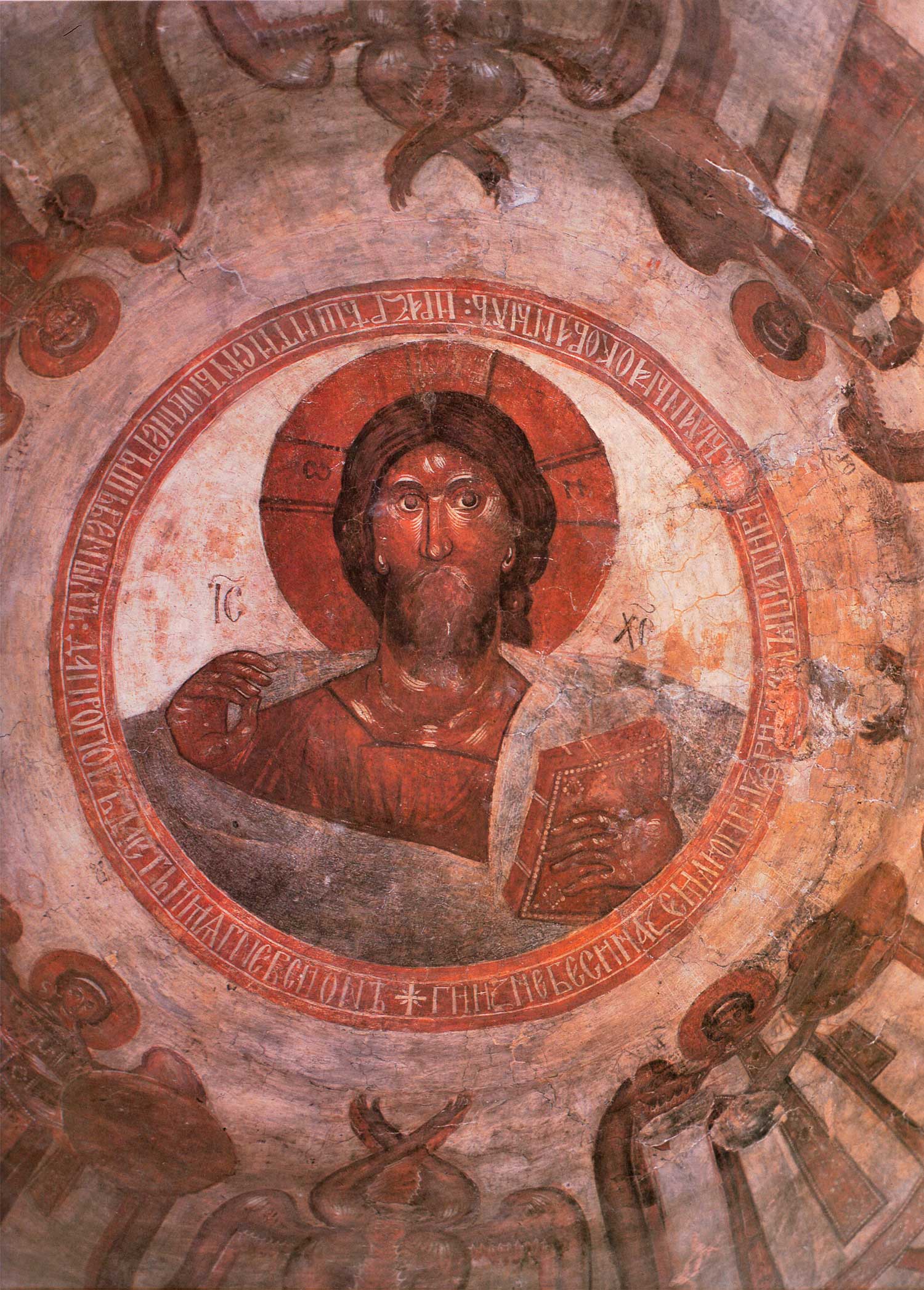
Christ Pantocrator; fresco of the top dome of the church
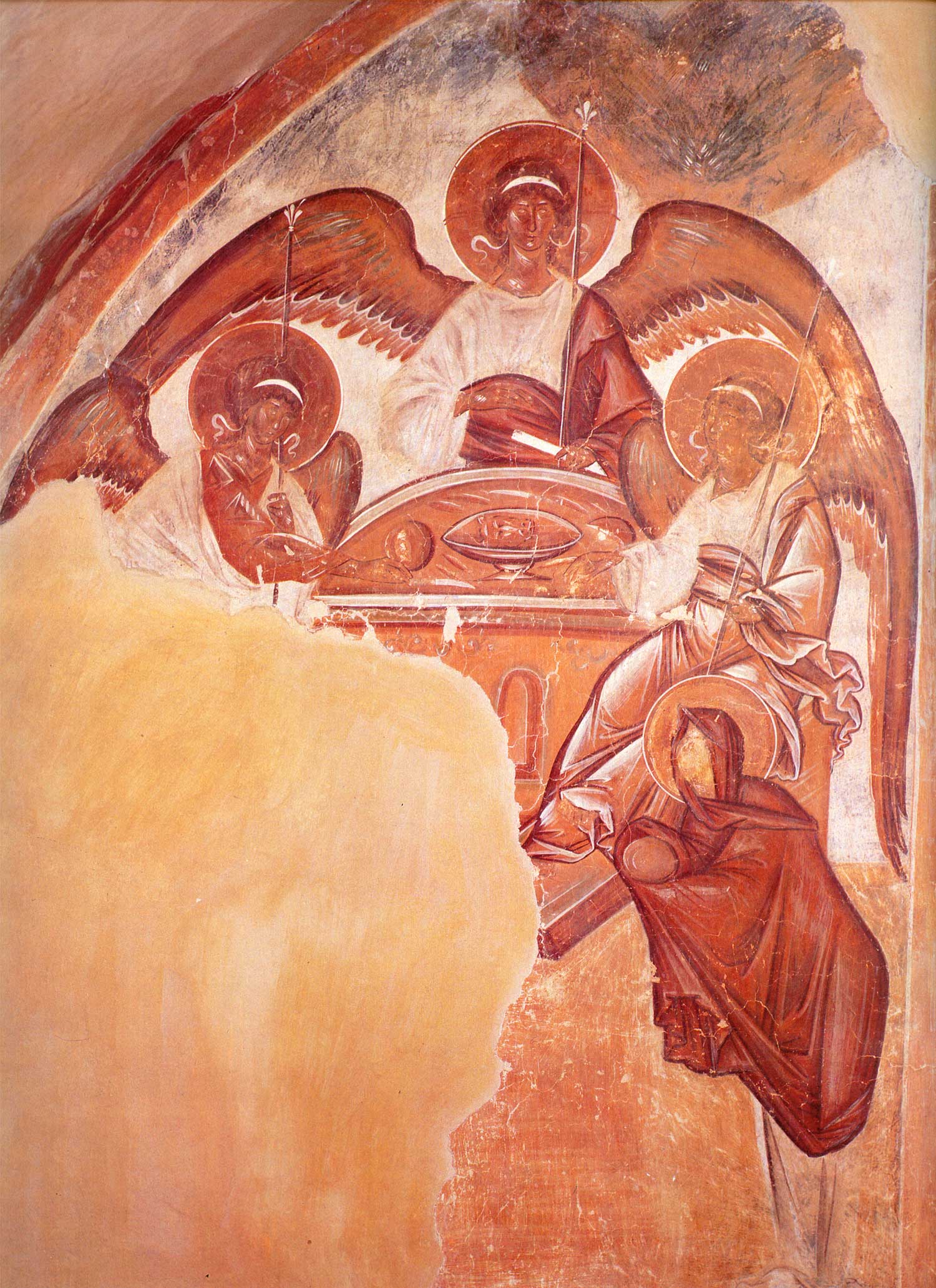
The Trinity
Dormition Cathedral, Vladimir, Russia
Originally comissioned by Andrew the Pious, the Grand Prince of Vladimir (1157-1174), a few frescoes in this church date from ~1189 A.D. - while the majority date from 1408 A.D. (attributed to Andrei Rublev and Daniil Cherny - some sources only attribute Rublev to the ceiling fresco of the Last Judgement).
More images of the frescoes and the exterior of the church can be seen here: https://www.icon-art.info/location.php?lng=ru&loc_id=135
Writing + images adapted from V.N. Lazarev's book "Andrei Rublev and his school"/"Андрей Рублев и его школа" exist here: https://www.icon-art.info/book_contents.php?book_id=112&chap=2&ch_l2=3#pic46
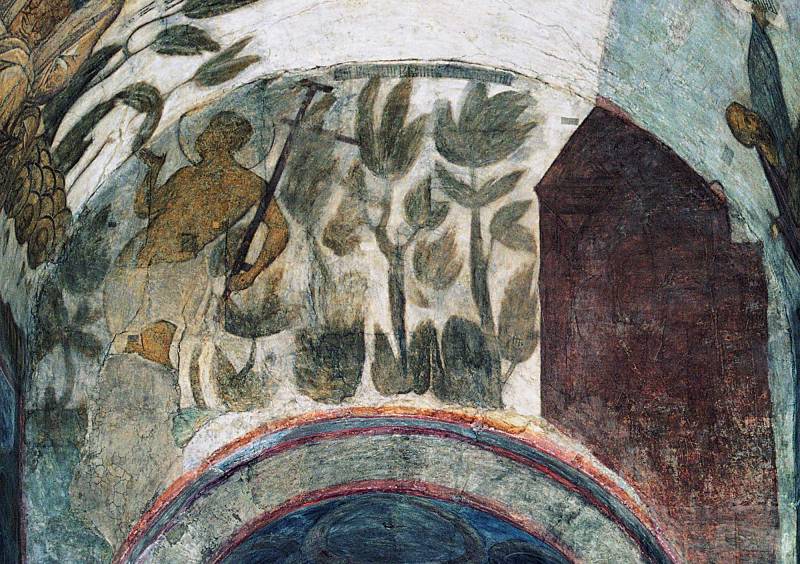
The Good Thief (St. Dismas) Entering Paradise; If you look closely in the dark red form on the right, you can see that it is the door to paradise that a Seraphim was placed to guard in Genesis after the expulsion from Eden.
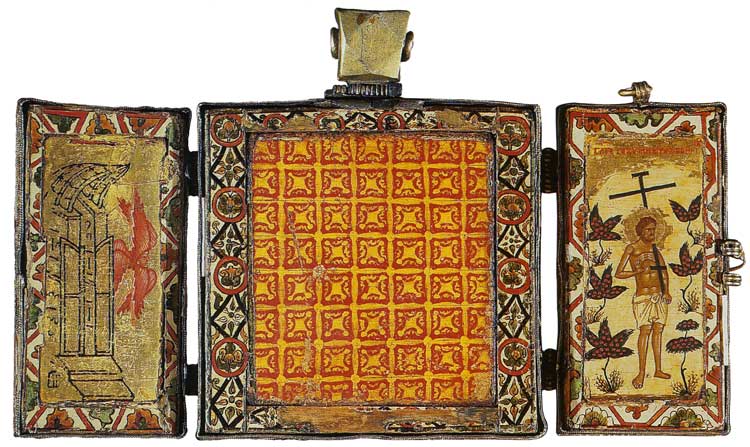
The reverse side from
a deesis tier triptych icon from the late 15th century. This is not from/associated with the Dormition Cathedral in Vladimir, it's just to show the same scene that appears in the (damaged) fresco immediately above this image.
The Rediscovery of the Icon
In the early 20th century,
Works by Fr. Gregory Kroug (+1969), Leonid Ouspensky (+1987), Saint Sophrony of Essex (+1993), and Mother Juliana (Sokolova) (+1981)
There are many articles and books written by people a lot more knowledgeable than me on this subject, and on the work of Fr. Gregory Kroug, Leonid Ouspensky, and Saint Sophrony. I'm including some external links to articles/books that should not be missed if this is of interest to you.
Fr. Gregory Kroug:
Born in 1908 in St. Petersburg, Russia, George Kroug emigrated first to Estonia, and then to Paris, attending art school there in 1931. During this time, he met Leonid Ouspensky, who was one of his classmates. Both soon turned their focus from secular artwork towards the icon. Kroug kept an interest and ties in the avant-garde art scene which existed in Paris at the time; unlike Ouspensky, who fully gave up all interest in secular work in favor of the icon. This was during the time that Kroug and Ouspensky were trying to create a "Western Orthodox" style of iconography - it's my personal opinion that Kroug's maintenance of these ties to secular art was not a hesitance to fully pursue the icon, but was partly a way to nourish his creation of icons. Matisse did this inversely, when he went to Russia in 1911; and was deeply shocked by icons, he took visual things from the exterior of them to use in his work. Kroug's interaction with secular work seems more like taking something back from contemporary painting. In some of his frescoes, we can see dark thick outlines and bright colors, similar to Matisse's way of painting. Fr. Gregory took back and transfigured these elements which Matisse (and other contemporary artists of the time) adapted from iconography to suit secular painting; and brought them back into iconography, and captive to Christ.
After much suffering, stress from trying to paint in a style unnatural to him (the 'Western Orthodox' style), the nazi occupation of Paris, George suffered a crisis that placed him in a mental asylum at the beginning of the 1940's. Heiromonk Sergei (Schevich) visited him daily, he began to recover, return to society, and shortly afterwards moved to Vanves where Fr. Sergei was founding a monastic skete. It was here, in 1945, that he became a novice, and 3 years later was tonsured into monastic life, recieving the name "Gregory" after Saint Gregory the iconographer of the Kiev Caves.
After Fr. Gregory reposed in 1969, his notes were compiled into a book,
Carnets d'un peintre d'icônes. This is an *incredible* book; but unfortunately is only available in French. Each chapter goes over one of the main types of icons (e.g. certain feast days, etc) - and there is a large chapter on representations of God the Father. One of the chapters can be viewed online
by clicking here. I have translated this book from French to English, and will update here if anything is possible regarding publishing, etc.
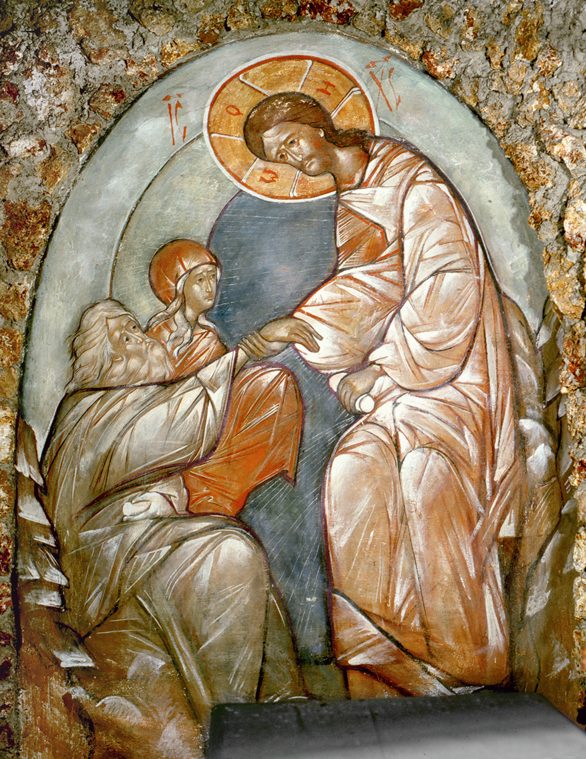
Fr. Gregory Kroug, "Anastasis", Fresco at the Skete of the Holy Spirit in Mesnil-Saint-Denis
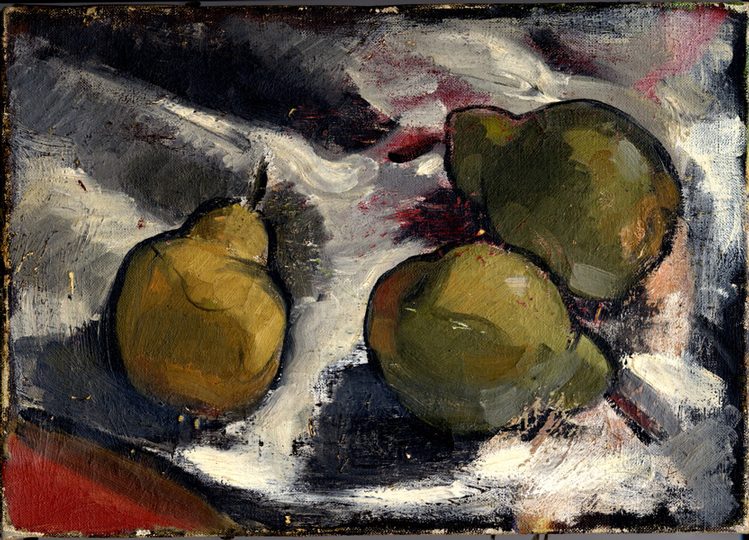
"Pears", still life by George Kroug, undated but probably 1920's
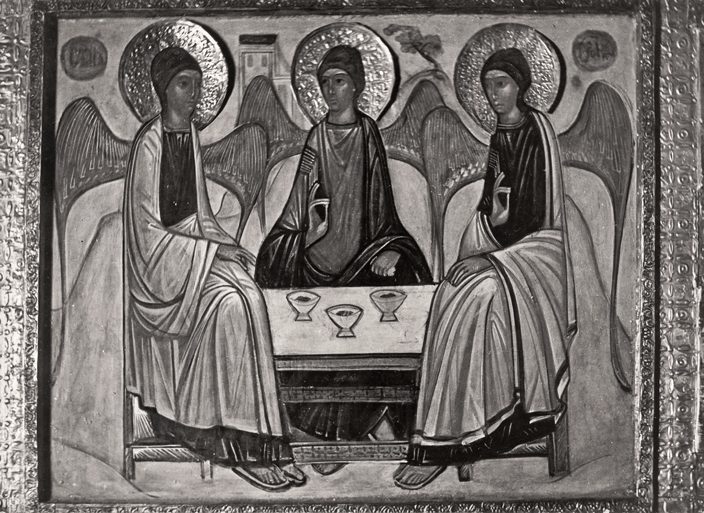
Icon of the Trinity in the "Western Orthodox" style, painted as part of the original iconostasis at rue Petel - so towards the very beginning of Fr. Gregory's 'career' in iconography.
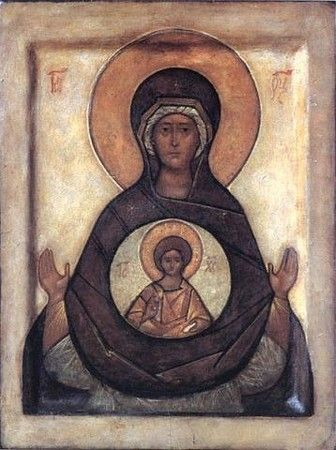
The Mother of God of the Sign, I can't find any information about this specific icon at all (where it is or which year it was made), but it seems incredibly exceptional to me.
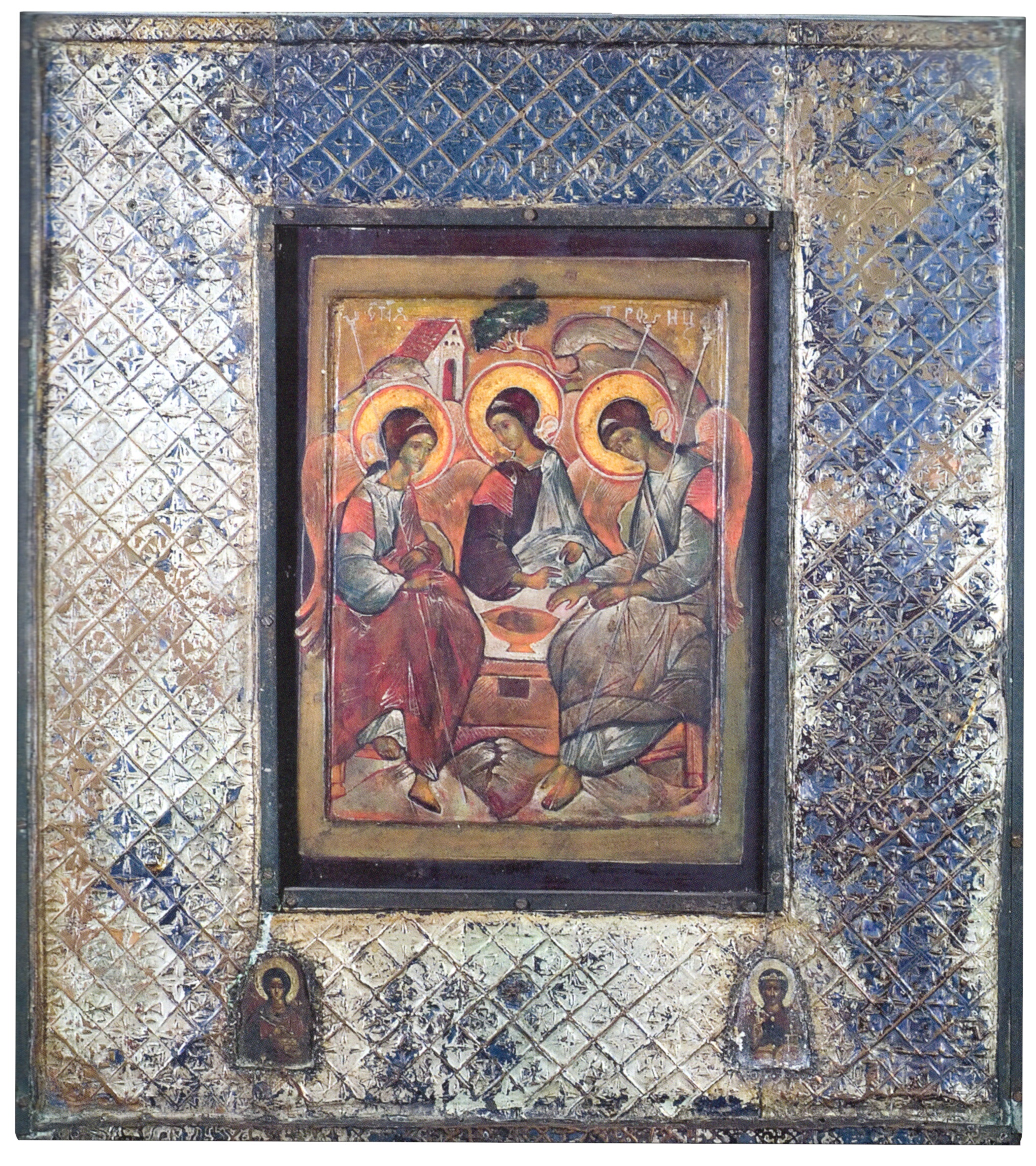
The Trinity, Painted by Fr. Gregory towards the end of his life. The frame it rests in is ancient.
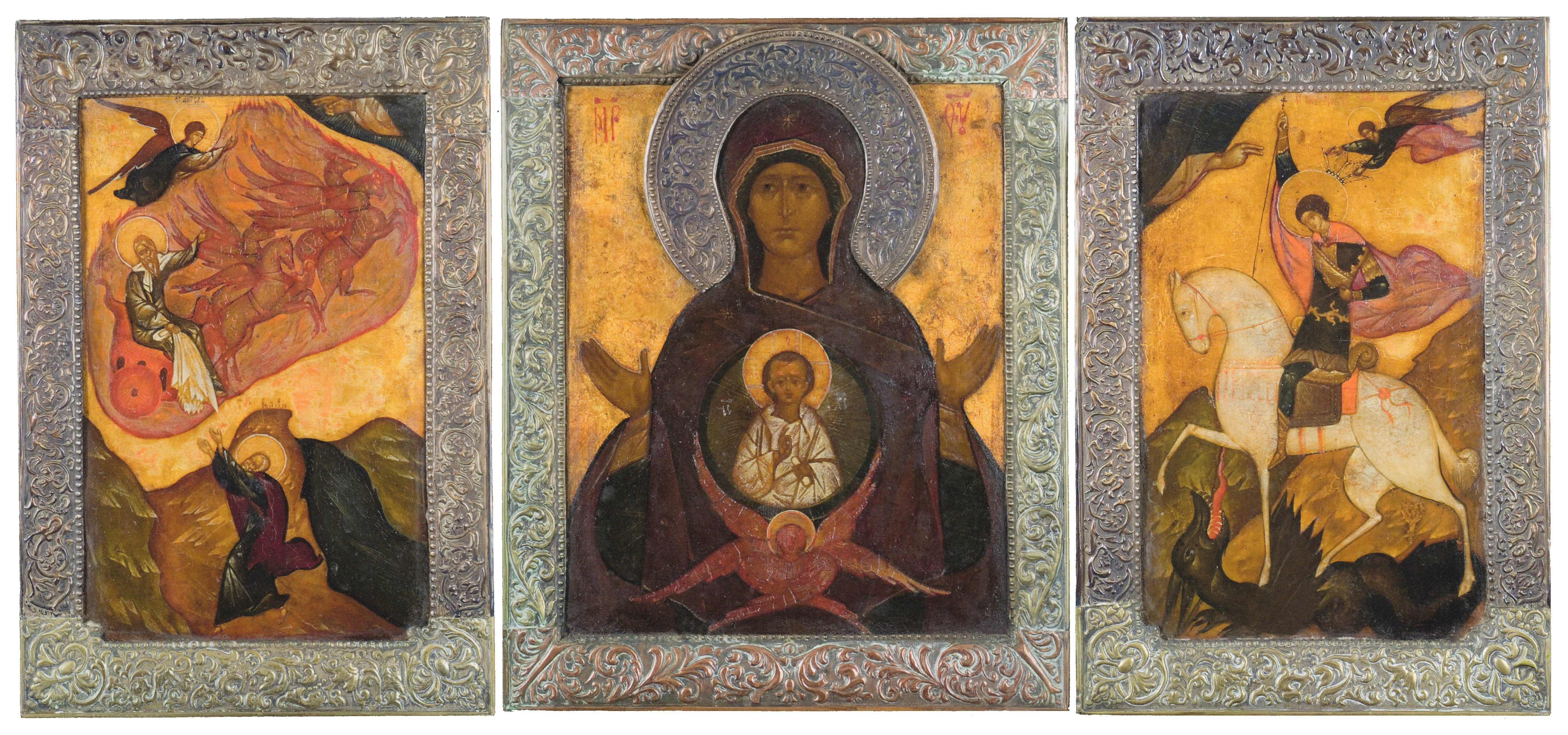
Fr. Gregory Kroug, Triptych (The Fiery Ascension of the Prophet Elijah, Theotokos of the Sign, St. George), painted towards the end of the 1950s - located in the Church of the Holy Trinity (Eglise de la Sainte Trinité), Vanves, France
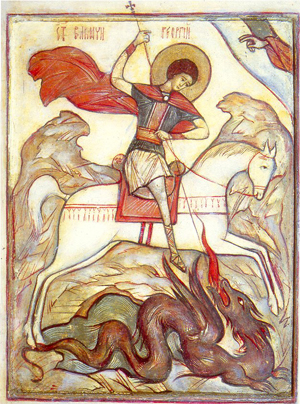
St. George
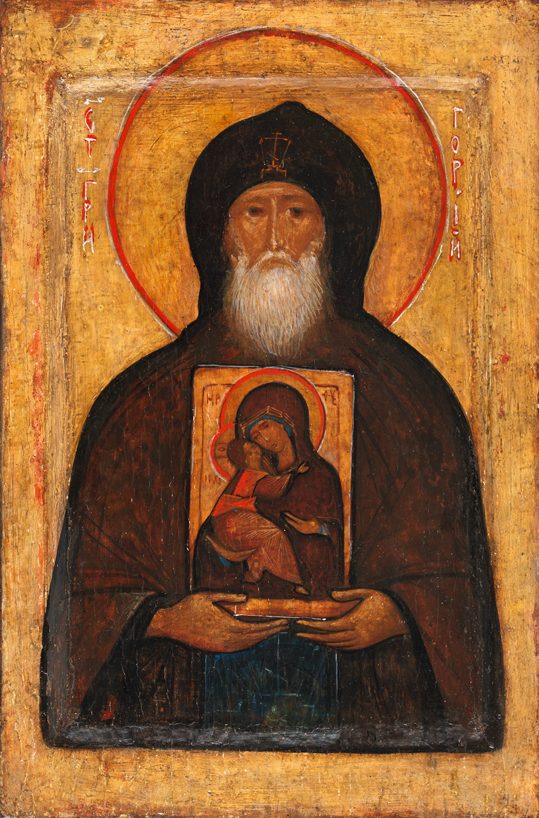
Saint Gregory, the iconographer of the Kiev Caves, Fr. Gregory's patron saint
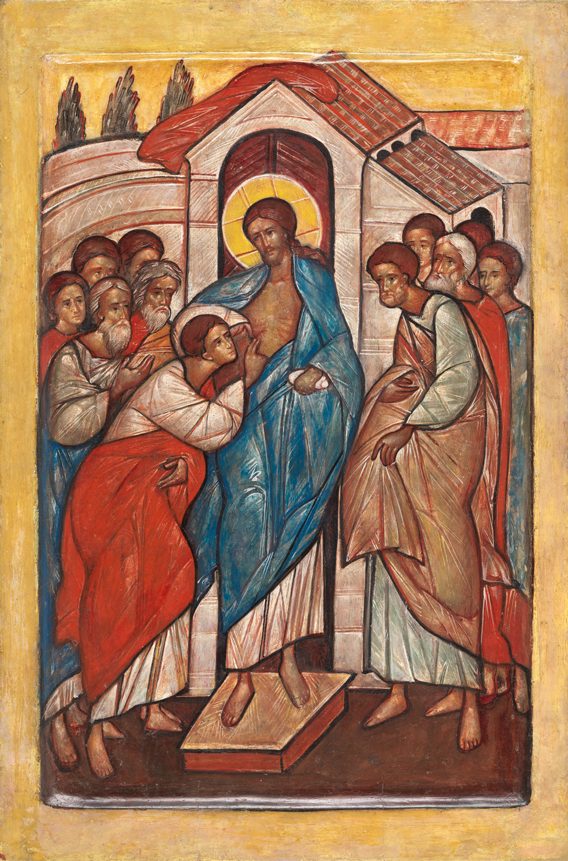
Apostle Thomas Witnessing the Wounds of the Risen Christ - Fr. Gregory died while painting this icon as a gift for his doctor
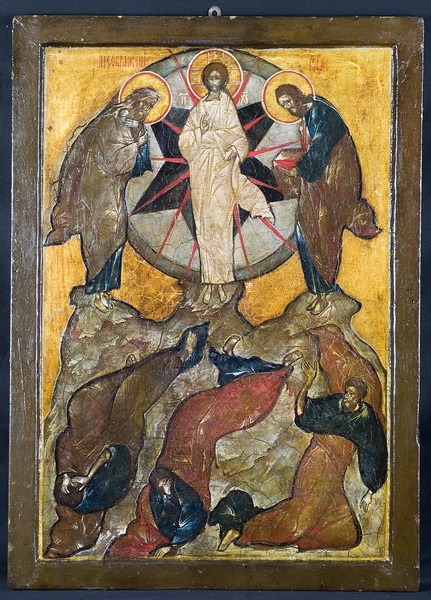
Transfiguration
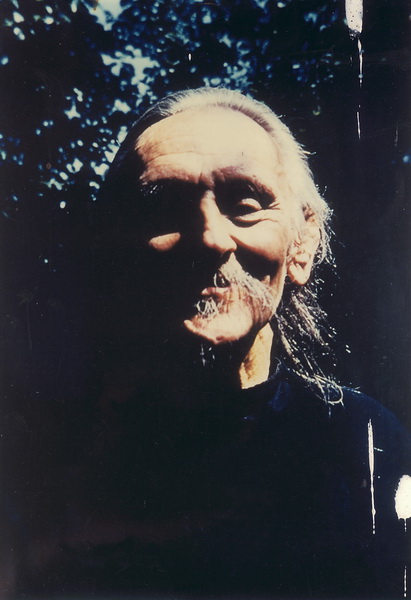
Fr. Gregory, May 1969 (a month before his repose)
Above are images from the Skite of the Holy Spirit in Mesnil-Saint-Denis (https://www.leskitdusaintesprit.fr/) - frescoes by Fr. Gregory.
More fresco work by Fr. Gregory can be seen in this book (which is fully viewable online at the following link!):
"The Light of Christ", Iconography of Father Gregory Kroug - Book by Andrew Tregubox: https://www.tregubov-icons.com/The-Light-of-Christ-Iconography-of-Father-Gregory-Kroug
For more information about Fr. Gregory, his work, and his life, the following links are wonderful resources:
Fr Gregory Kroug – An Exhibition Honoring the 50th Anniversary of his Repose, by Seraphim O'Keefe: https://orthodoxartsjournal.org/fr-gregory-kroug-an-exhibition-honoring-the-50th-anniversary-of-his-repose/
Grigorii (Krug) (1908-69) The Estonian Andrei Rublev, Baltic Orthodoxy https://www.balticorthodoxy.com/grigorii-krug
Jaime Rall: Gregory Krug — Visual Theologian of the Neopatristic Synthesis https://www.instituteofsacredarts.com/illuminations/2024/12/9/jaime-rall-gregory-krugvisual-theologian-of-the-neopatristic-synthesis
New Liturgical Movement : Russian Iconographer, Fr. Gregory Krug, 1908-1969 https://www.newliturgicalmovement.org/2010/02/russian-iconographer-fr-gregory-krug.html
Website by Emilie van Taack - student of Leonid Ouspensky http://iconeorthodoxe.free.fr/
A list of the locations of much of Kroug's work: https://eglise-orthodoxe-vanves.org/personnalites/moine-gregoire/principales-oeuvres-du-pere-gregoire-kroug/
Emilie van Taak, National Hellenic Research Foundation: Seminar "The Icon through the Teachings of Monk Gregory (Krug) and Leonid Uspensky" https://trois-saints-docteurs.fr/ru/2021/04/12/seminaire-emilie-van-taack/
Leonid Ouspensky:
Unlike Fr. Gregory, Leonid Ouspensky wrote and published texts, and was also a teacher of iconography with many students.
As it's too long to include in this section; a more complete bio of Ouspensky can be found here:
https://www.gsinai.com/leonid-ouspensky-biography
Ouspensky and Fr. Gregory Kroug met at art school in Paris, and became lifelong friends, often working together, even sometimes working together on the same icon. Ouspensky completely gave himself to iconography, most days working 16 hours, this allowed him to work with many different mediums (painting, fresco, wood, metal, embroidery) - as well as writing and teaching. Ouspensky reposed in 1987 at the age of 85.
Elizaveta Ozolina, a French icon painter, said:
«Just before his death, you could say, a few days before, I visited him, and, he was barely able to speak, but he said something that still simply, how can I say it, shakes me. He said "Have we understood what an icon is?" After everything he wrote, after all his works, after his whole life, which he dedicated to the icon, this was, how can I tell you, proof of how humble he was.. And precisely humble. He still felt that perhaps he did not understand what an icon was. »
Ouspensky's books "The Meaning of Icons" (written with Vladimir Lossky), and "The Theology of the Icon" (a two volume set) are incredibly rich, and indispensable for anyone wanting to deepen their knowledge about icons, whether or not they are interested in making icons themselves. "The Meaning of Icons" is more accessible, and includes a lot of high quality images of historical icons. "The Theology of the Icon" is much more dense, and without as many pictures.
"The Meaning of Icons", -
https://svspress.com/meaning-of-icons-the-paperback/?srsltid=AfmBOopfLJru5kMTvkKNOzmdgZORENAQkFOyahOcFJQvxi8gH-QMGNIj
"Theology of the Icon", -
https://svspress.com/theology-of-the-icon-set/?srsltid=AfmBOoq_PzkL86hu3u2e-4wqc05Eg5kLN0FqNODYB4G-kc27YAC42IpB
Below is a short excerpt from "A Lesson by Leonid Uspensky" from the book: "Theologie En Couleur - Les fresques des fetes en la Cathedrale des Trois Saints Heirarques a Paris"
(
https://editions-orthodoxes.fr/boutique/livres/histoire/theologie-en-couleur-les-fresques-des-fetes-en-la-cathedrale-des-trois-saints-hierarques-a-paris/) - the book is trilingually English, French, and Russian)
Ouspensky (in response to a student who had drawn the hands on an icon in a naturalistic manner):
"The hands, the nose, the ears are rather signs, do you see, they are types of outline, but they are used in such a manner that they belong as an integral part of the depicted person. Because these are sense organs they feel something other than natural matter, do you understand? Remember the transfiguration of saint Seraphim; his disciple asks him:
«What are you feeling? - I can smell a perfume that does not exist in this world, and I feel a warmth (it was in winter, wasn't it, in the forest, and both were covered with snow), a kind of warmth which is not that of wooden fire; an absolutely extraordinary kind of warmth»
So, do you see, that is the reason why in an iconographic drawing, sense organs are restricted to signs. In your drawing, the line seeks to imitate nature, and this is not only foreign to the icon, but it is the opposite of the icon. Look what you have done with these dashes, which are supposed to be the folds of the mantle; one does not understand anything any more: neither where it comes from, nor where it goes. In an icon, everything is logical, even the folds of the robe; they underline the shape of the body, they are not lines traced at random, no matter how and no matter where. (He shows an ancient icon undergoing restoration.) Look at this movement, it is extraordinary because it follows the natural movement of the body, but it is not naturalistic."
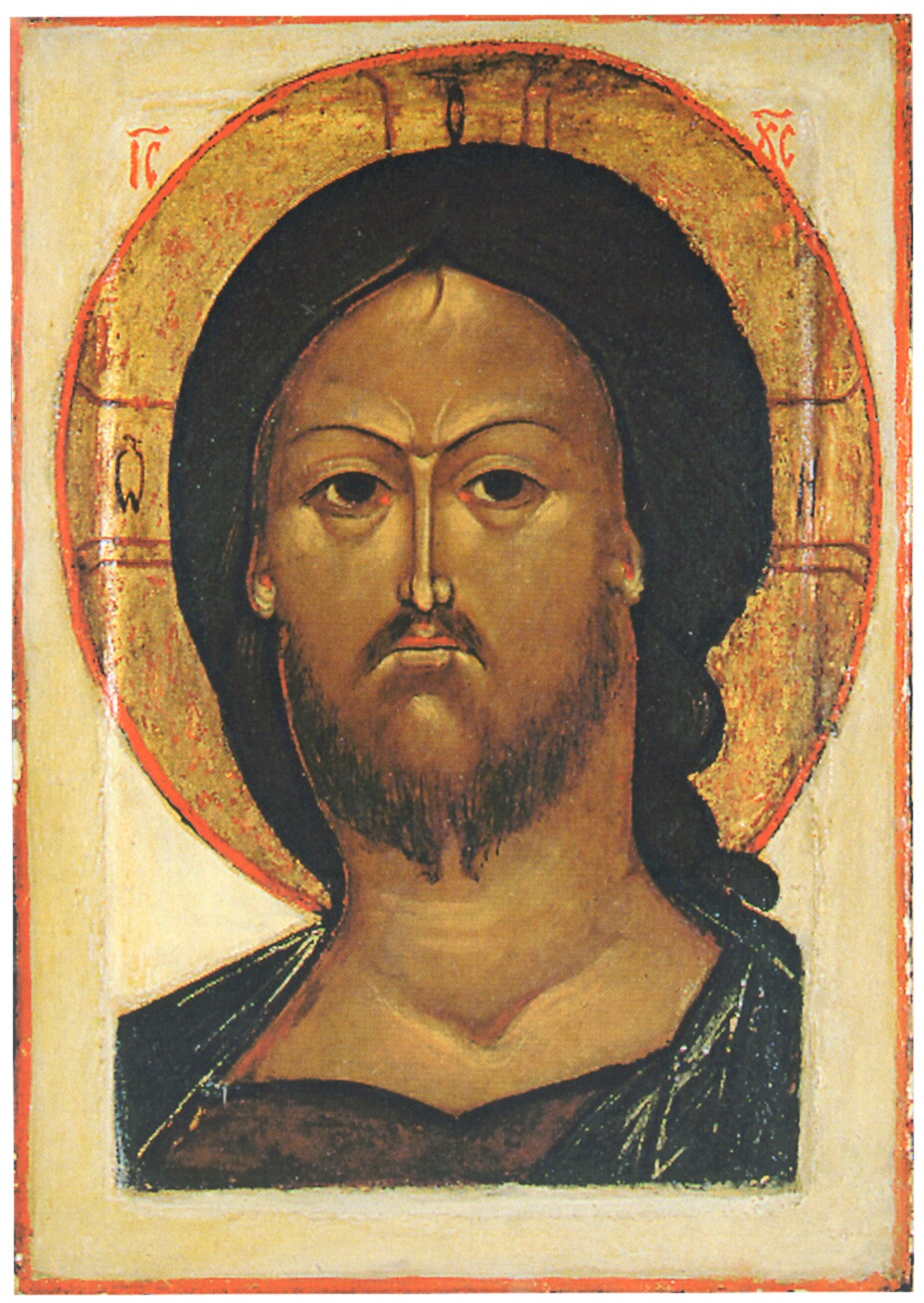
Leonid Ouspensky, Christ of the Fiery Eye (shoulder image of Christ)
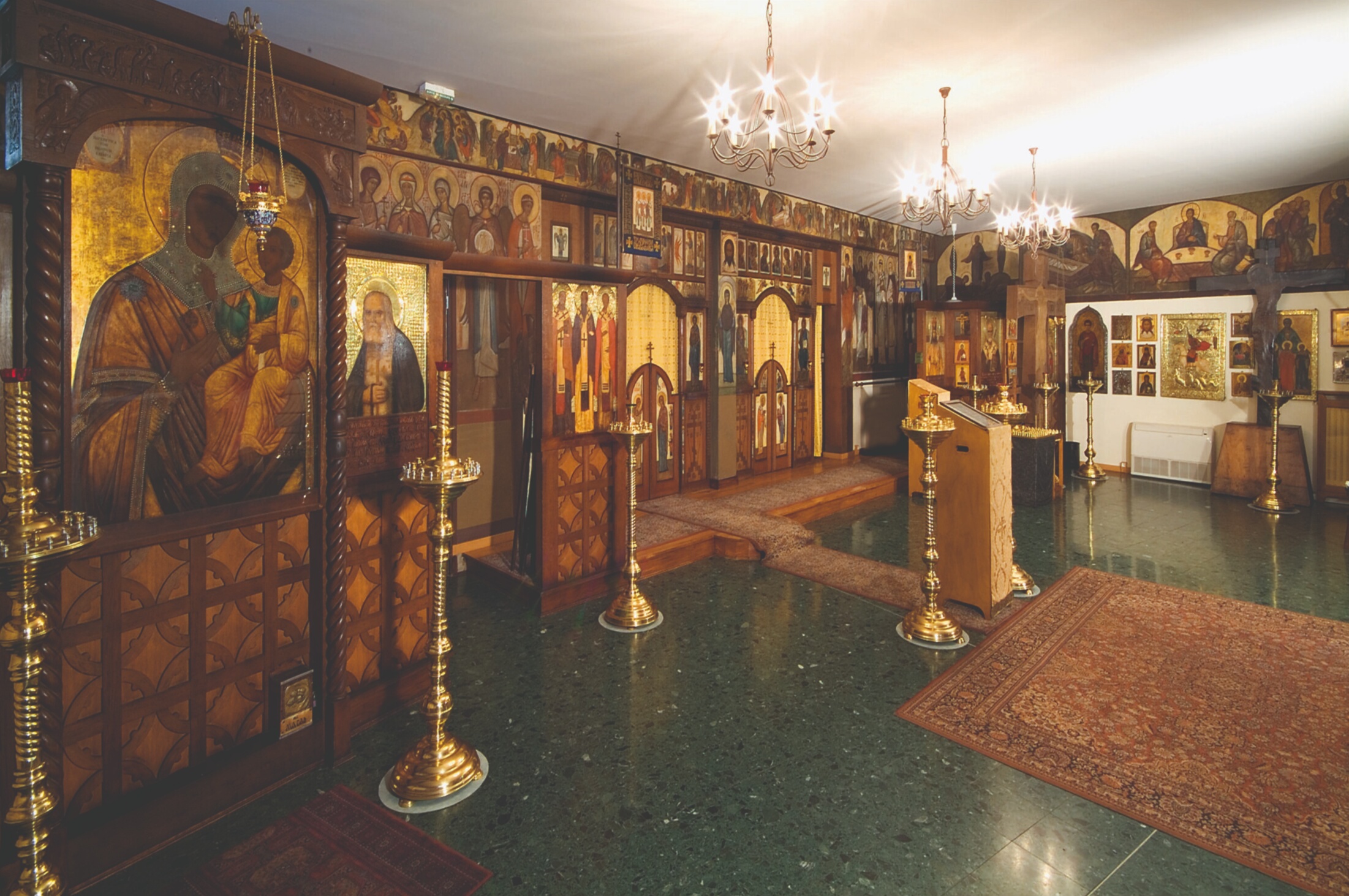
Church of the Three Holy Heirarchs, rue Petel, Paris. Ouspensky and Fr. Gregory both worked together on the iconography here.
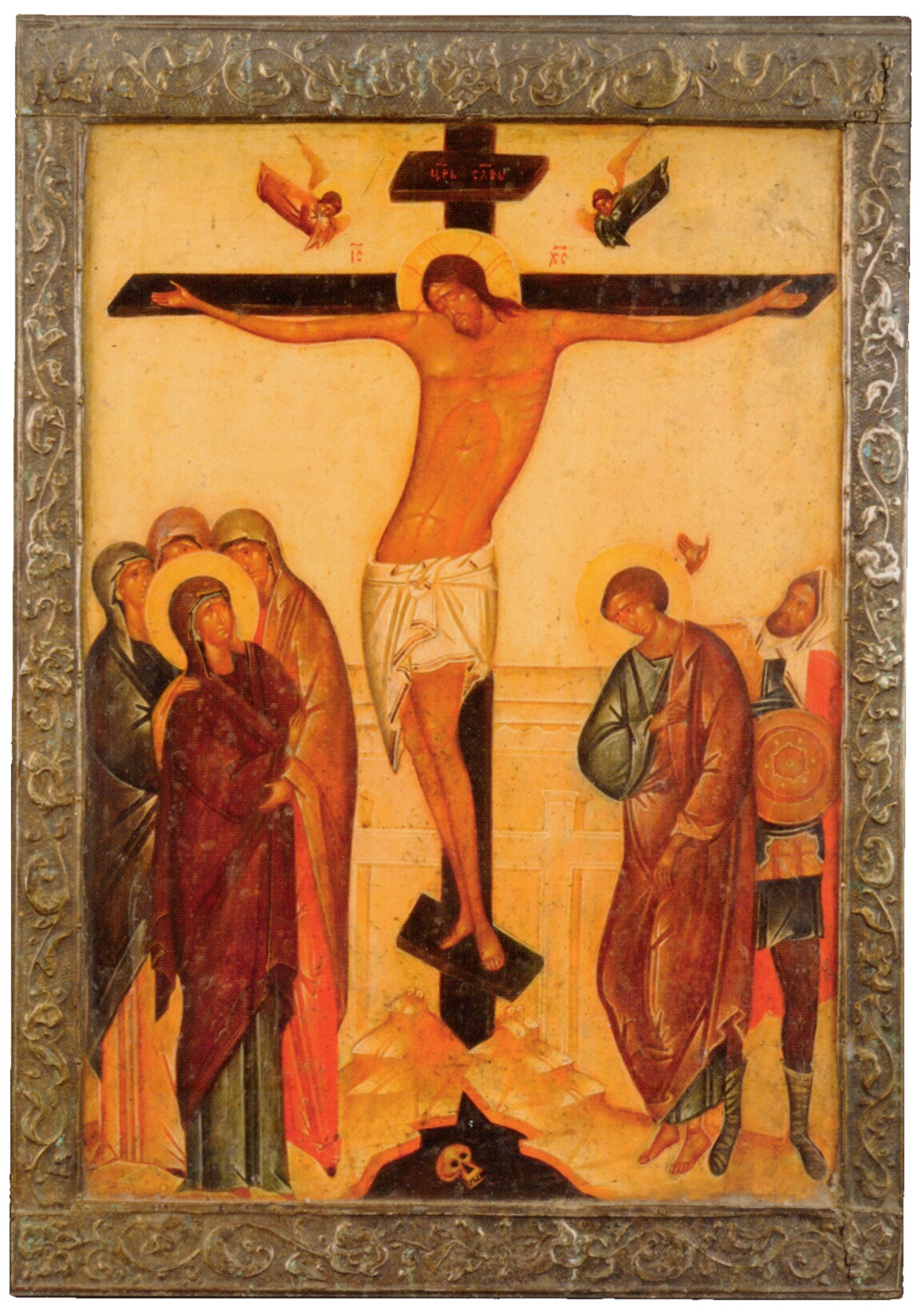
Leonid Ouspensky, Crucifixion, 1955
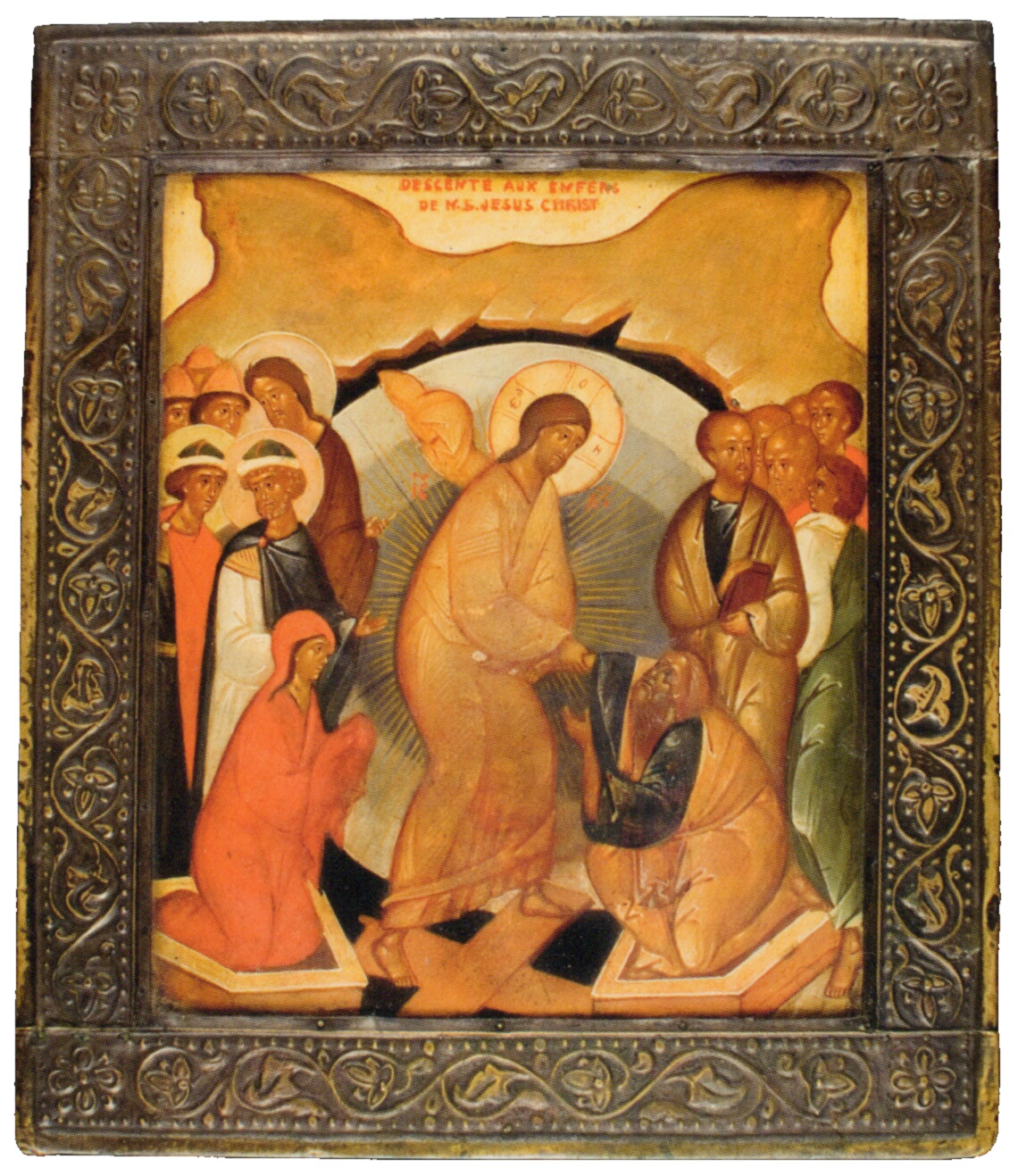
Leonid Ouspensky, Anastasis (Descente aux enfers), Beginning of the 1950's
Ouspensky experimented with many different mediums, making a few icons in wood, and to the best of my knowledge, only ever making one in stone.
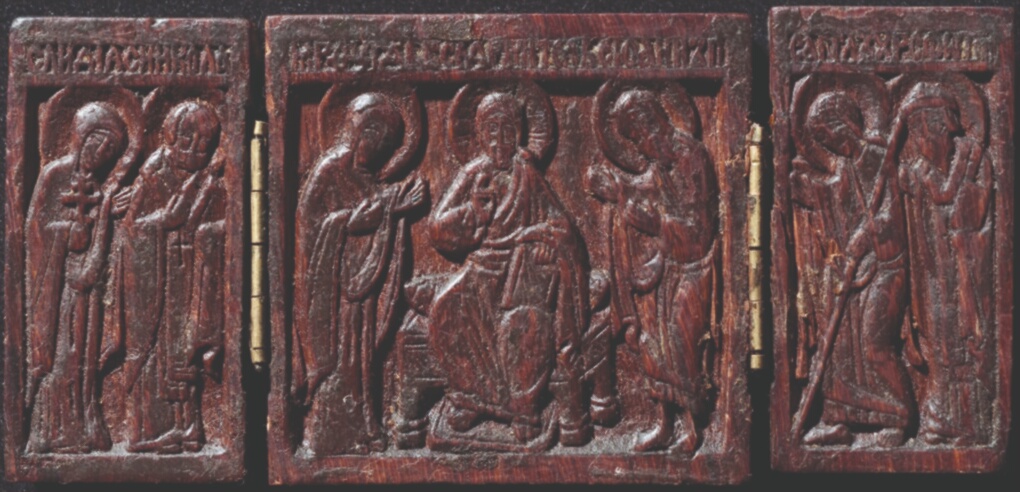
Ouspensky, Triptych. The holy martyr St. Lydia is the first figure on the left. The triptych itself is from the personal collection of Lydia Ouspensky, Leonid's wife.
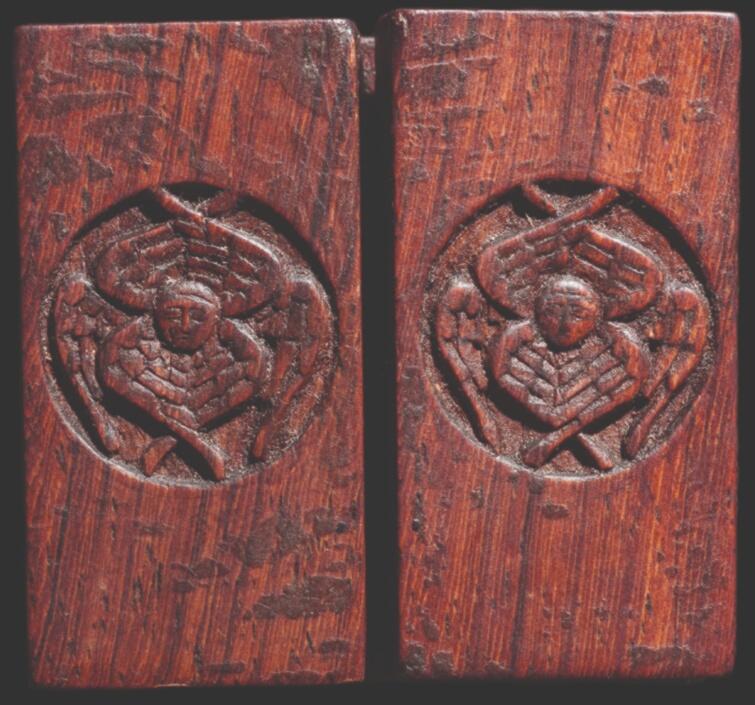
The triptych when closed
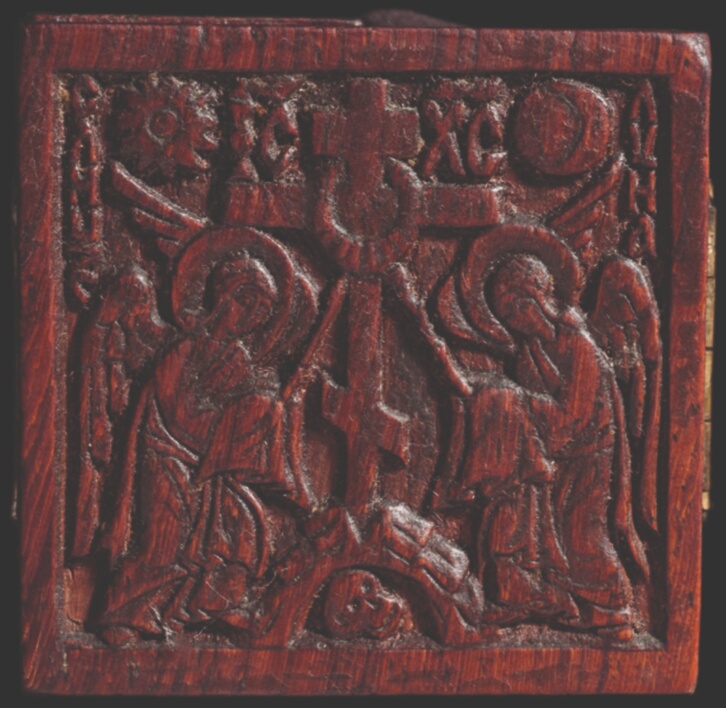
Reverse of the same triptych
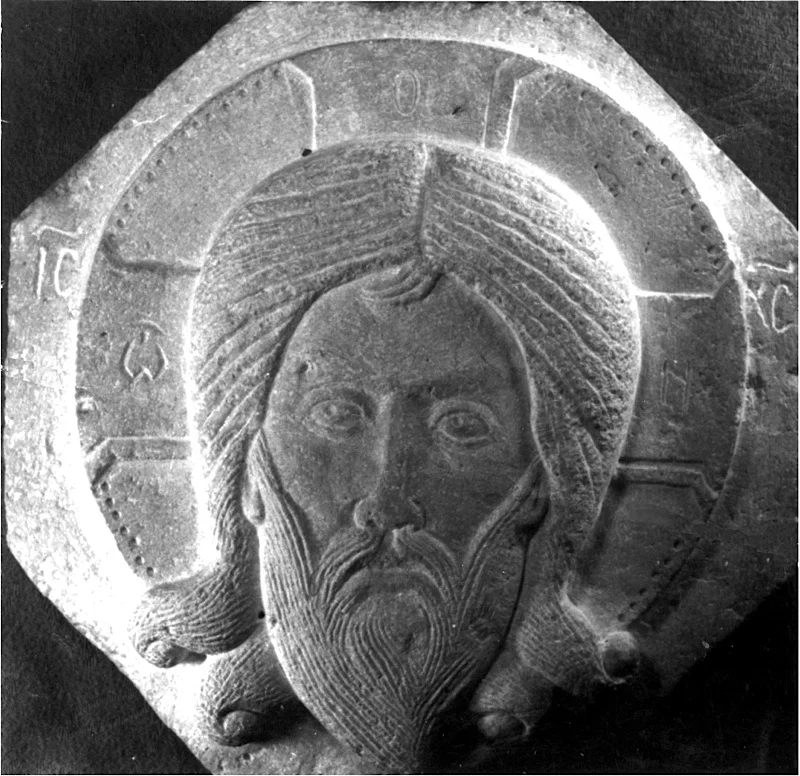
The Holy Face / The Holy Mandylion - carved in stone
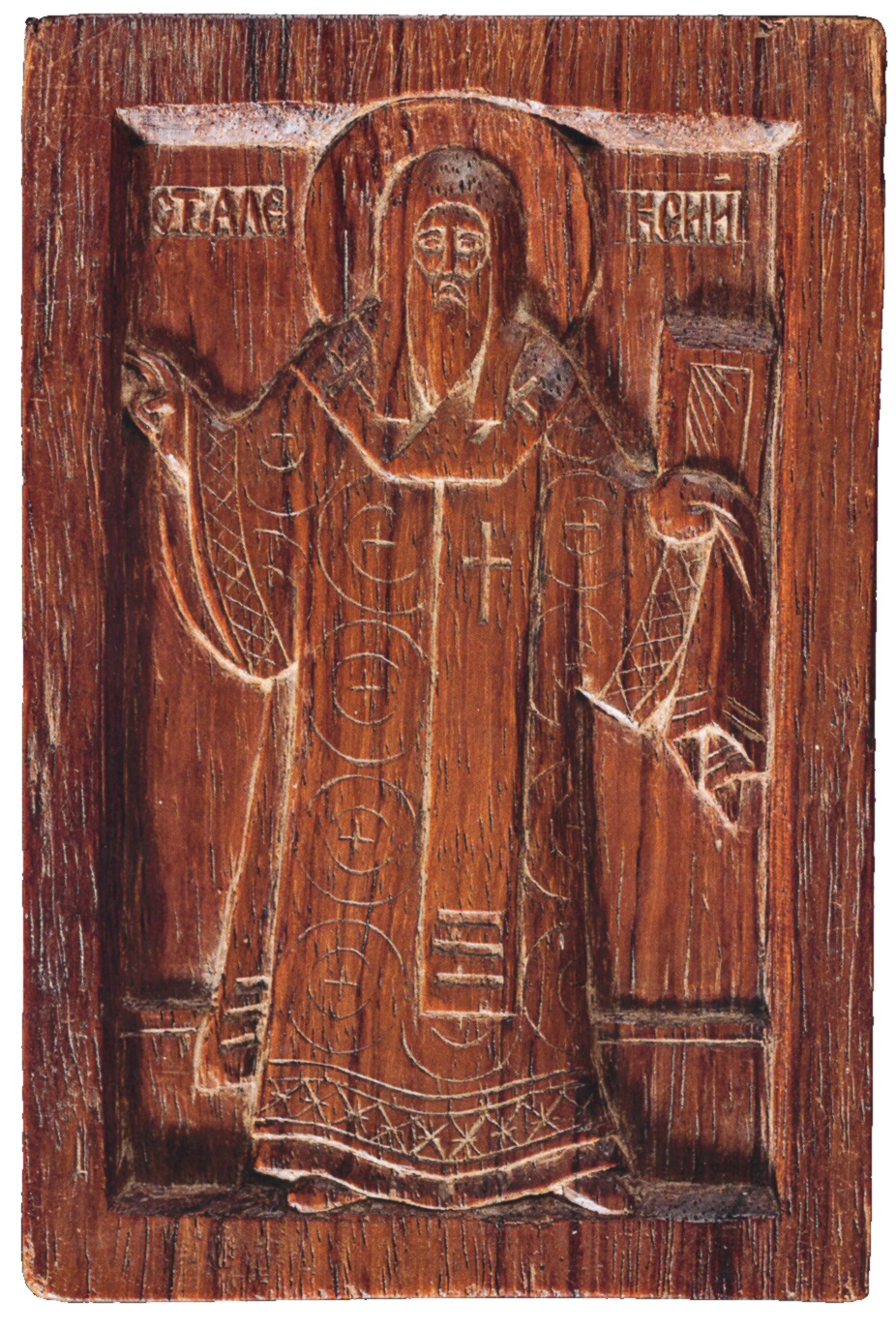
St. Alexis of Moscow
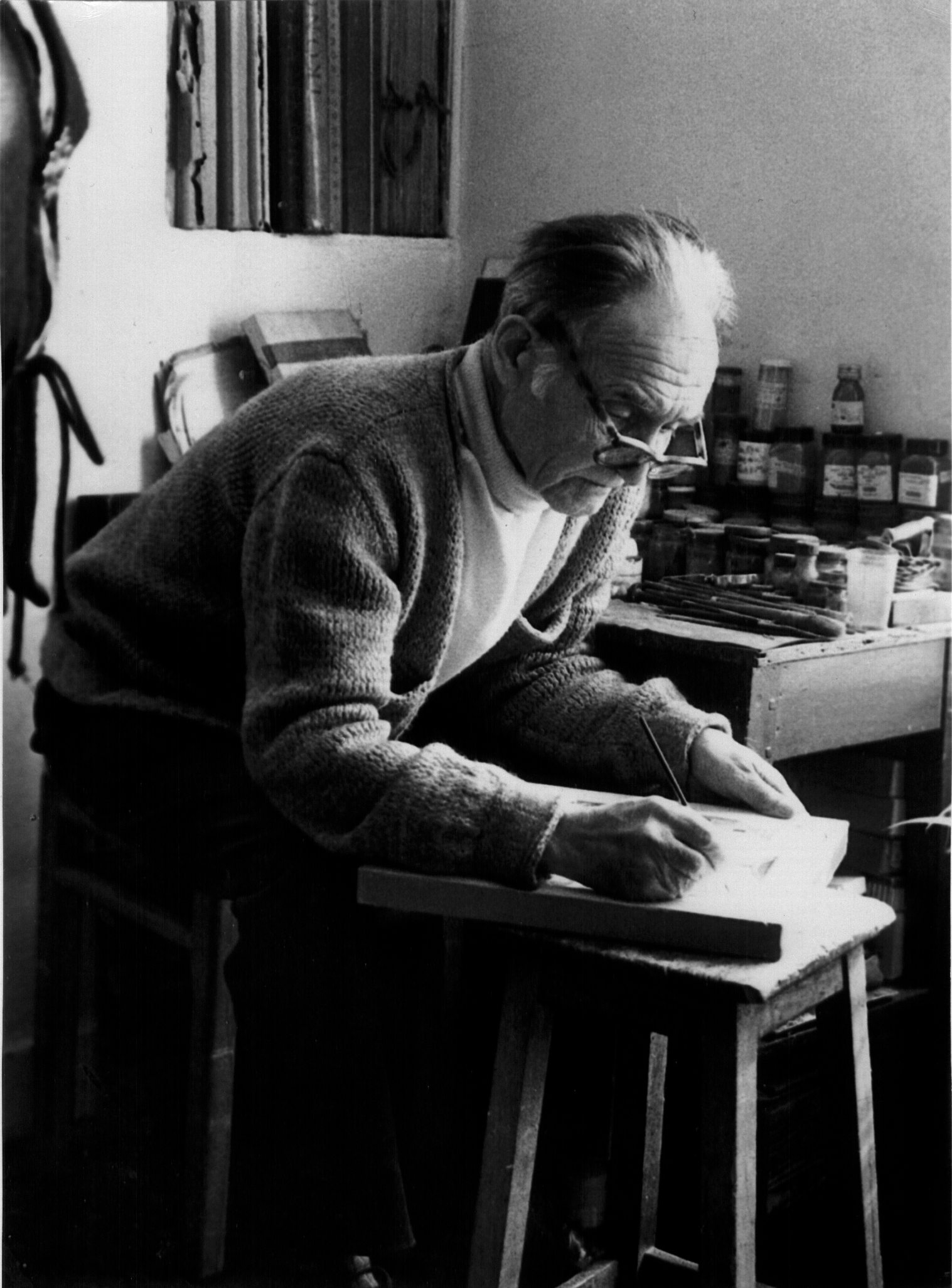
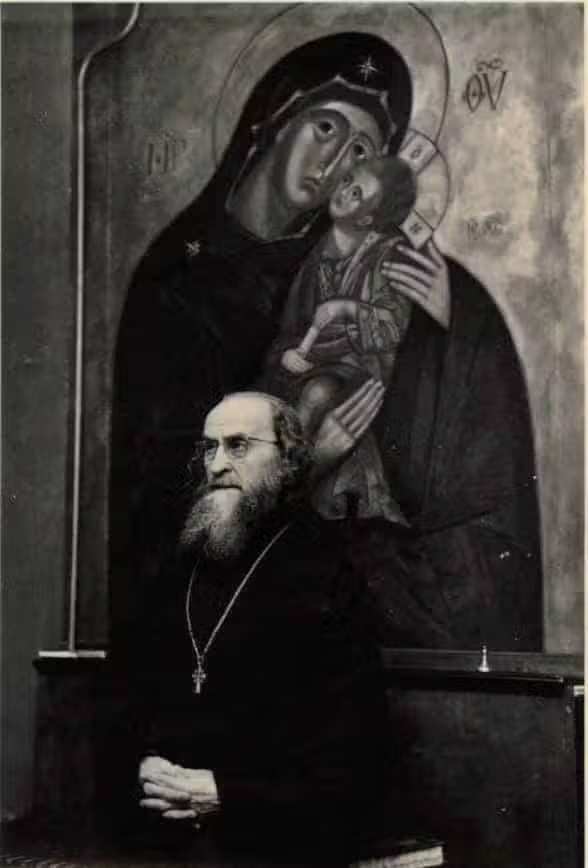
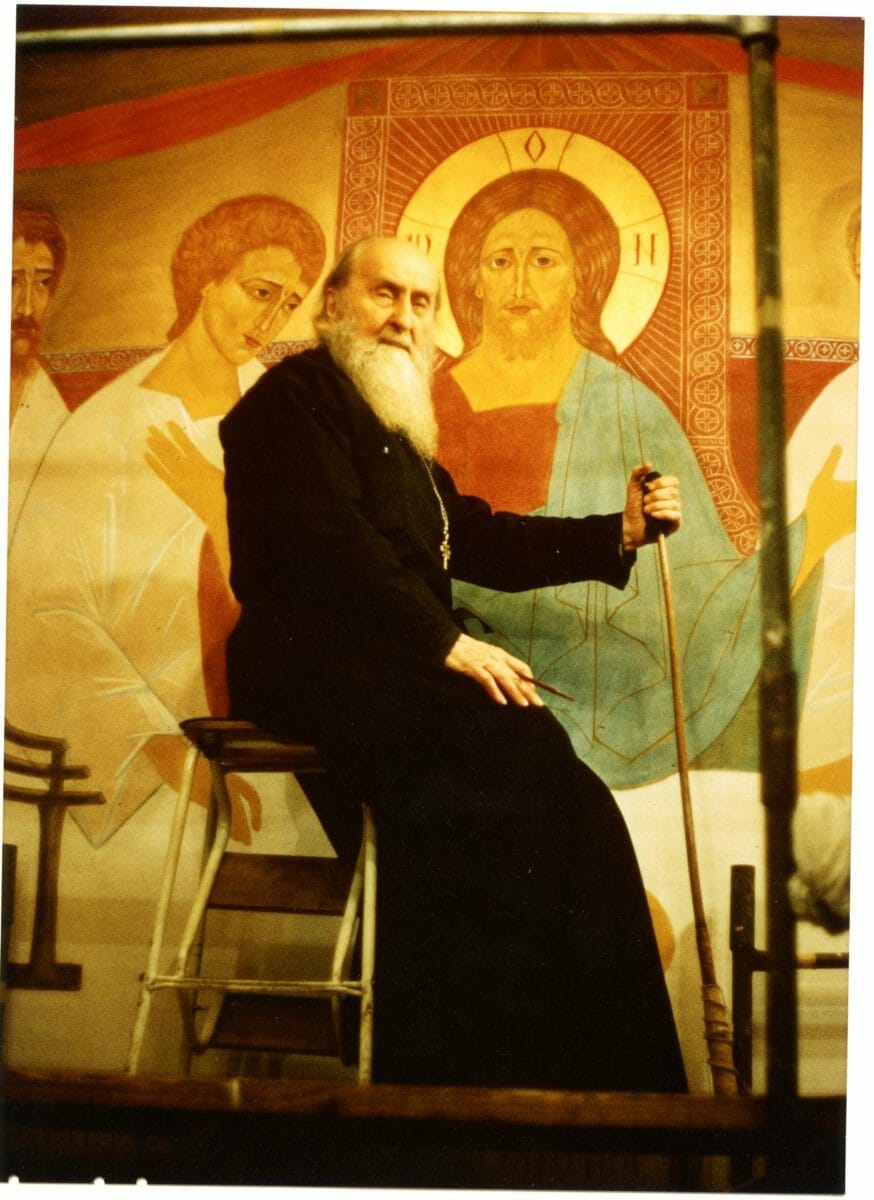
Ouspensky working on an icon - unknown year, probably late 1970's or 1980's
Another highly recommended book, that details Ouspensky's work as well as the currents around the 'rediscovery of the icon' at the time is:
"Recovering the Icon: The Life & Works of Leonid Ouspensky", Patrick Doolan - https://easternchristiansupply.biz/index.php/cse/recovering-the-icon-the-life-and-work-of-leonid-ouspensky-by-father-patrick-doolan.html
Overall though, I think the best way to get to know Ouspensky is to read his books "The Meaning of Icons" and "The Theology of the Icon"; and his interview in "Theologie En Couleur" (all linked at the top of this section)
Saint Sophrony of Essex (+1993):
One of the monumental saints and one of the most noted ascetic monks of the 20th century, St. Sophrony of Essex, born Sergei Sakharov, has left behind numerous writings; perhaps most well known as the disciple and biographer of St. Silouan the Athonite; but also the founder of the Stavropegic Monastery of St. John the Baptist in Essex, England, and as an important iconographer of the 20th century.
St. Sophrony was raised Orthodox and spent much time in Church and in prayer from a young age. He signed up for art education at the end of his secondary education, and in 1918 applied to the Moscow School of Fine Arts (where one of his teachers was Kandinsky). World War 1 had begun and the Bolshevik Revolution followed soon after - Sergei was deeply affected by the sheer amount of human suffering he witnessed then, leading him to abandon Christianity;
“I can remember myself as I was then, behaving in everyday life like any of my contemporaries though there were moments when I could not feel the earth under my feet. I could see it with my eyes but in spirit I was moving over a bottomless abyss.” “I was living as if in a dream. And that dream was a nightmare…at times a dark abyss opened under me and a thick leaden wall was looming over me. I was twice arrested at the beginning of the revolution. Many people perished at the time but I felt no fear, as if there were nothing terrible in those arrests. But the vision of that wall and that abyss put me in a state of inexplicable, silent terror. And this went on for many years.”
He spent years like this, before a mystical experience occured on Great Friday, bringing him back to the Church. He tried to balance secular artwork and prayer (since he was an artist and living in Paris at the time) - but ultimately was unable to do so, since both required the entire person.
"The battle between art and prayer, that is, between two forms of life which require the whole of man, continued within me in a very intense manner for a year and a half or two years. In the end, I was convinced that the means at my disposal in art would not give me what I was looking for. That is, even if I could intensely sense eternity through art, this awareness is not as deep as prayer. And I decided to give up art–which for me was a terribly high price to pay."
In 1926, at the age of 30, he arrived at Mt. Athos, where he would meet his spiritual father St. Silouan the Athonite, and receive his monastic tonsure.
“An artist is a person who believes with deep conviction in the rightness of what he creates; who devotes his entire life to art for mankind. Only in such people does the Divine spark burn, brightly an unquenchably. And this is what’s most important in art.” - St. Sophrony of Essex
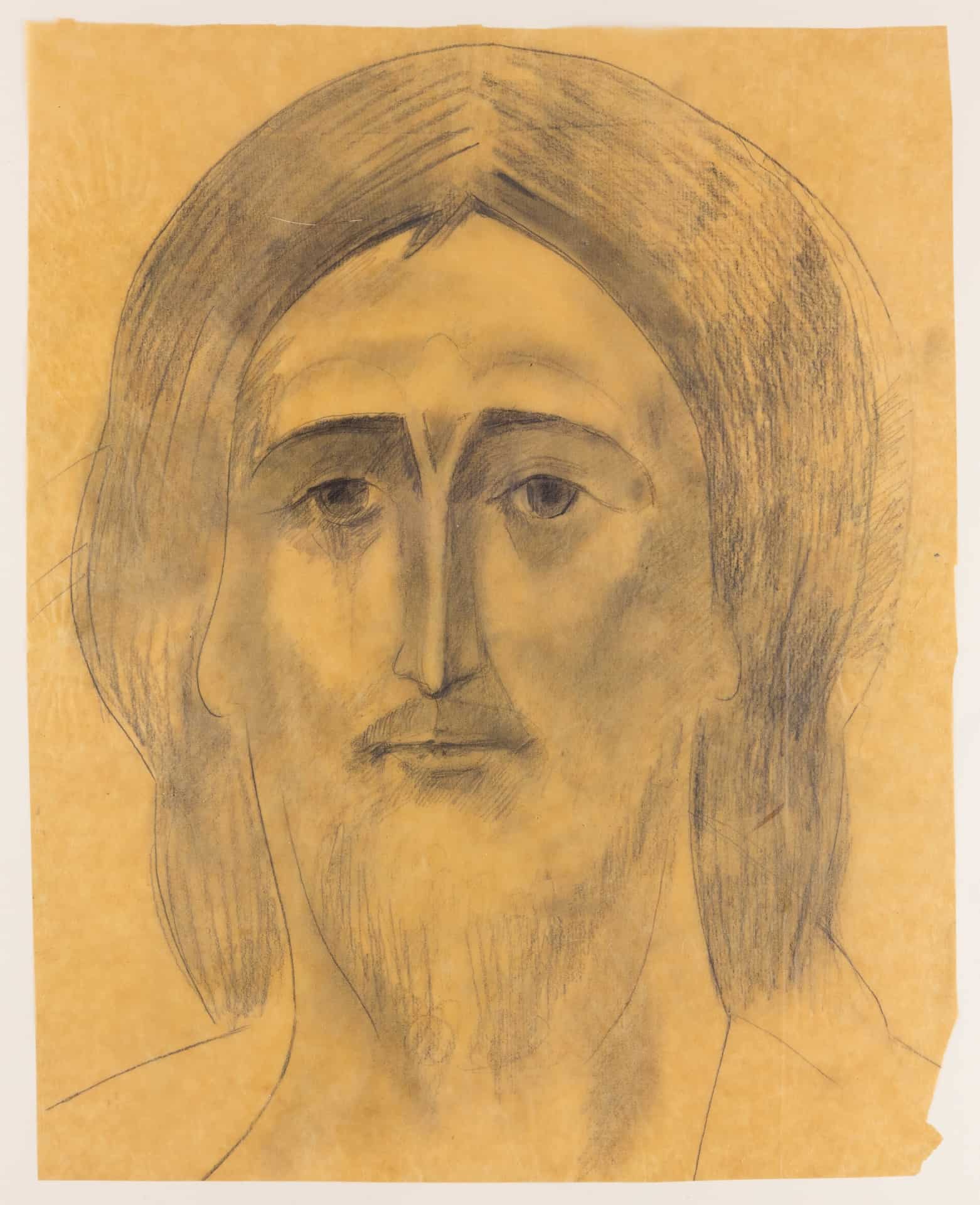
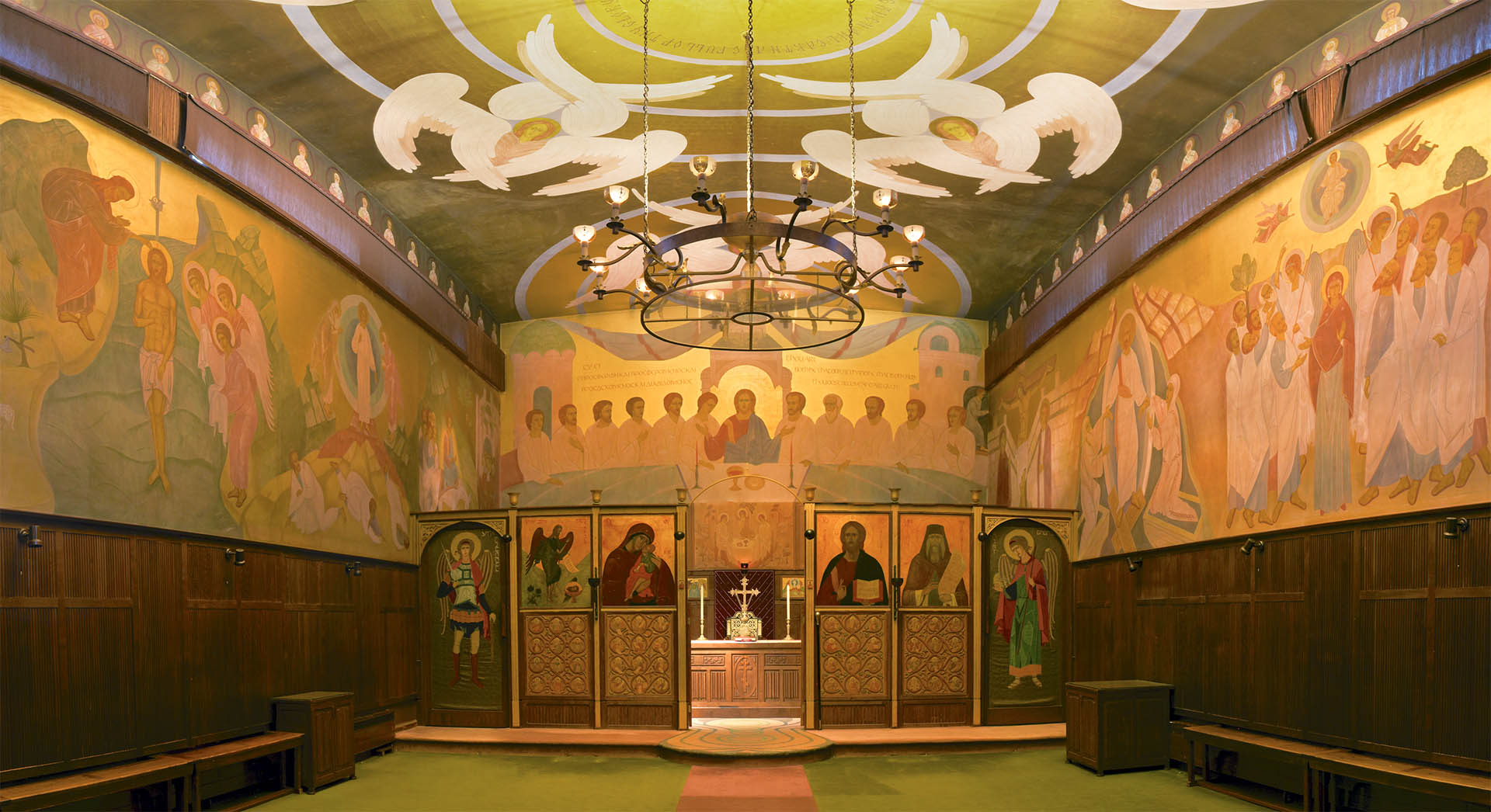
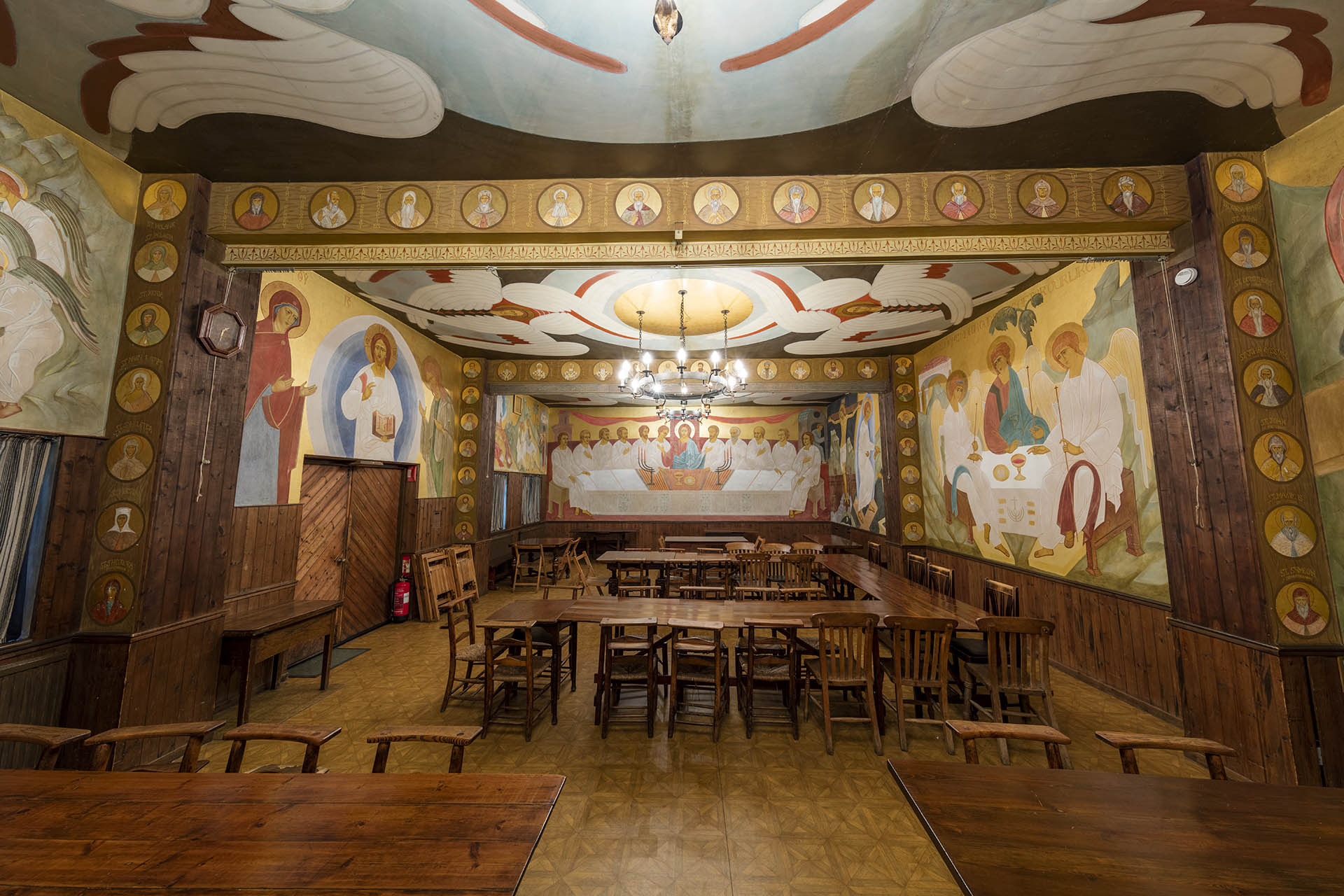
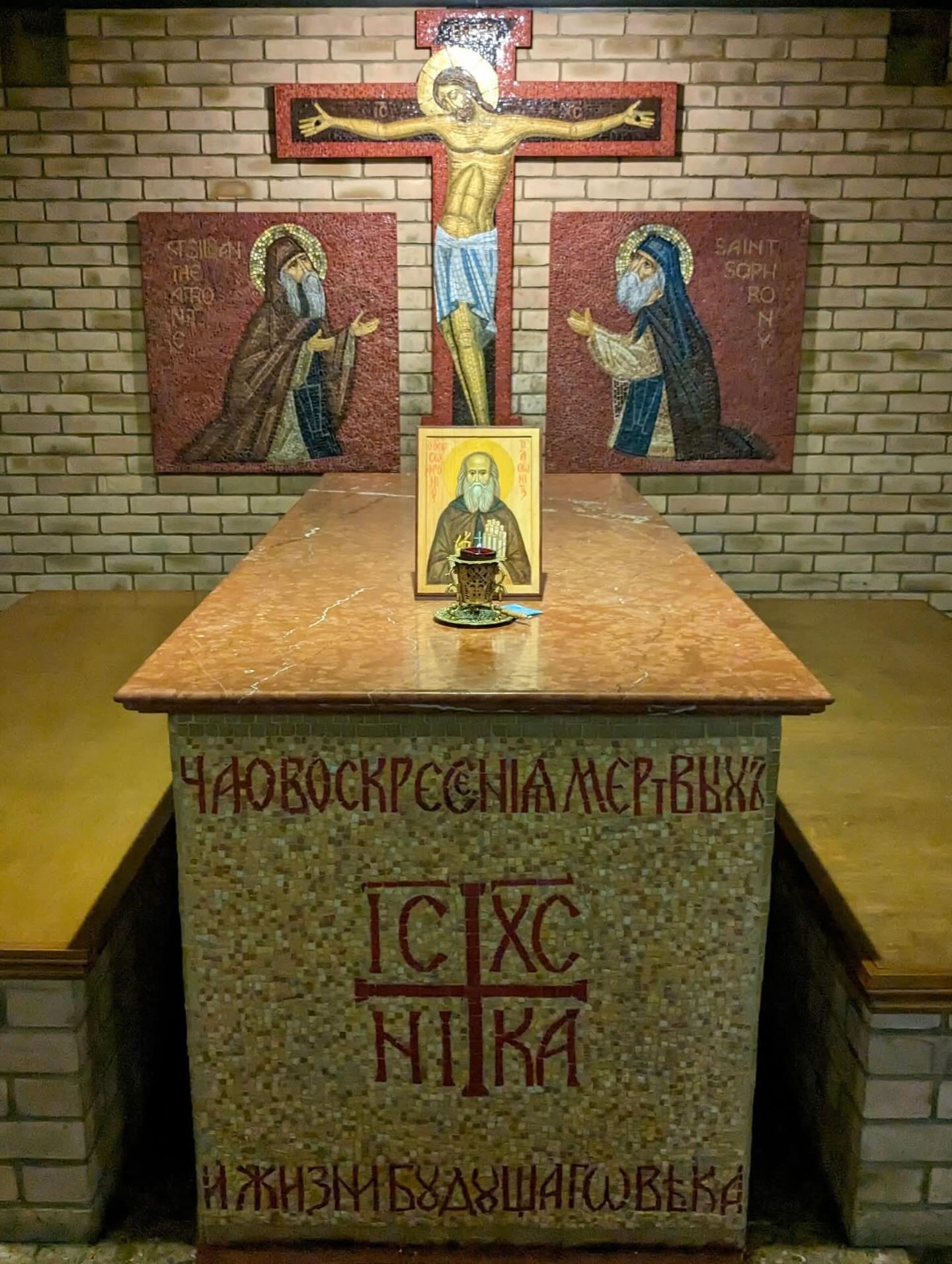
This image and the image on the left are pictures of the refectory and St. Silouan's chapel at the monastery St. Sophrony founded in Essex. St. Sophrony painted the frescoes.
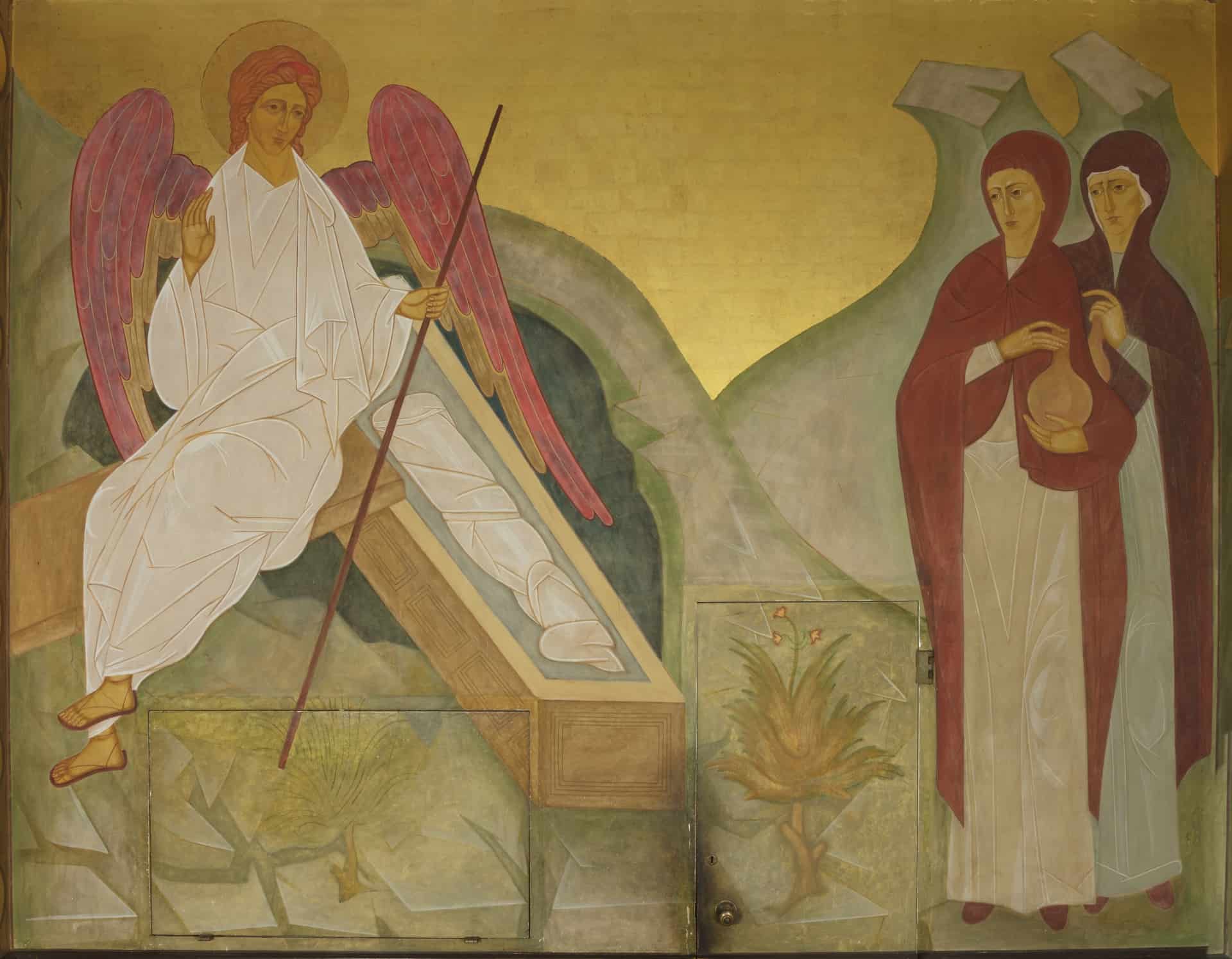
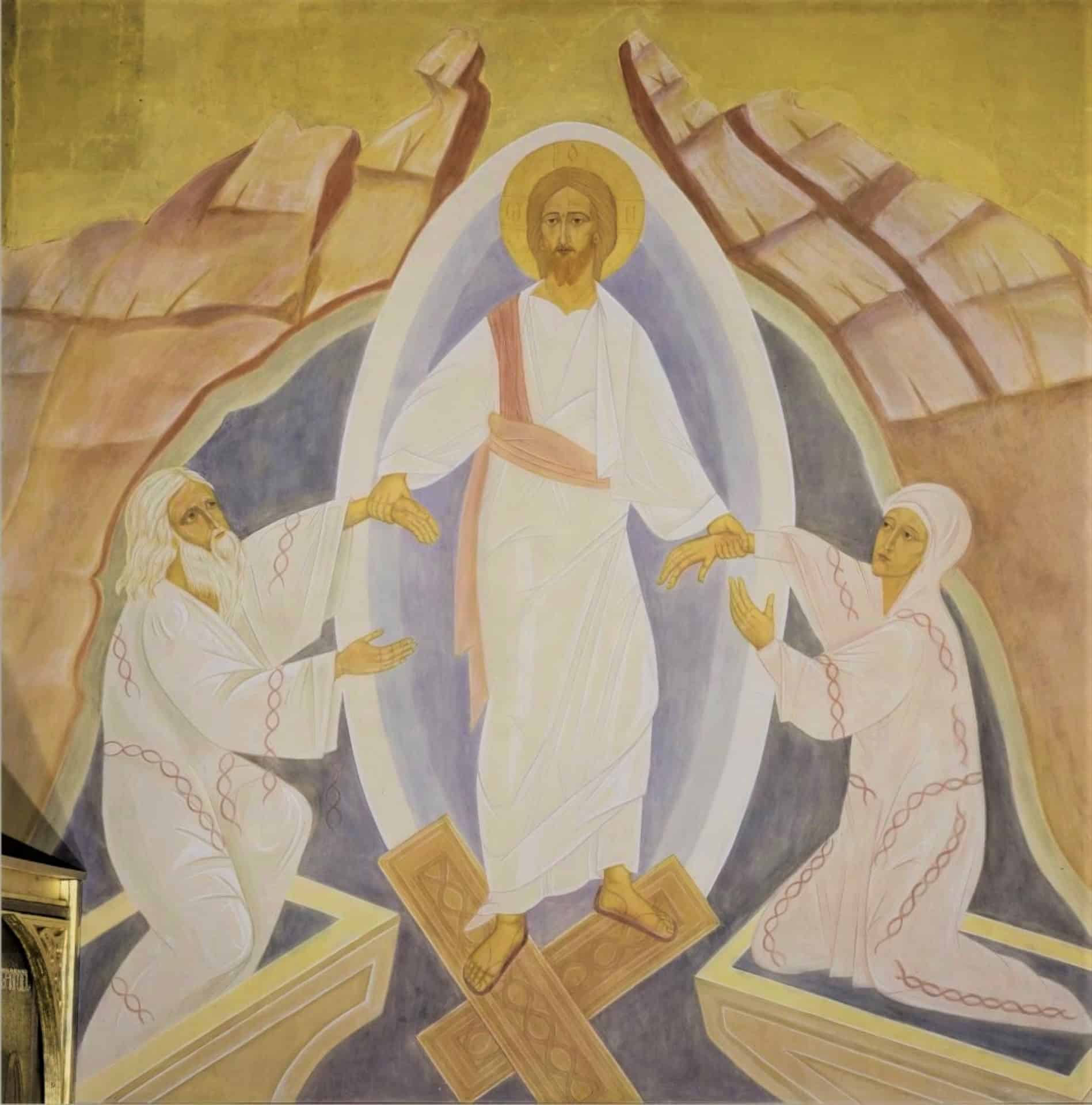
Above: The empty Tomb
Right: Anastasis
Both frescoes painted by St. Sophrony at the monastery of St. John the Baptist in Essex.
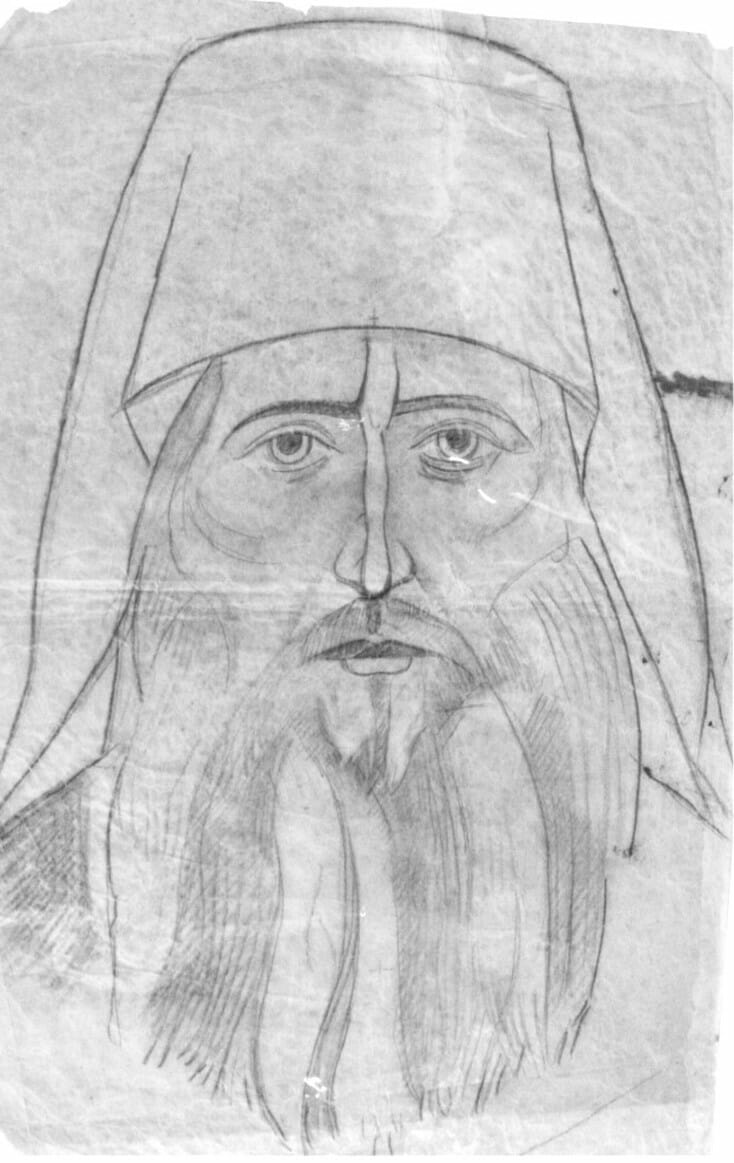
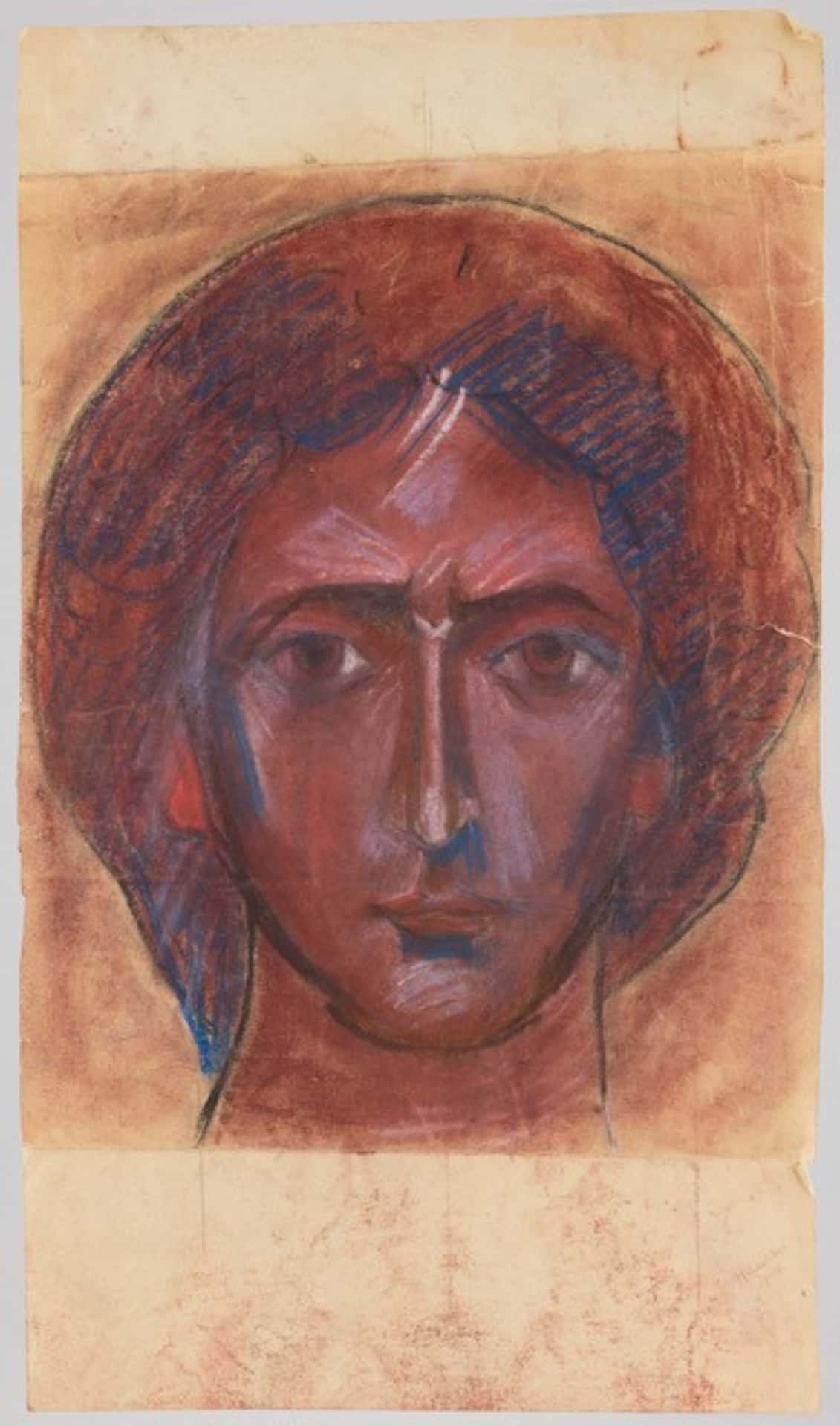
Above: Drawing/Study of St. Silouan's face.
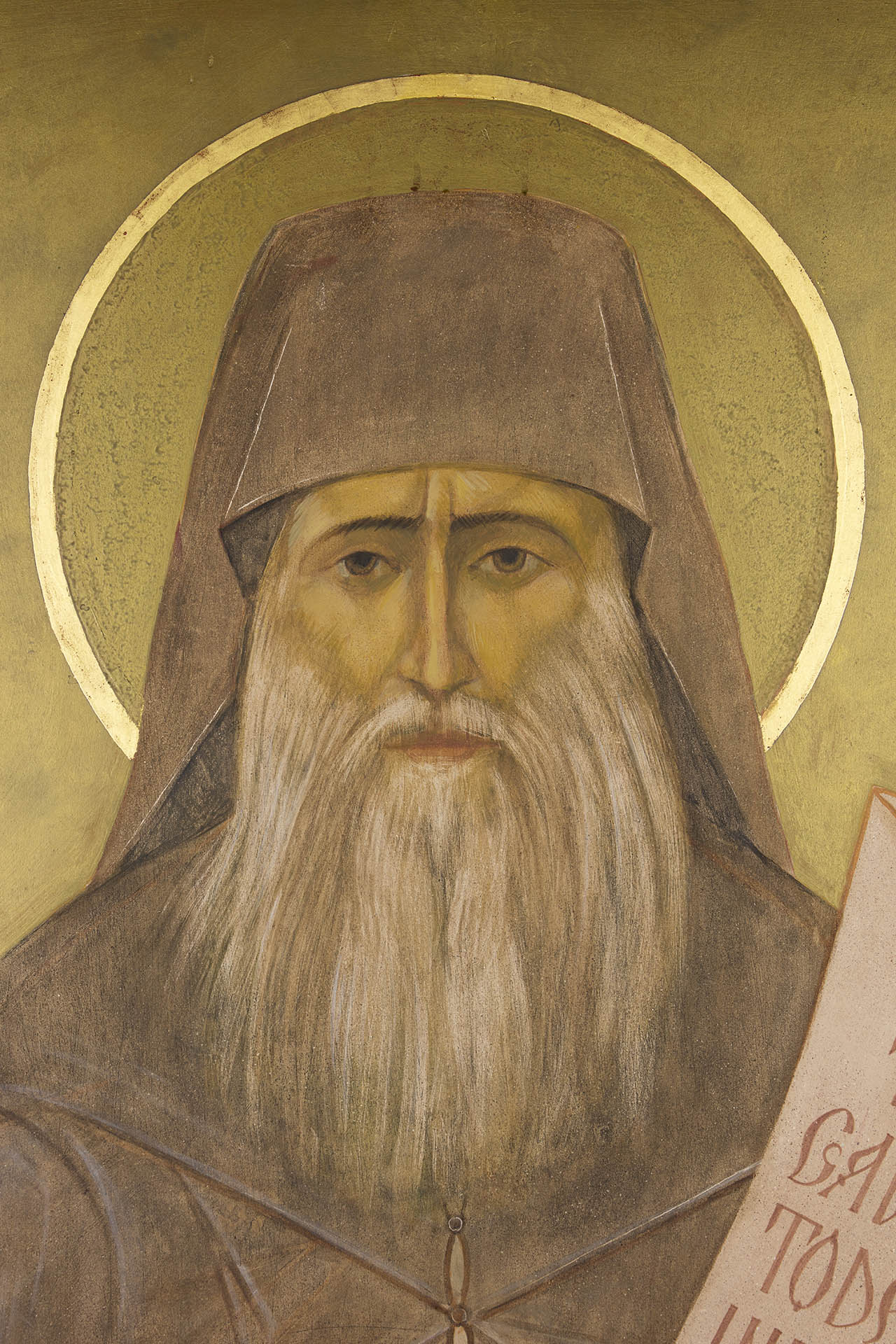
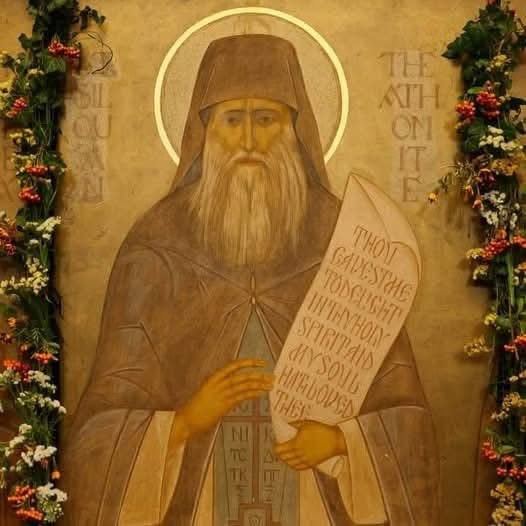
Above: Wall painting of St. Silouan, from the west wall of Saint Silouan's chapel, from The Stavropegic Monastery of Saint John the Baptist, Essex. Fragment (
view a wider shot of this icon)
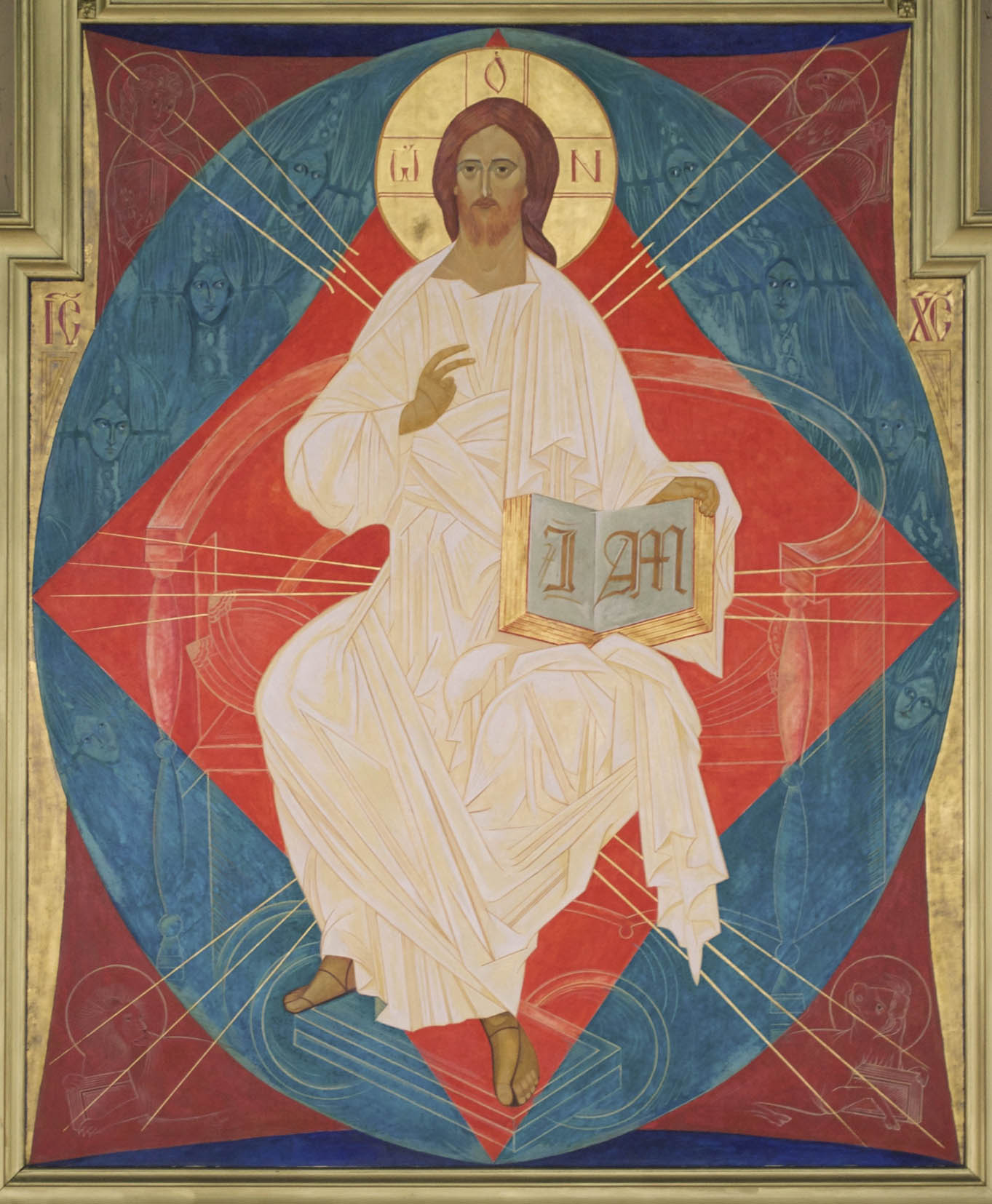
Above: Christ In Power, Painted by St. Sophrony in 1974
Right: Detail of one of the Seraphim
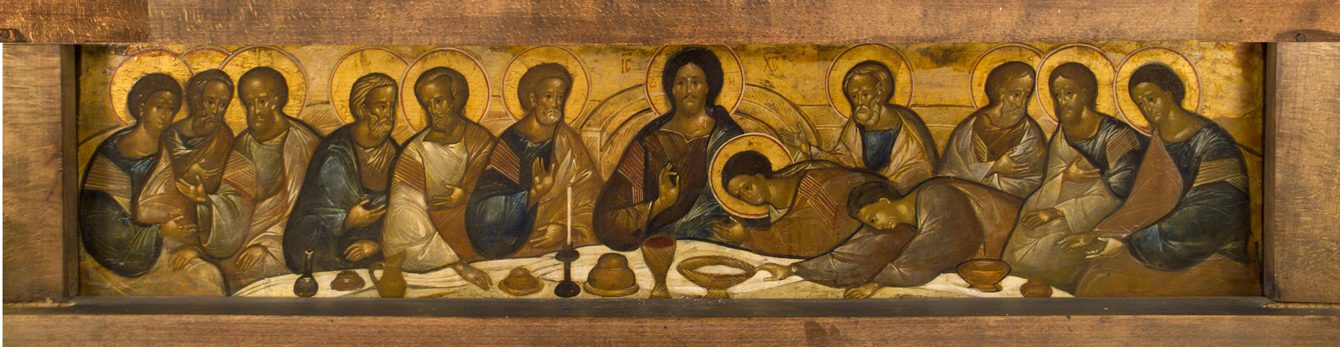
Above: The Mystical Supper, Painted by Fr. Gregory Kroug.
From
an article about Fr. Gregory on 'Orthodox Arts Journal'::
Before his monastic years, Fr Gregory also painted icons for a shack that was used by a community of parishioners at Rue Petel, which for a time included Fr Sophrony Sakharov after the latter’s return from Mount Athos. The spiritual quality of these icons so impressed Fr Sophrony that he asked Fr Gregory to make the iconostasis for the monastic community he began in France. This iconostasis now stands at the monastery Fr Sophrony founded in Essex, England.
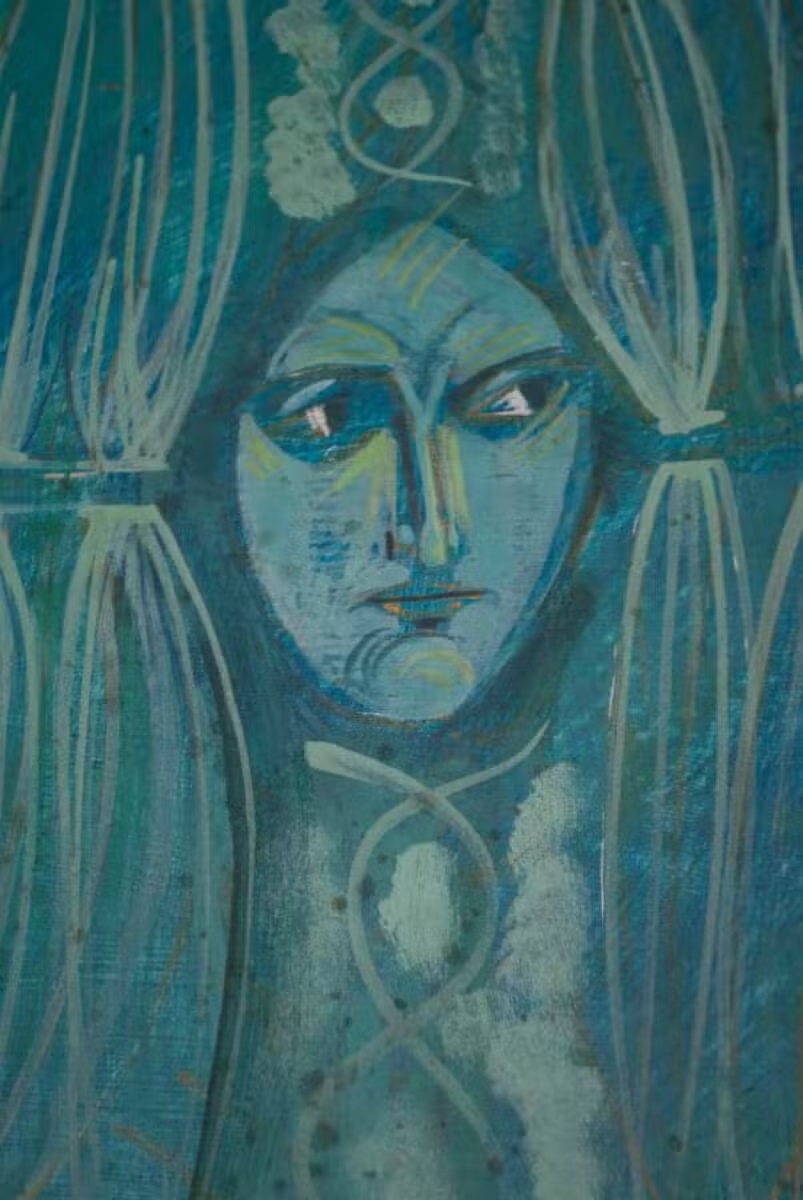
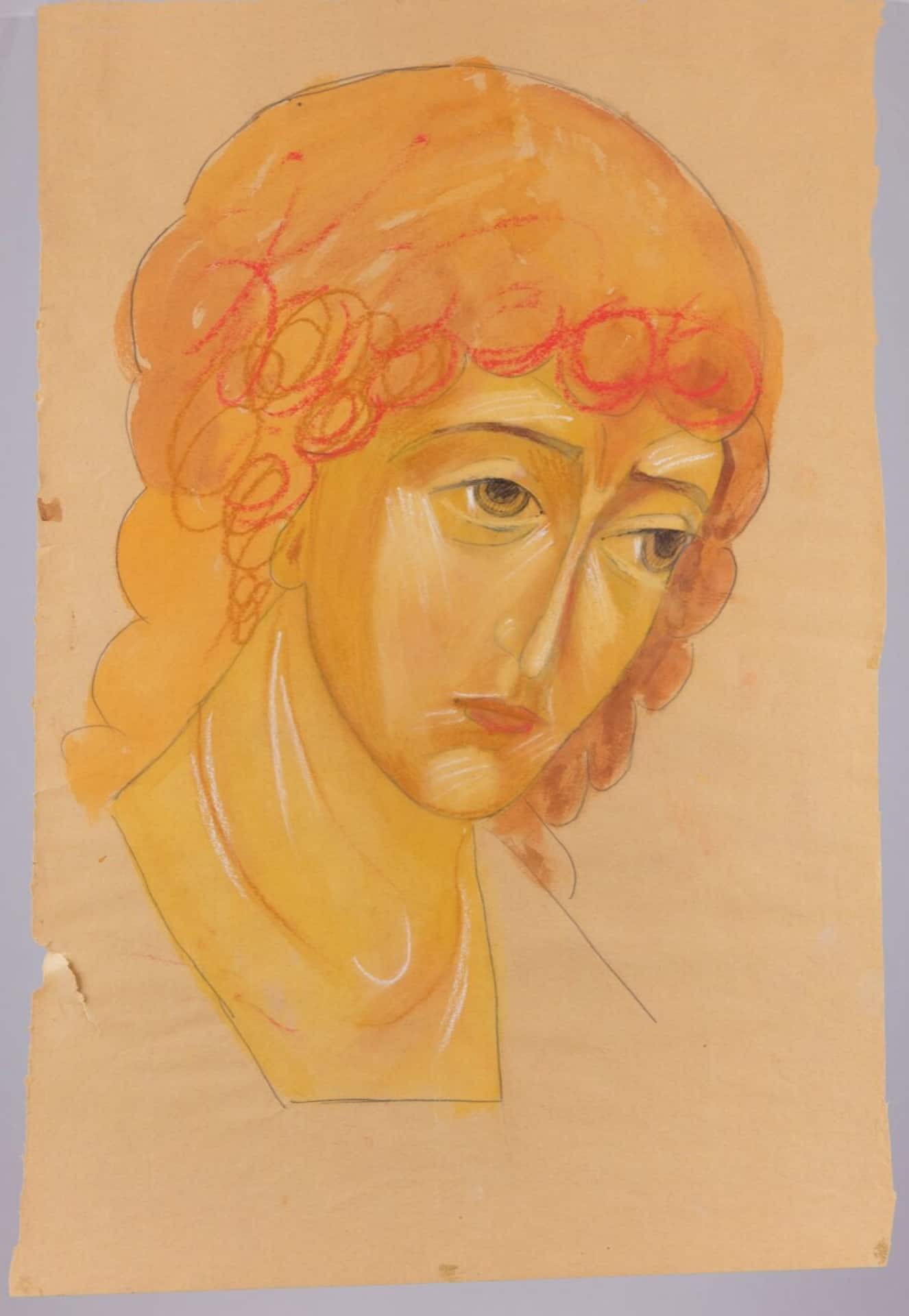
Below: Various studies and drawings by St. Sophrony. From left to right: God the Father from the 'Trinity' icon. The face of a Seraphim. Christ's face from a study of an 'Entrance into Jerusalem' icon. The Mother of God's face from a study of a Crucifixion icon.
Below are some links to get to know the work of St. Sophrony better.
‘Being’, The Art and Life of Father Sophrony: https://essexmonastery.com/library/read/being-the-art-and-life-of-father-sophrony-by-sister-gabriela/
Seeking Perfection in the World of Art: The Artistic Path of Father Sophrony: https://orthodoxartsjournal.org/seeking-perfection-in-the-world-of-art-the-artistic-path-of-father-sophrony/
Painting as Prayer, The Art of A. Sophrony Sakharov: https://orthodoxartsjournal.org/painting-as-prayer-the-art-of-a-sophrony-sakharov/
- and a book of the same title as the above: https://essexmonastery.com/bookshop/painting-as-prayer/?srsltid=AfmBOoqRGQXE__c5bopSaJY3PTHNXvGQE4OOnRo8iSDNizYe2vpOUkql
"The Face of Light", St. Sophrony's Icons of Christ: https://essexmonastery.com/bookshop/the-face-of-light/?srsltid=AfmBOor7kpsXx1DW9hxhJ4fsQAOUEbxjajVmYUJY_hqJWrpnO2tkYj51
"A. Sophrony (Sergei Sakharov) Catalogue Raisonné" - Vol 1. "Drawings and Paintings" and Vol. 2 "Icons: commissions & collaborations" and Vol 3. "Discoveries & Works by his Studio" can be found here (among other books focusing on specific series of frescoes): https://essexmonastery.com/bookshop/category/sister-gabriela/
Saint Sophrony and the Place of Prayer in Creating Art - https://saintpatrickpress.com/saint-sophrony-and-the-place-of-prayer-in-creating-art/
"Seeking Perfection in the World of Art: The Artistic Path of Father Sophrony": https://stmpress.com/products/seeking-perfection-in-the-world-of-art-the-artistic-path-of-father-sophrony?_pos=1&_sid=c7b42beee&_ss=r
Mother Juliana (Sokolova)
Mother Juliana (born in 1899 as Maria Sokolova) is perhaps the most important figure when discussing iconography in Russia during the 20th century.
During a time of intense Soviet persecution, she took enormous risks to preserve the art of iconography - studying church art through ancient monuments, both artistically and theologically, and immersing herself deeply in the tradition, she was able to create new images/prototypes, spiritually close to the works found in the 14th-16th centuries, at the height of iconography.
During her life, she noticed a lack of understanding of ancient icons within the Church community - at a time when preference was given to painted images with renaissance influence. In response to this, she taught many students; technical instruction for iconographers, lectures on art, iconography, and the theology of the icon directed specifically for future priests, and she leaves behind to us today very important writing/teaching material. She also worked in restoring ancient icons. Unfortunately, not very much information about Mother Juliana exists in English - at the bottom of this page there are some links; some of them are in Russian and can be read with google translate. We are fortunate enough that her work
"The Iconographer's Labor", a wonderful instructional text, has been translated into English.
In 1970, she secretly took monastic vows and was tonsured in the name of the Holy Martyr Juliana. She reposed in 1981, after roughly 60 years of painting icons.
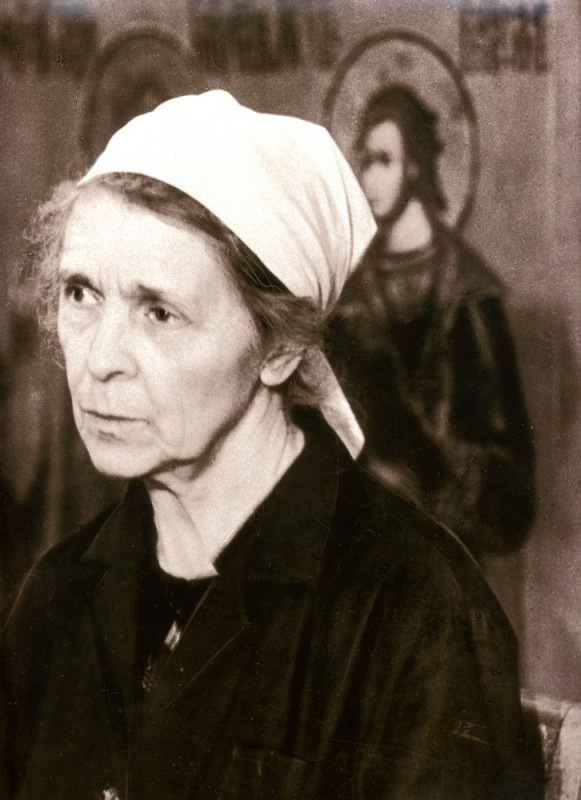
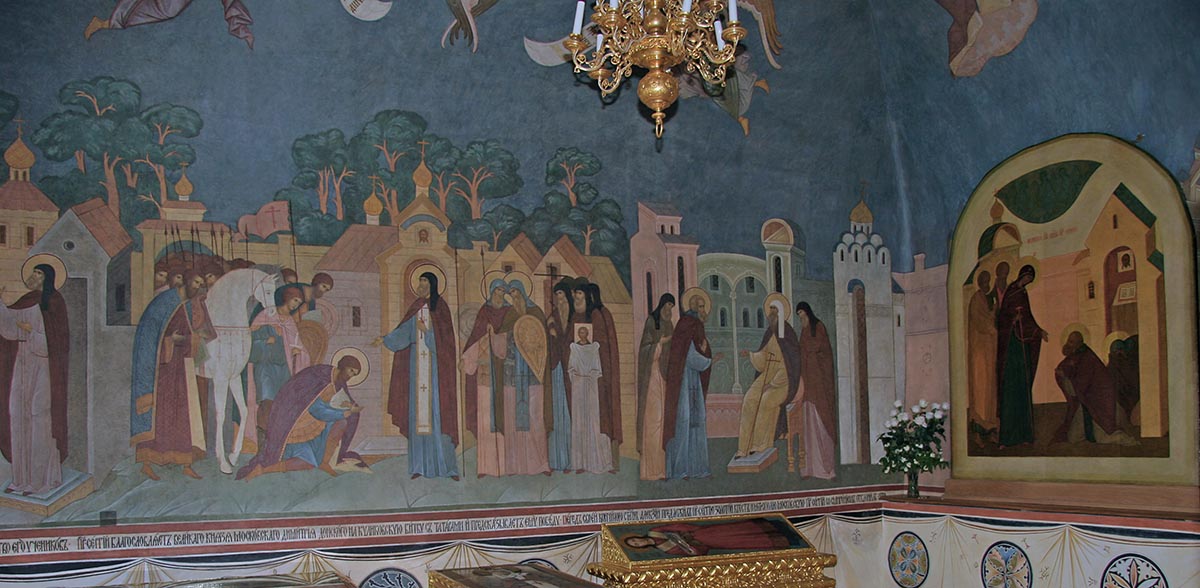
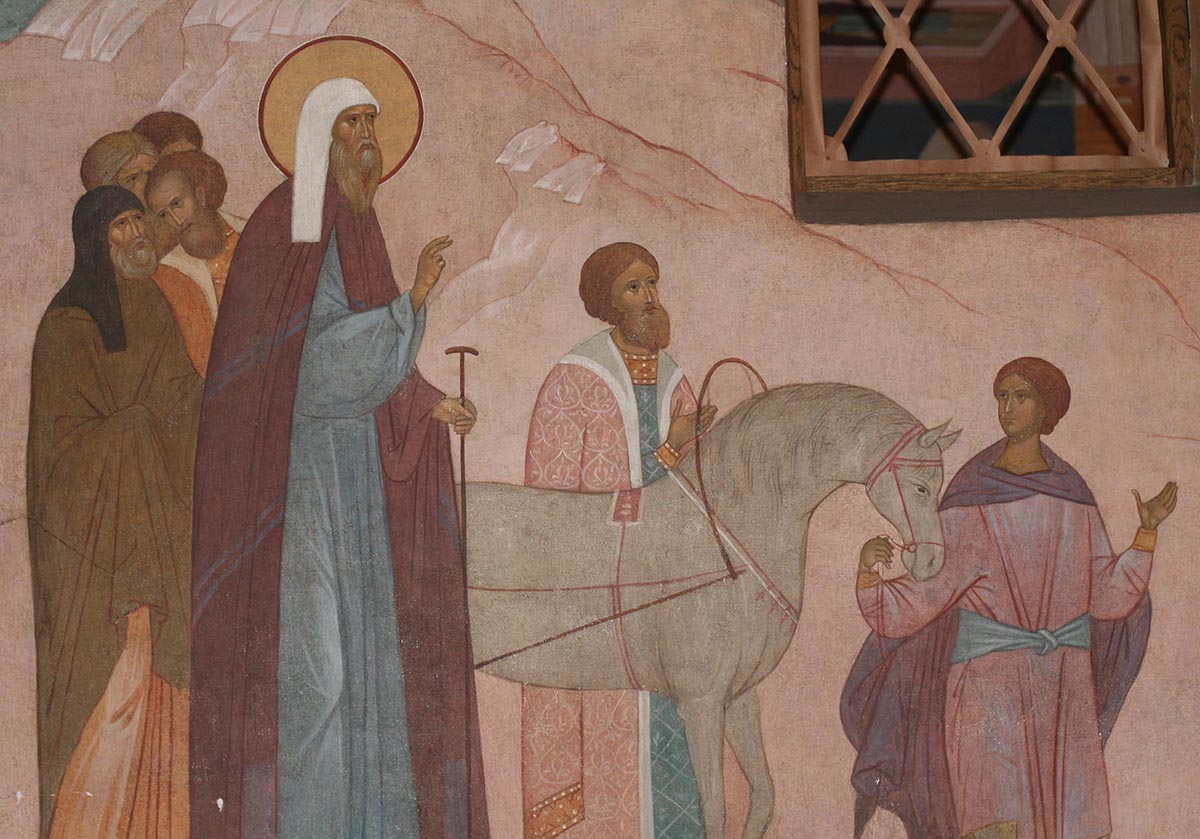
The two images above are frescoes made by Mother Juliana, in the Serapion Tent in the Monastery of St. Sergius. According to ancient monastery tradition, the wooden cell of St. Sergius stood on this site, so the theme of the murals is scenes of his life.
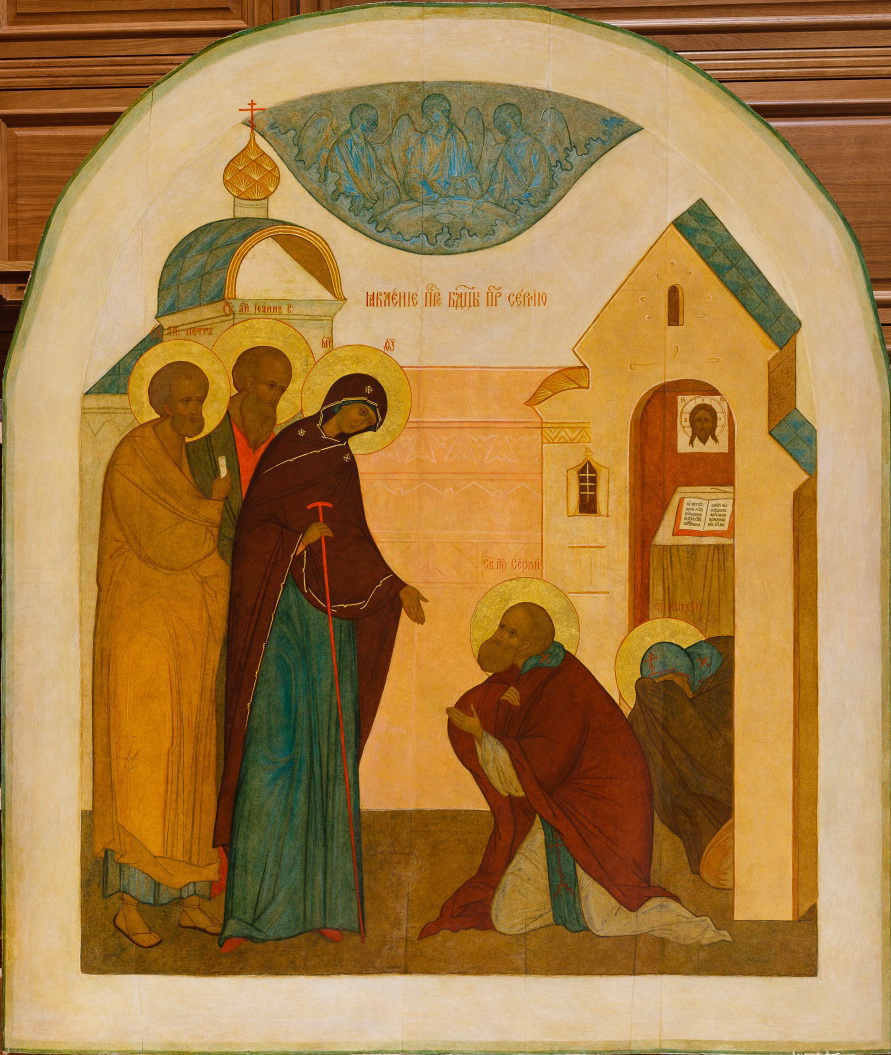
Above: The appearance of the Mother of God to St. Sergius of Radonezh, 1950
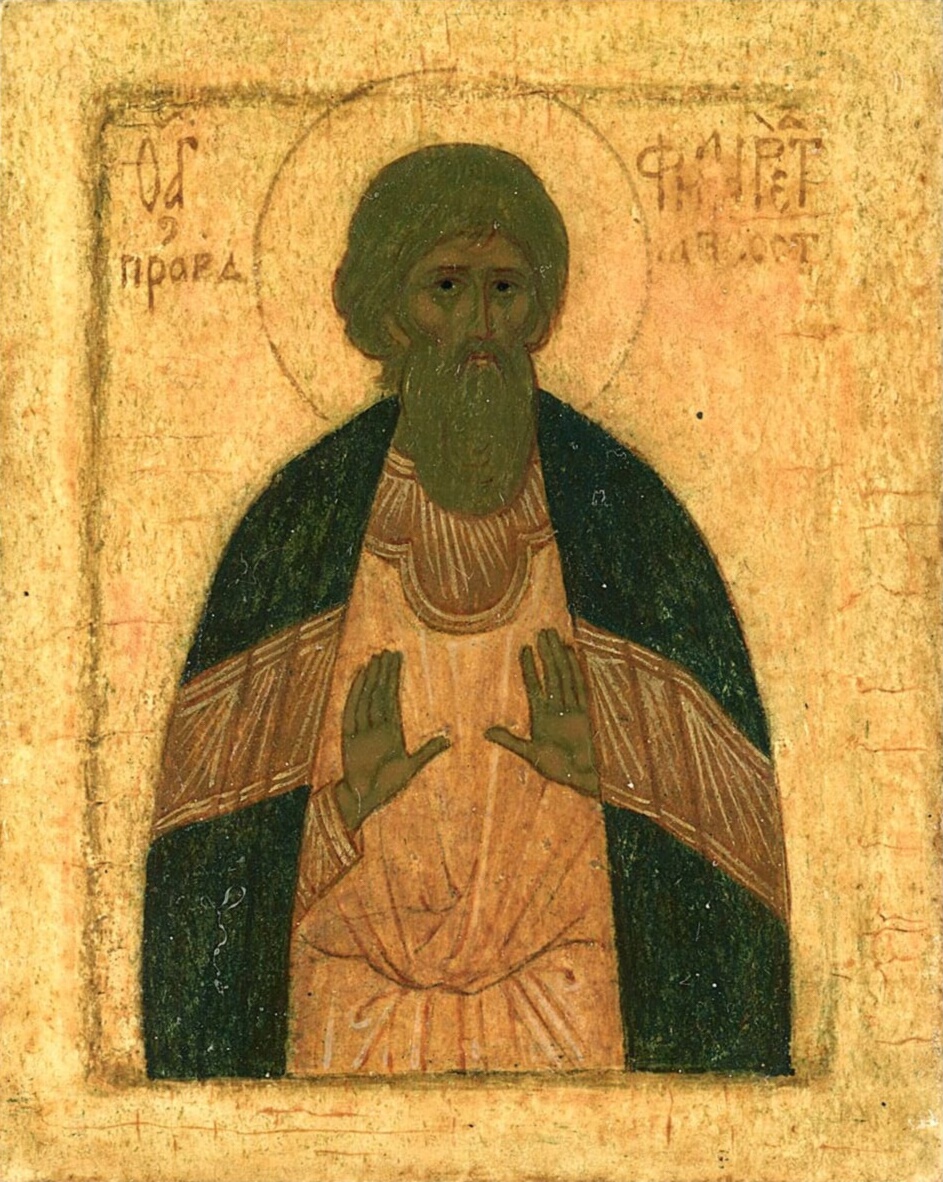
Above: St. Philaret
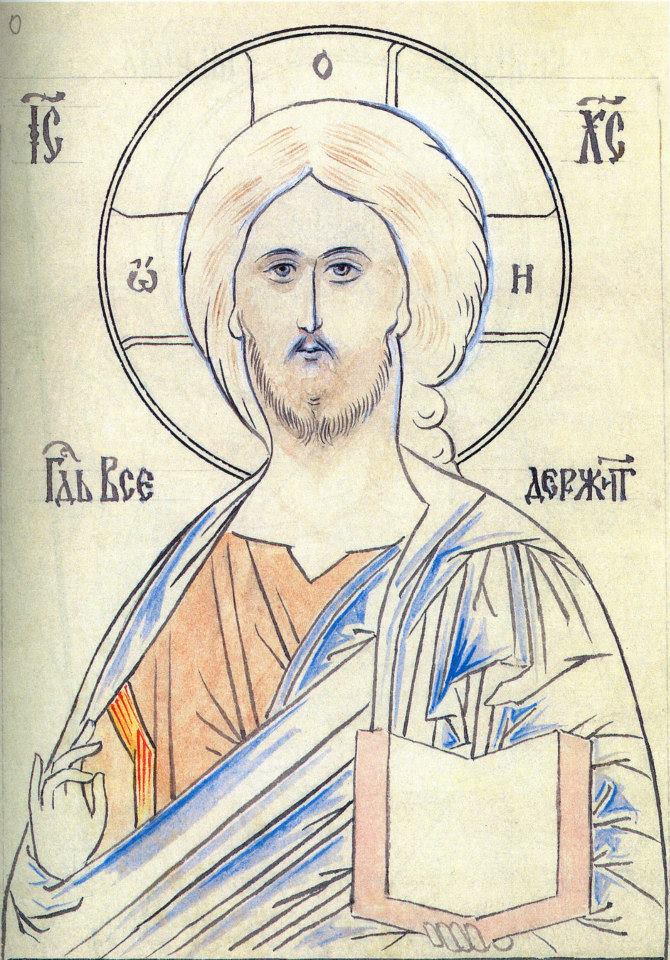
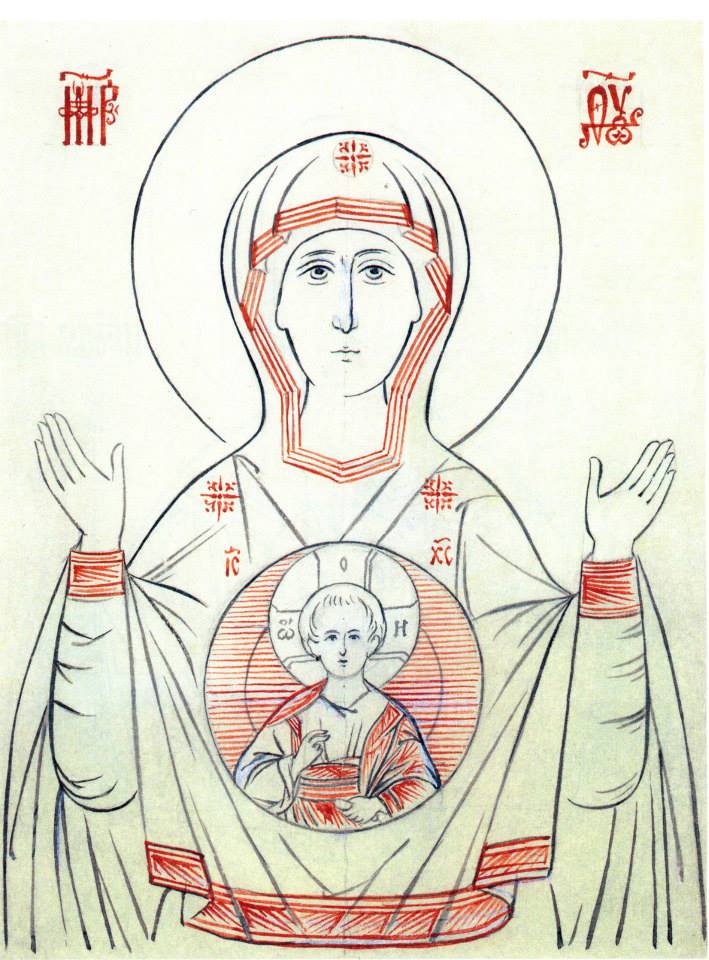
Above (from left to right): St Basil the Great, Christ Pantocrator, The Mother of God of the Sign.
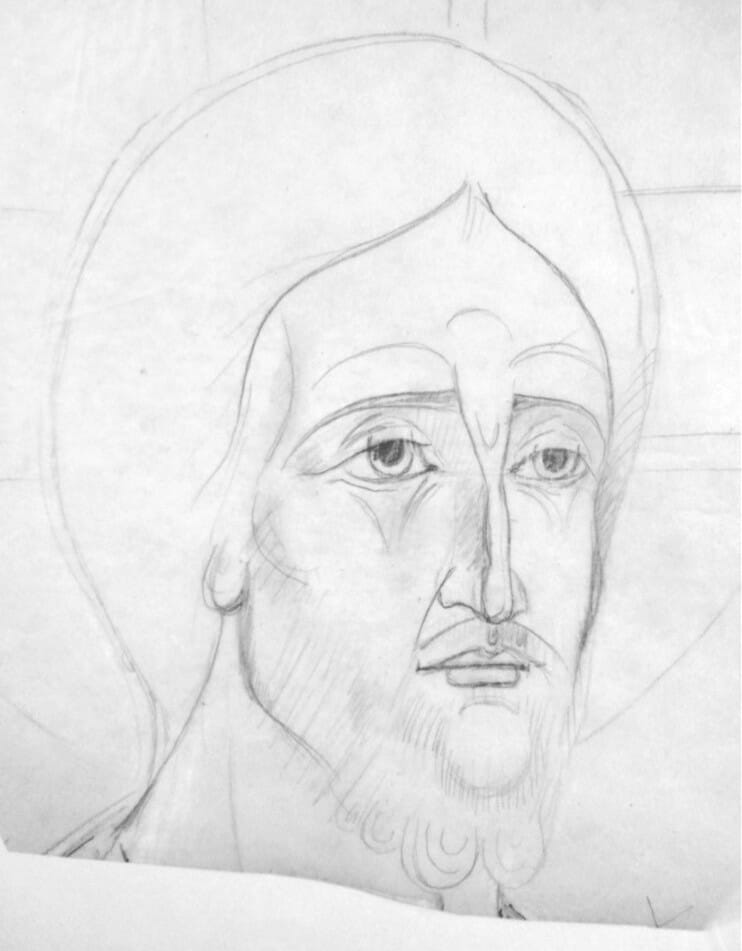
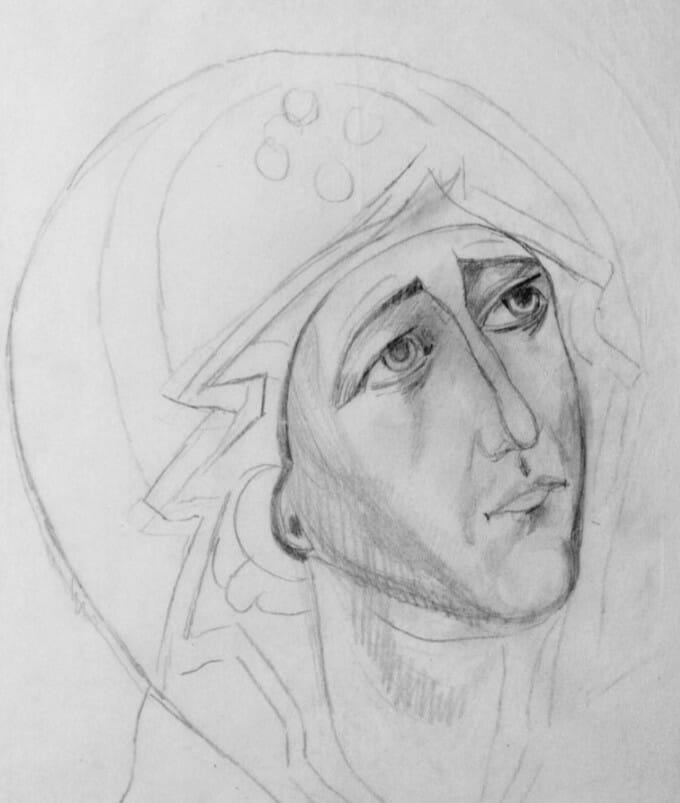
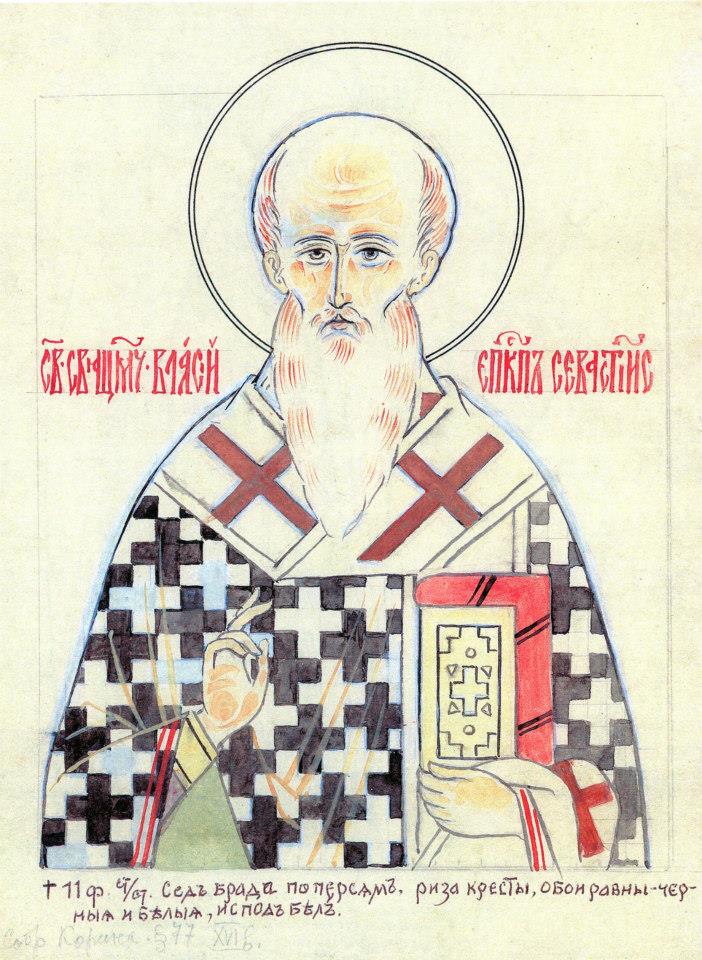
Mother Juliana made various sketches in order to teach / to be used by other iconographers. The highlights are in reverse on Christ and St. Basil.
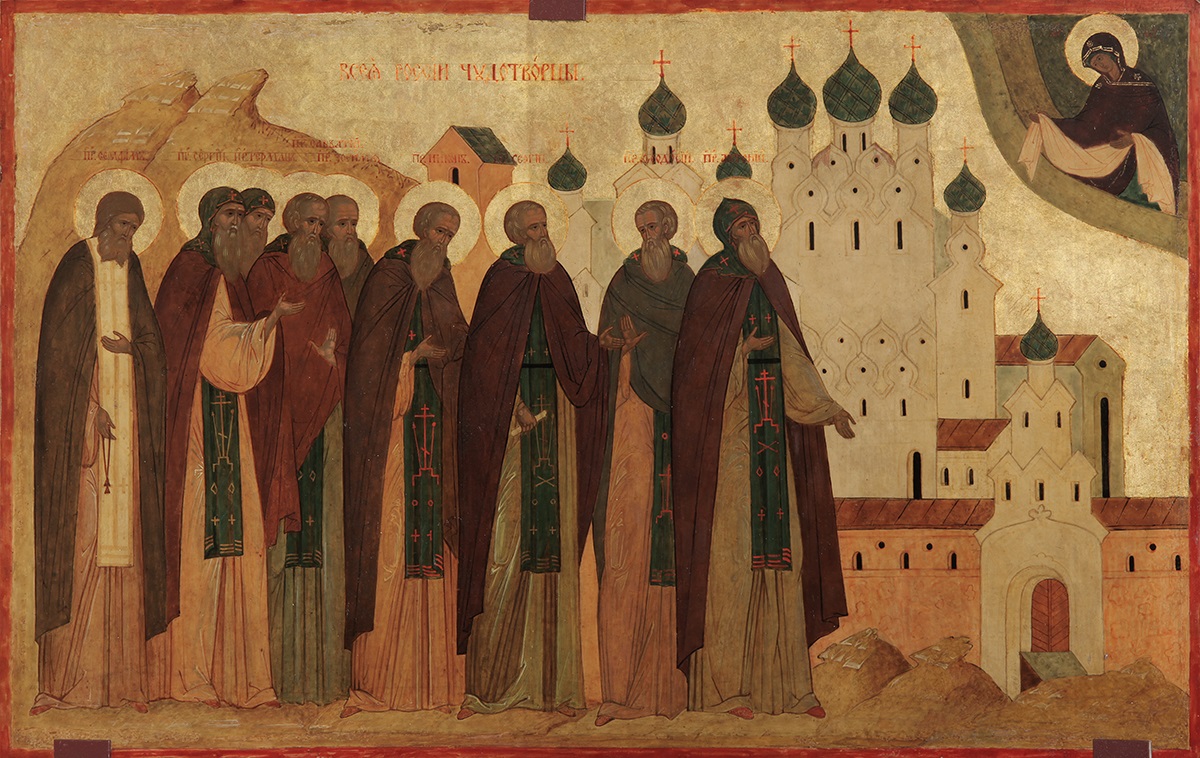
Above: The Venerable Miracle Workers of All Russia
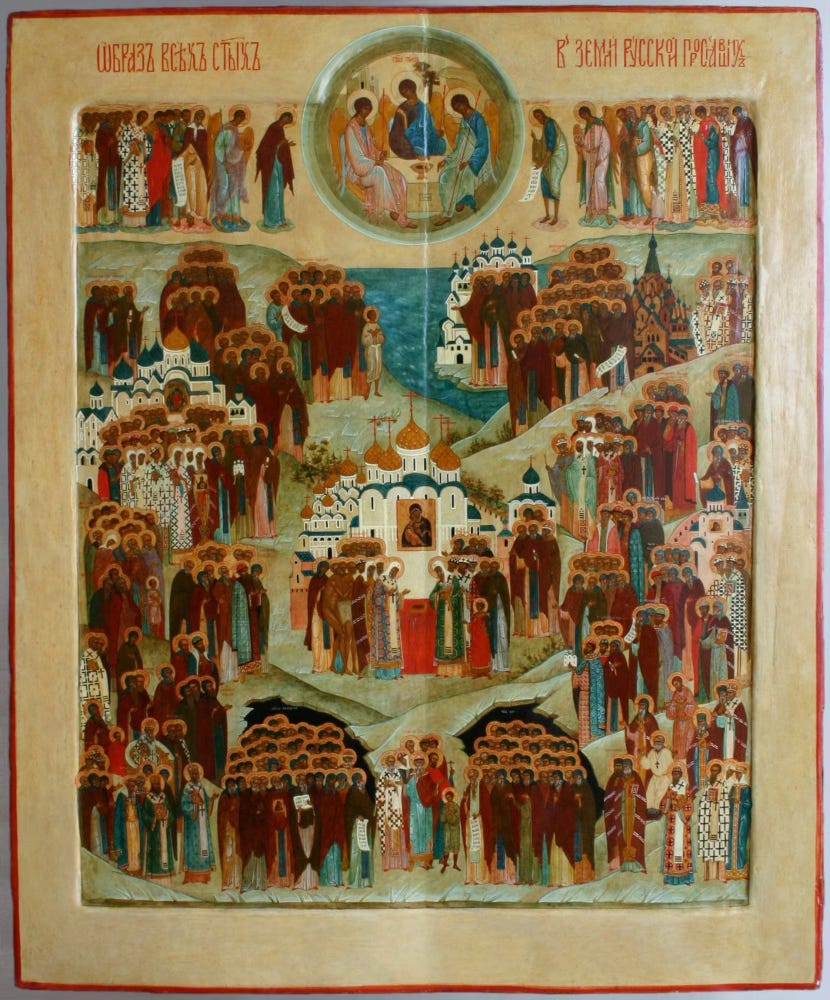
Above: All Saints Who Shone Forth in the Russian Land
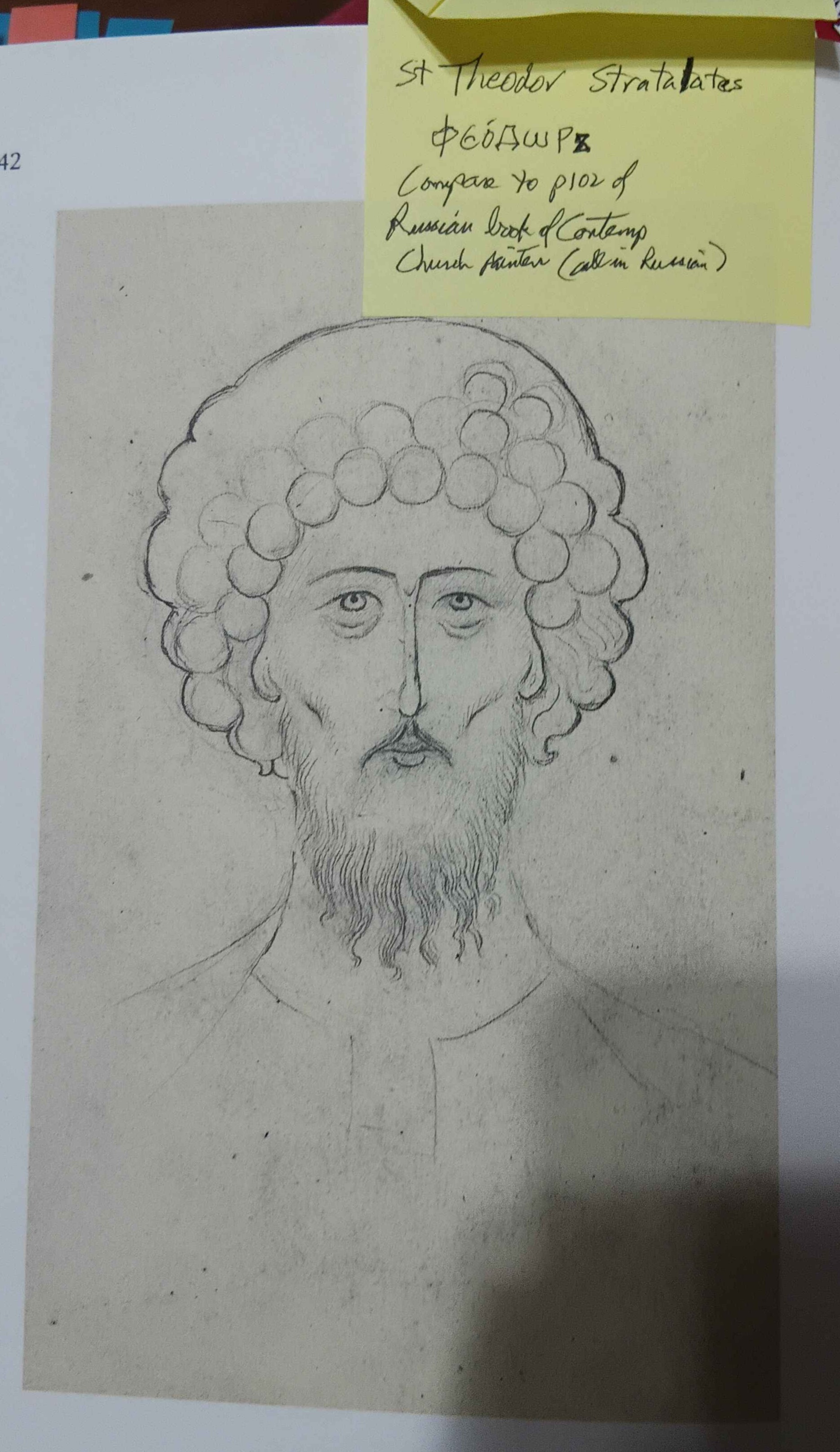
Above: St. Theodore Stratelates - an *exceptional* sketch; ID'd by one of my friends, who is an iconographer monk at
Holy Cross Monastery.
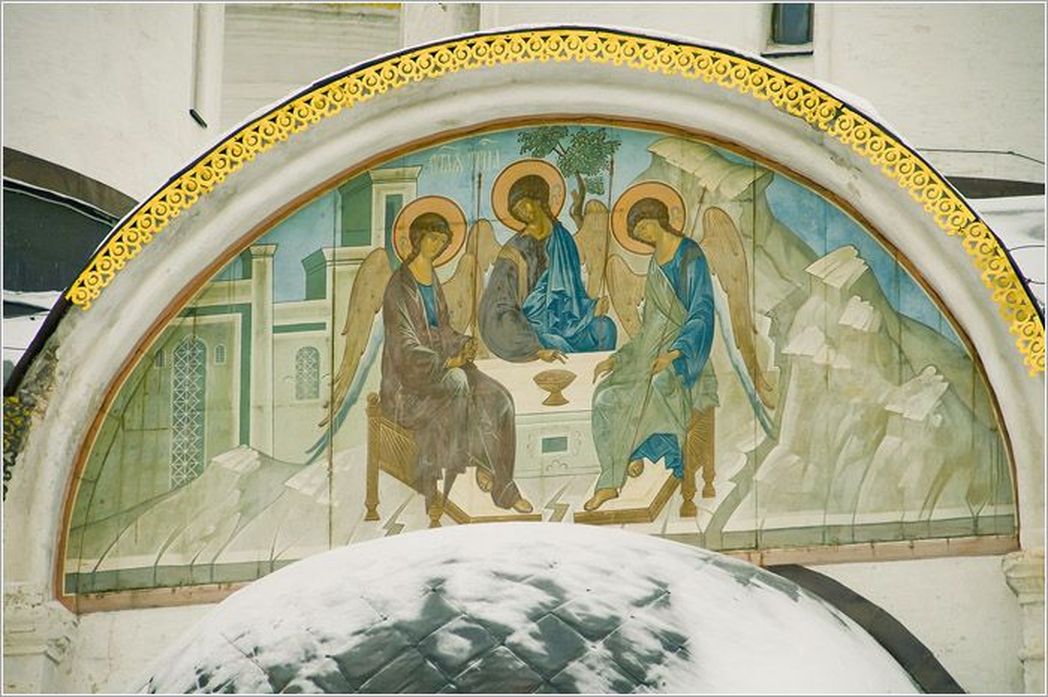
Above: The Trinity. The last icon Mother Juliana made before her repose.
"
Symbolically, already gravely ill, Nun Juliana painted an icon of the Holy Trinity. This work, which now hangs above the entrance to the Holy Gates of the Trinity Lavra of St. Sergius, was Nun Juliana's last. Nun Juliana's blessed death occurred on February 16, 1981. An hour before her death, she received the Holy Mysteries of Christ in full consciousness. The Lord graciously delivered her from the excruciating suffering inherent in her grave illness."
(source)
Further reading about Mother Juliana, her life and work:
"She revived the icon in our Church" - On the 40th anniversary of the death of nun Juliana (Sokolova) (+ Feb. 18, 1981) https://pravoslavie.ru/137391.html
Saint Sergius - Icons of the Nun Juliana (Sokolova) - https://stsl.ru/news/all/prepodobnyy-sergiy-ikony-monakhini-iulianii-sokolovoy
"The Iconographer's Labor" - Instructional text written by Mother Juliana herself (PDF) - https://www.sacredmurals.com/texts/the_iconographers_labor.pdf (Please note that this is an instructional text that deals a lot with the technical process of making an icon. To make icons you should be baptized/chrismated into the Orthodox church and have a blessing from your priest. This is something that I wish I knew when I first found out about icons and started making my own prematurely.)
Juliana - https://www.pravenc.ru/text/1237861.html
«Давно я ждал эти глаза…» К 120-летию со дня рождения монахини Иулиании (Соколовой) - https://monasterium.ru/doklady/stati/davno-ya-zhdal-eti-glaza/
Book: "Russian Saints" by Mother Juliana, a posthumous compilation of sketches of Russian saints. Complete text in English, Finnish, and Russian: http://www.iconofile.com/detail.asp?product_id=150:9519846417
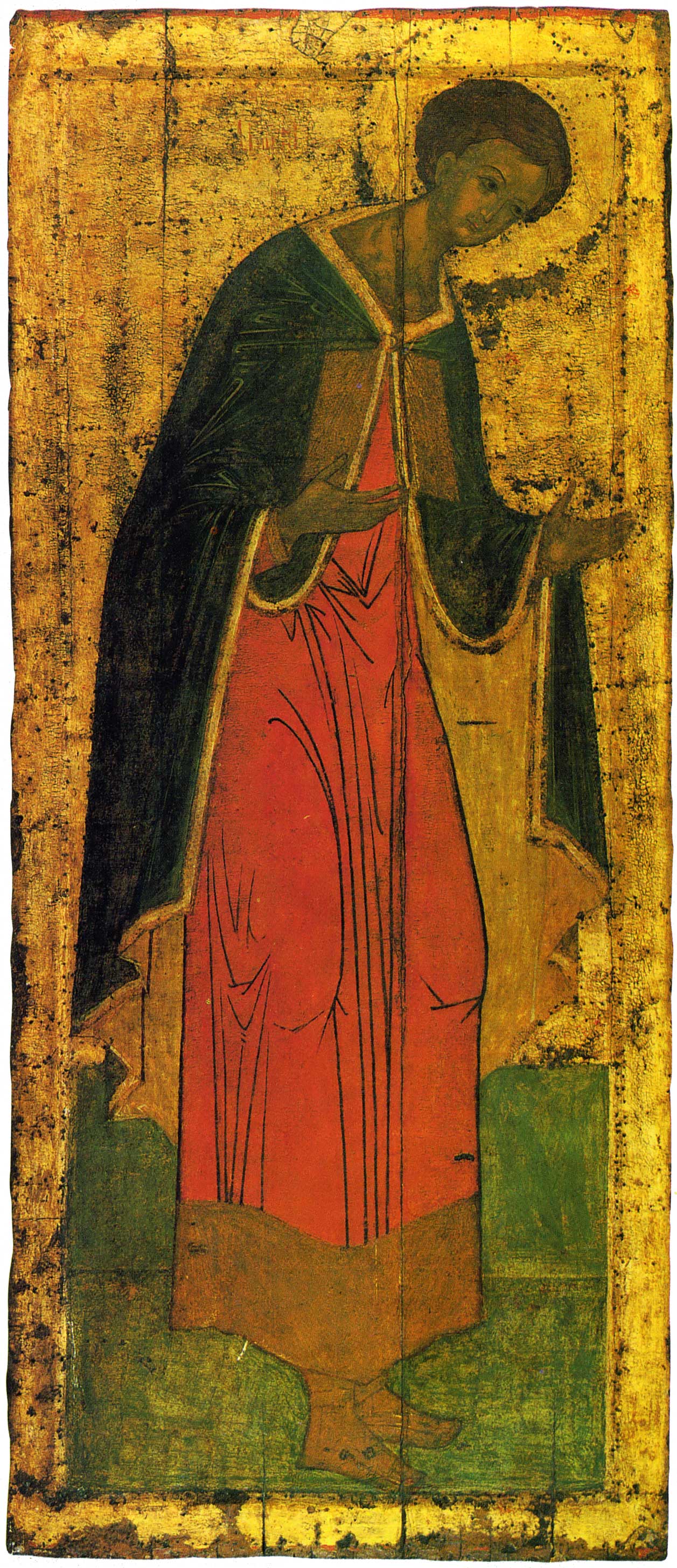
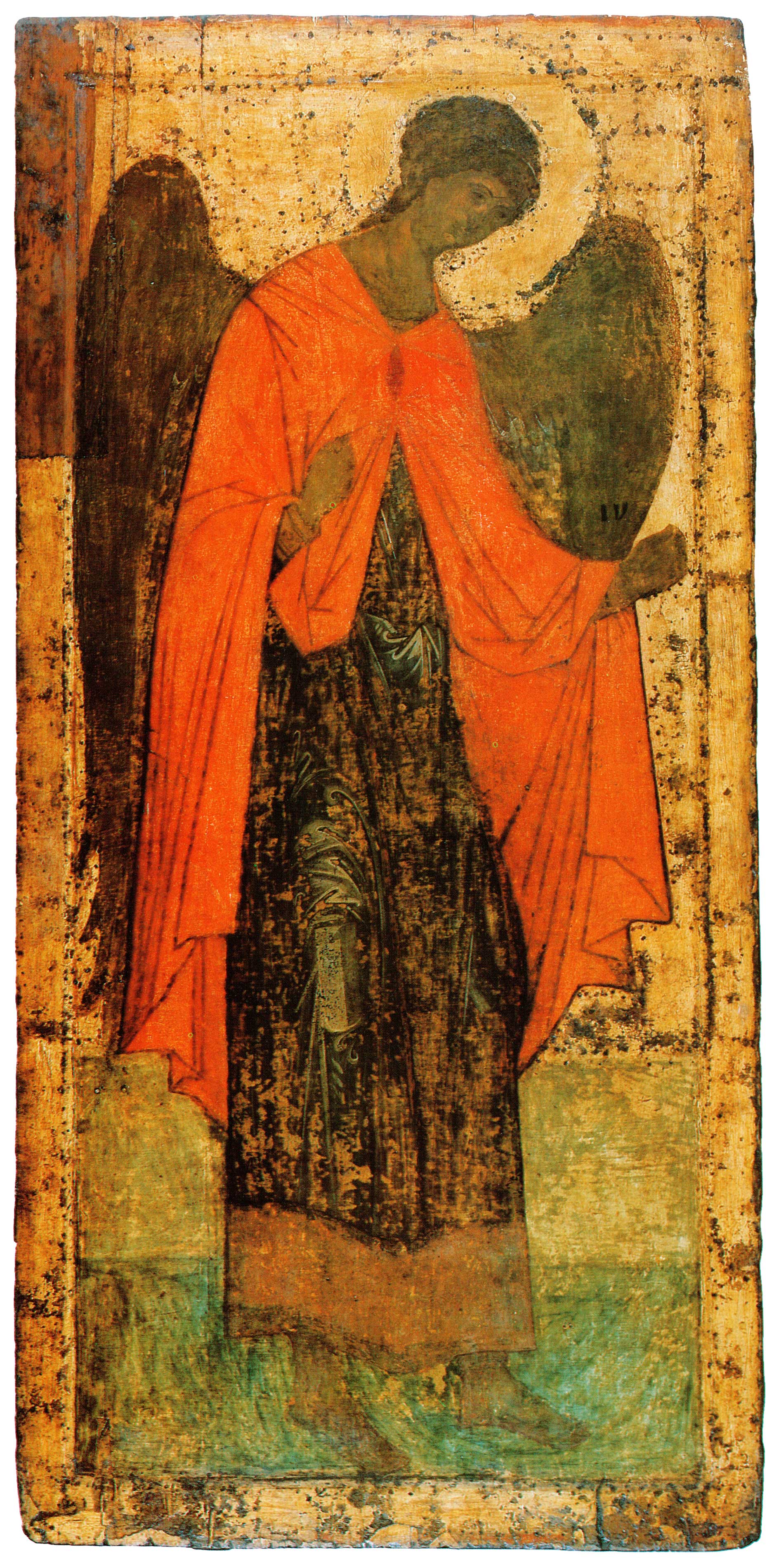
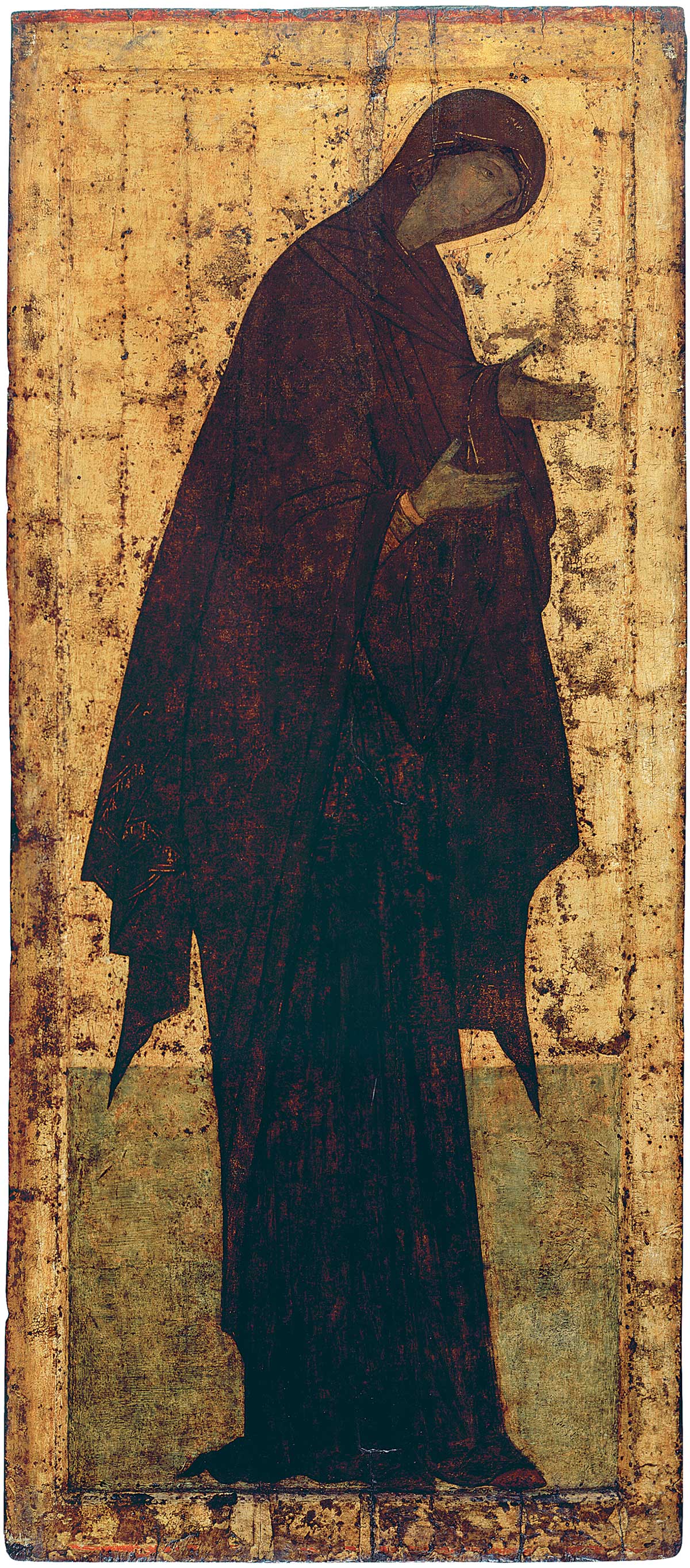
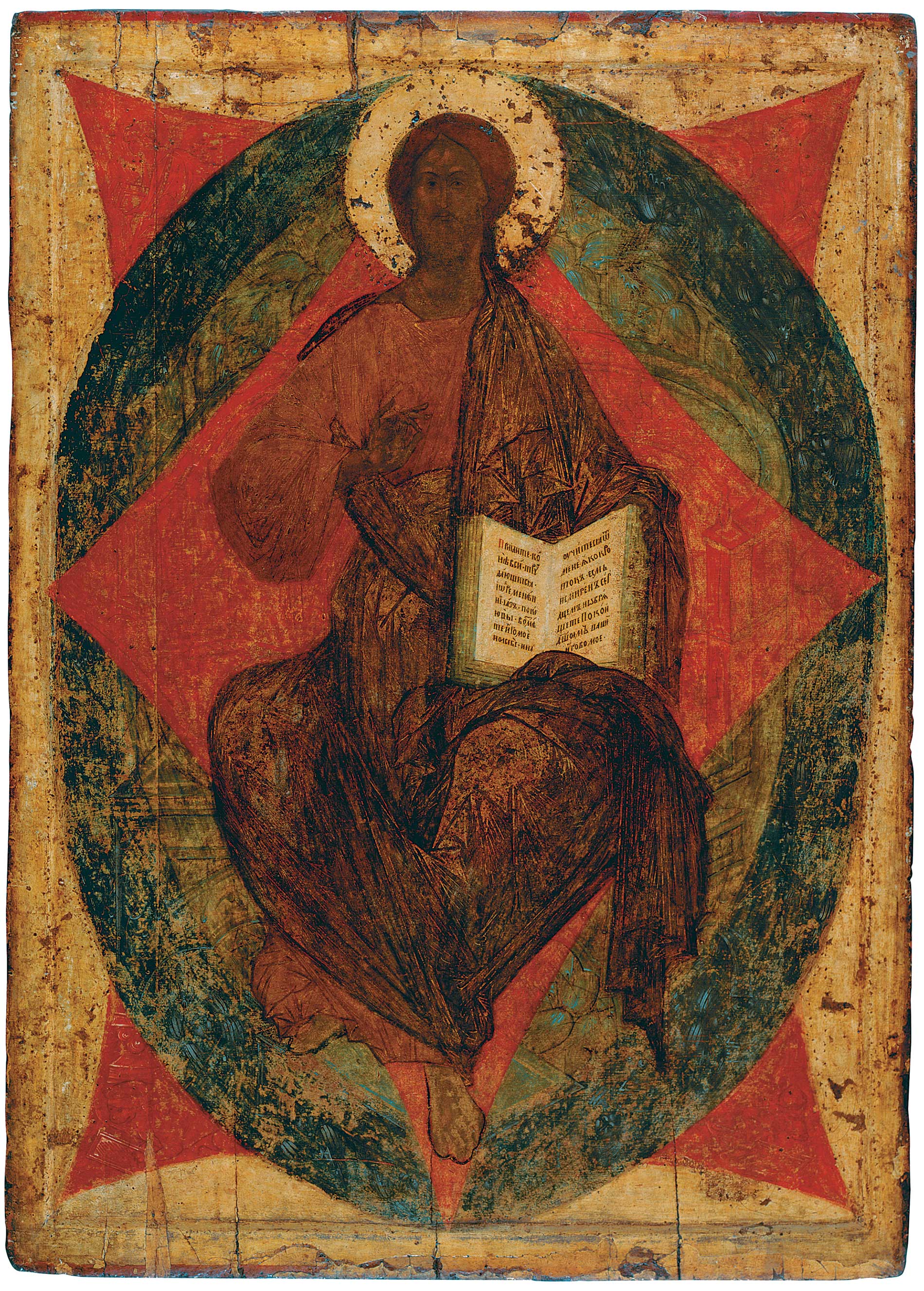
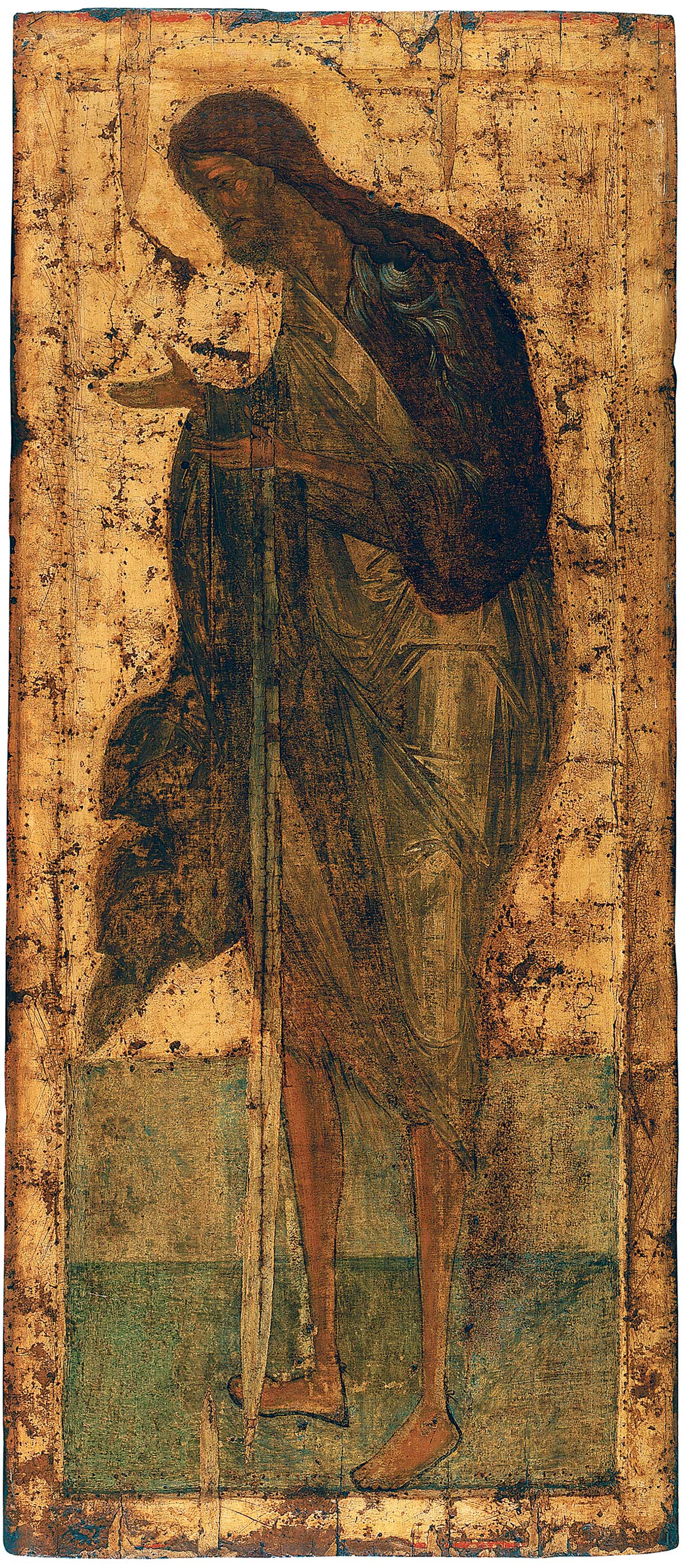
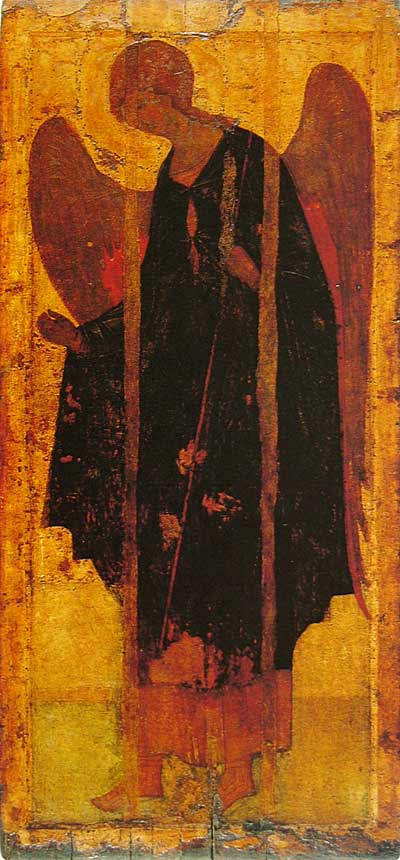
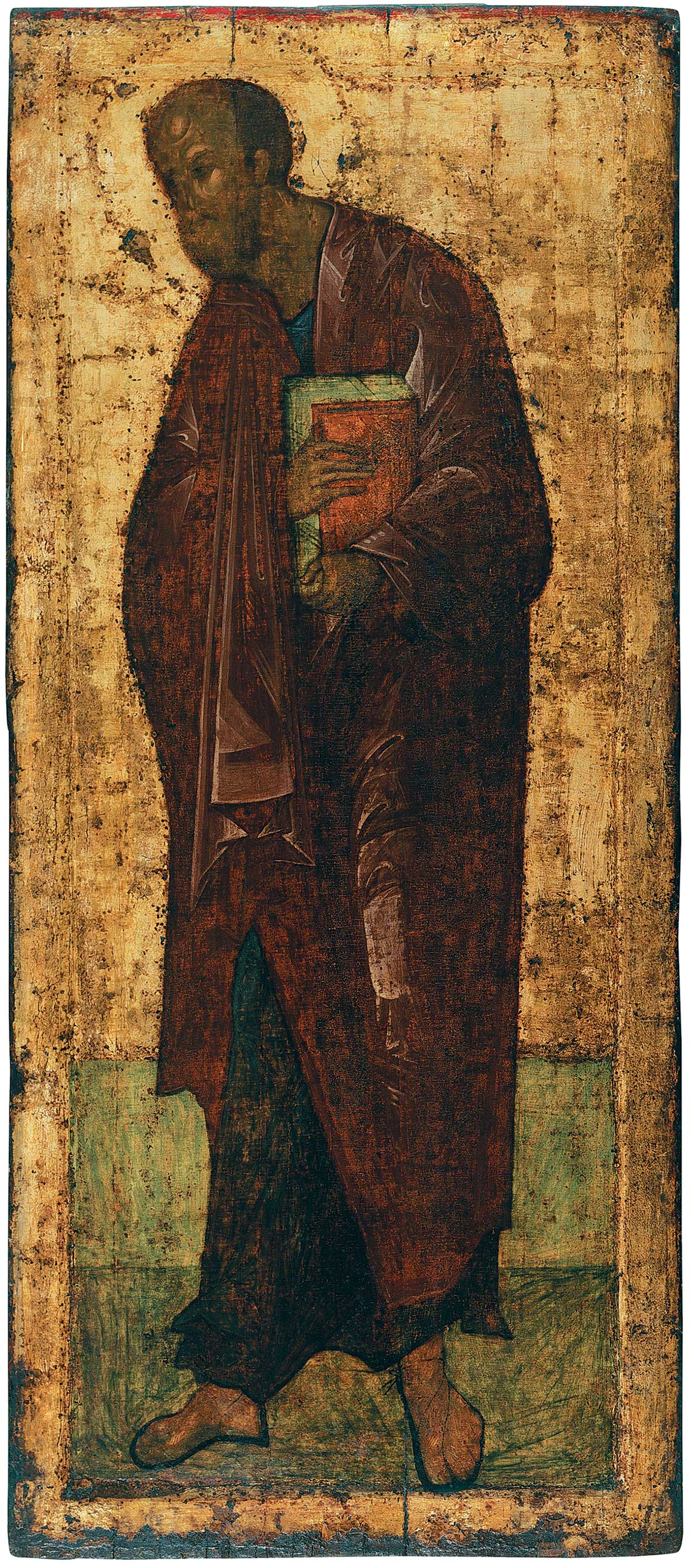
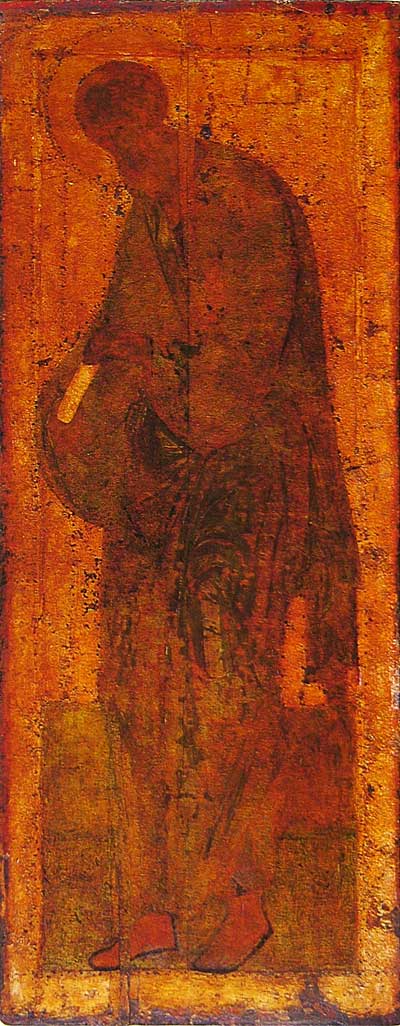
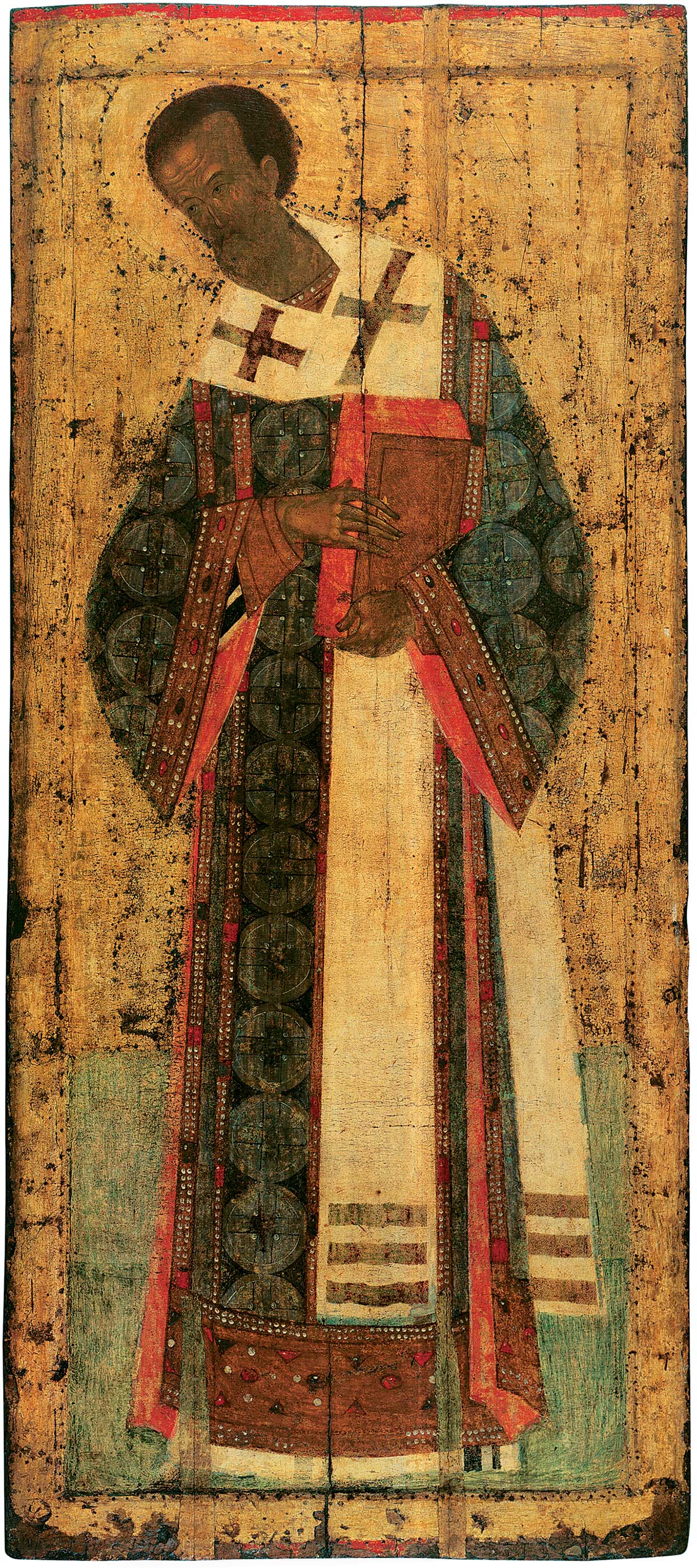
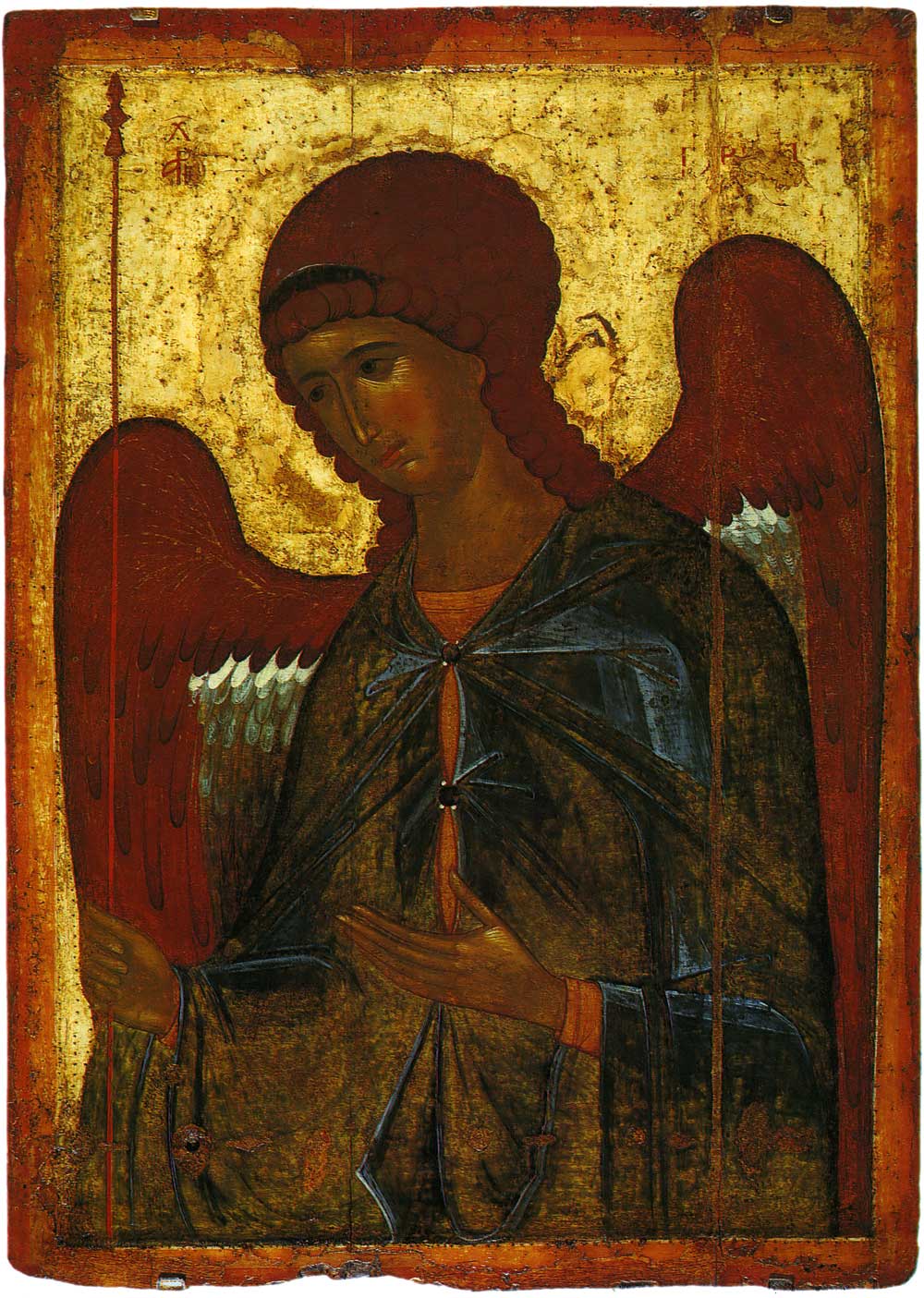 Archangel Gabriel; painted sometime between 1387-1395 (!!). The rest of this group of icons (the deesis row from the Vysotsky Monastery in Serpukhov) is worth looking at: https://www.icon-art.info/group.php?grp_id=19
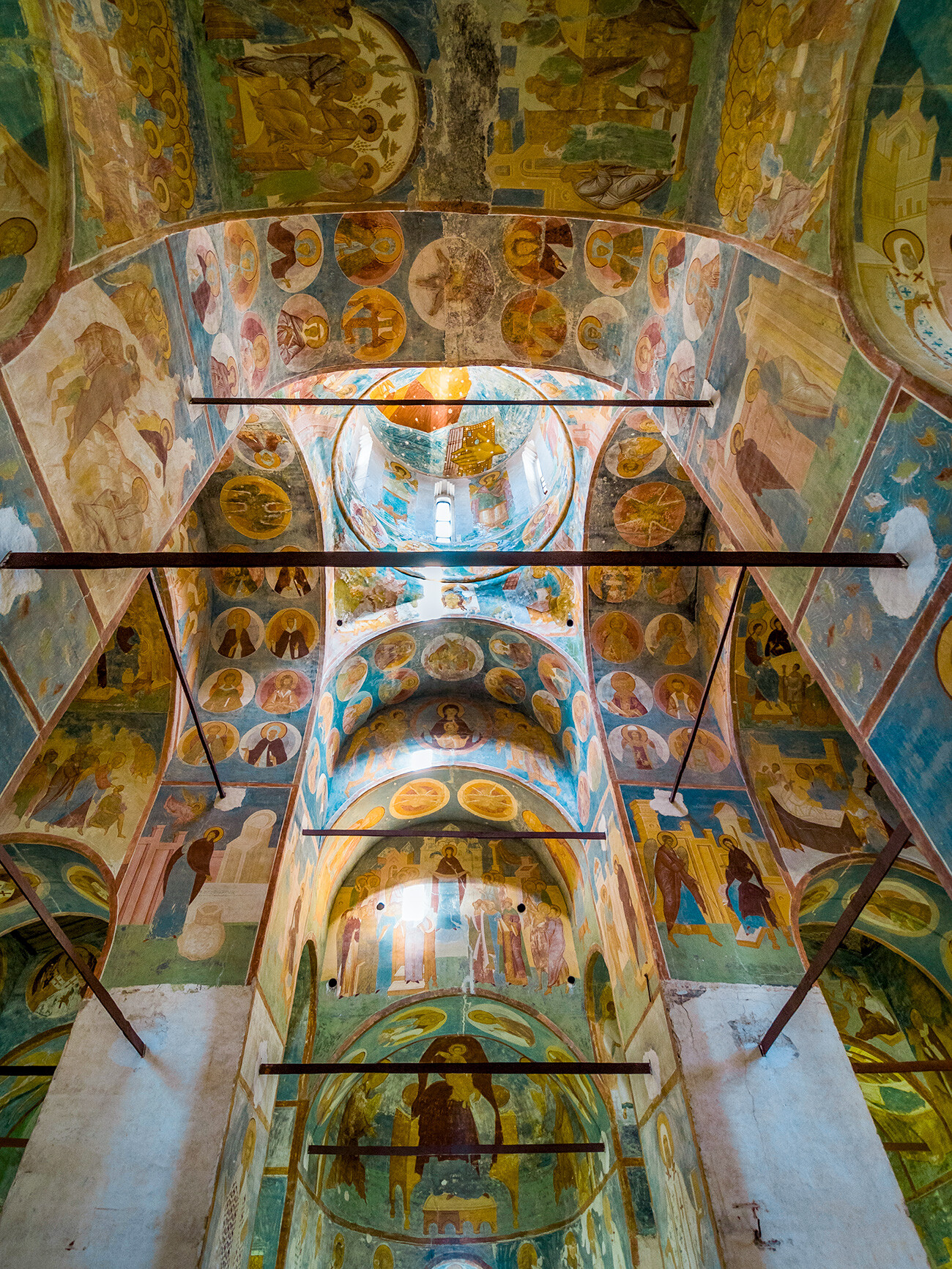
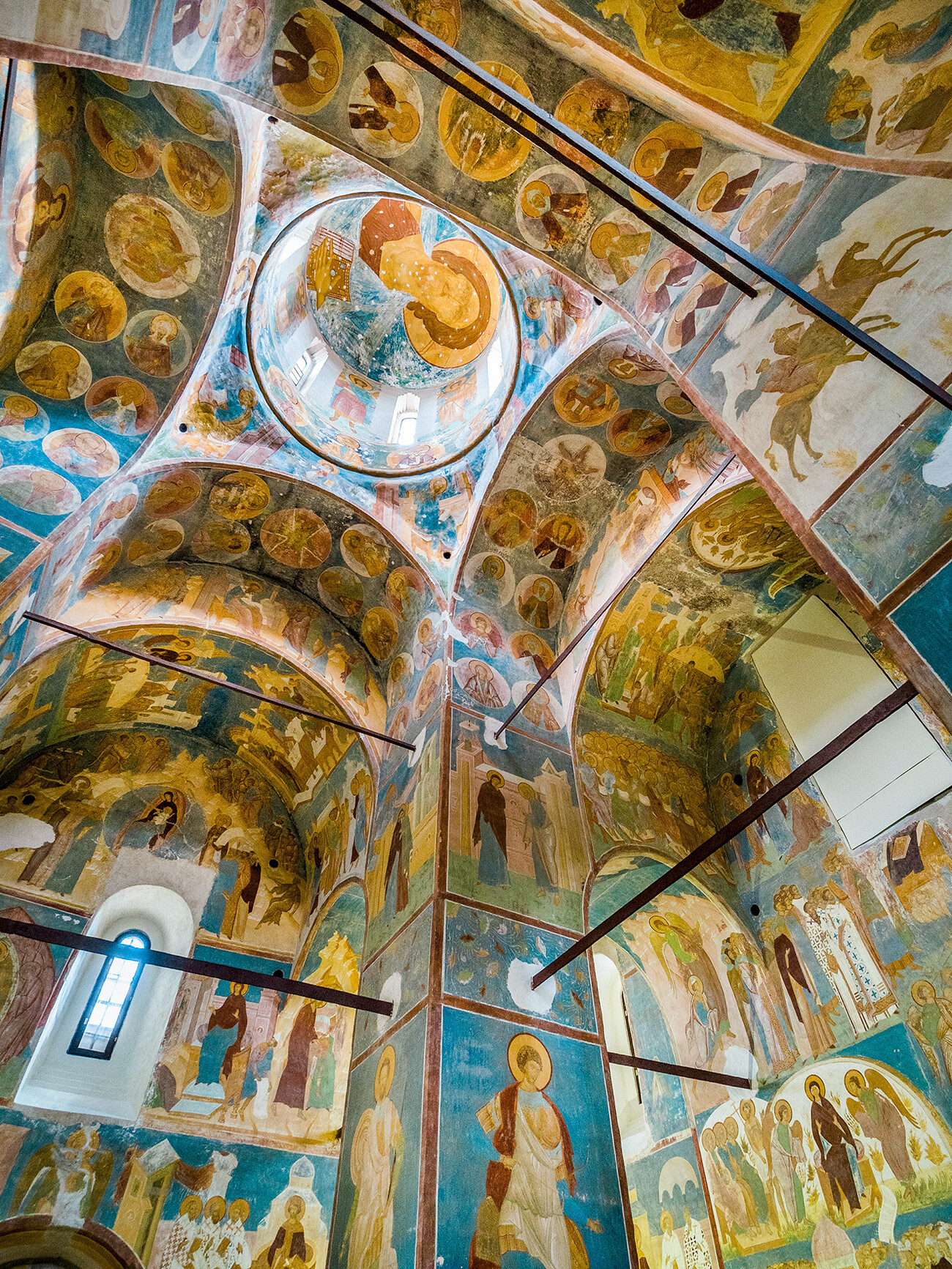
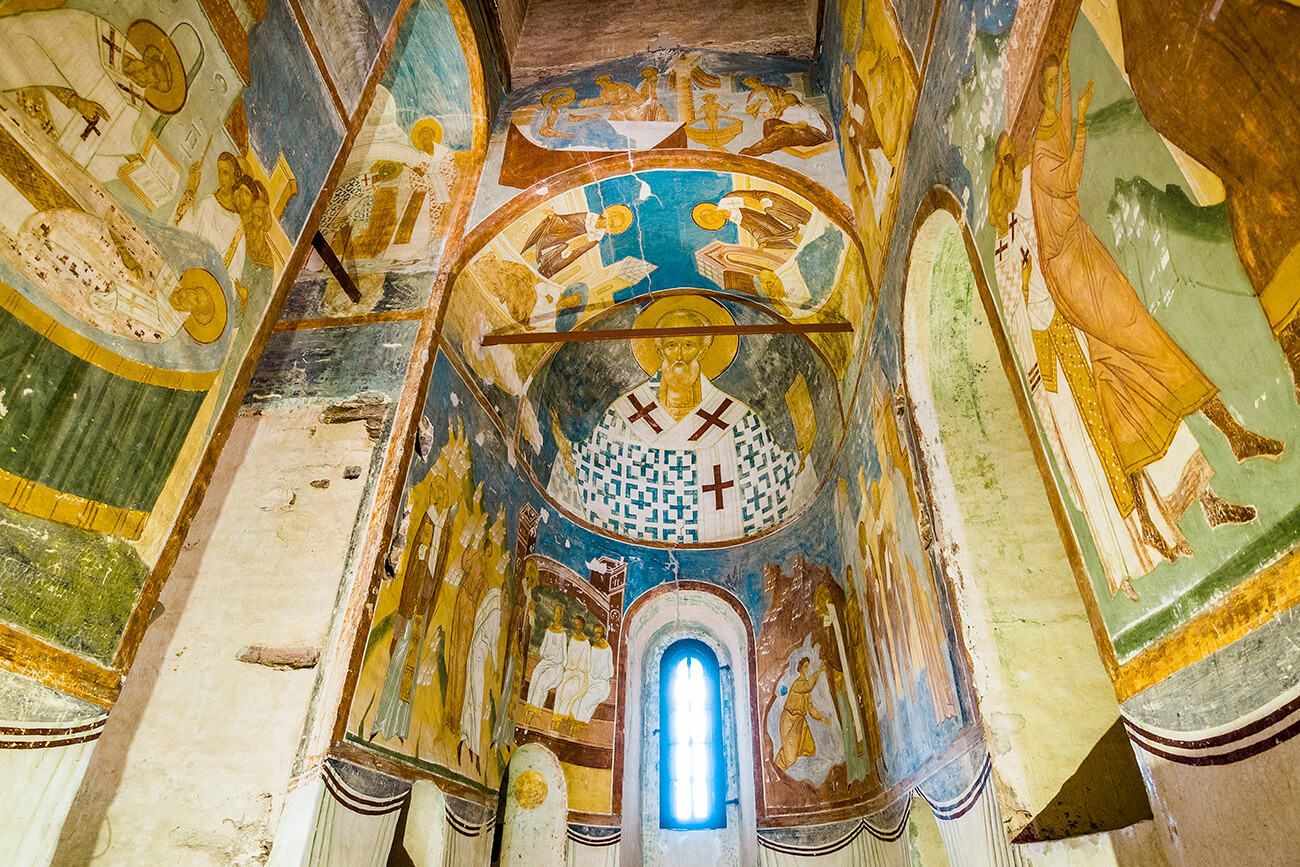
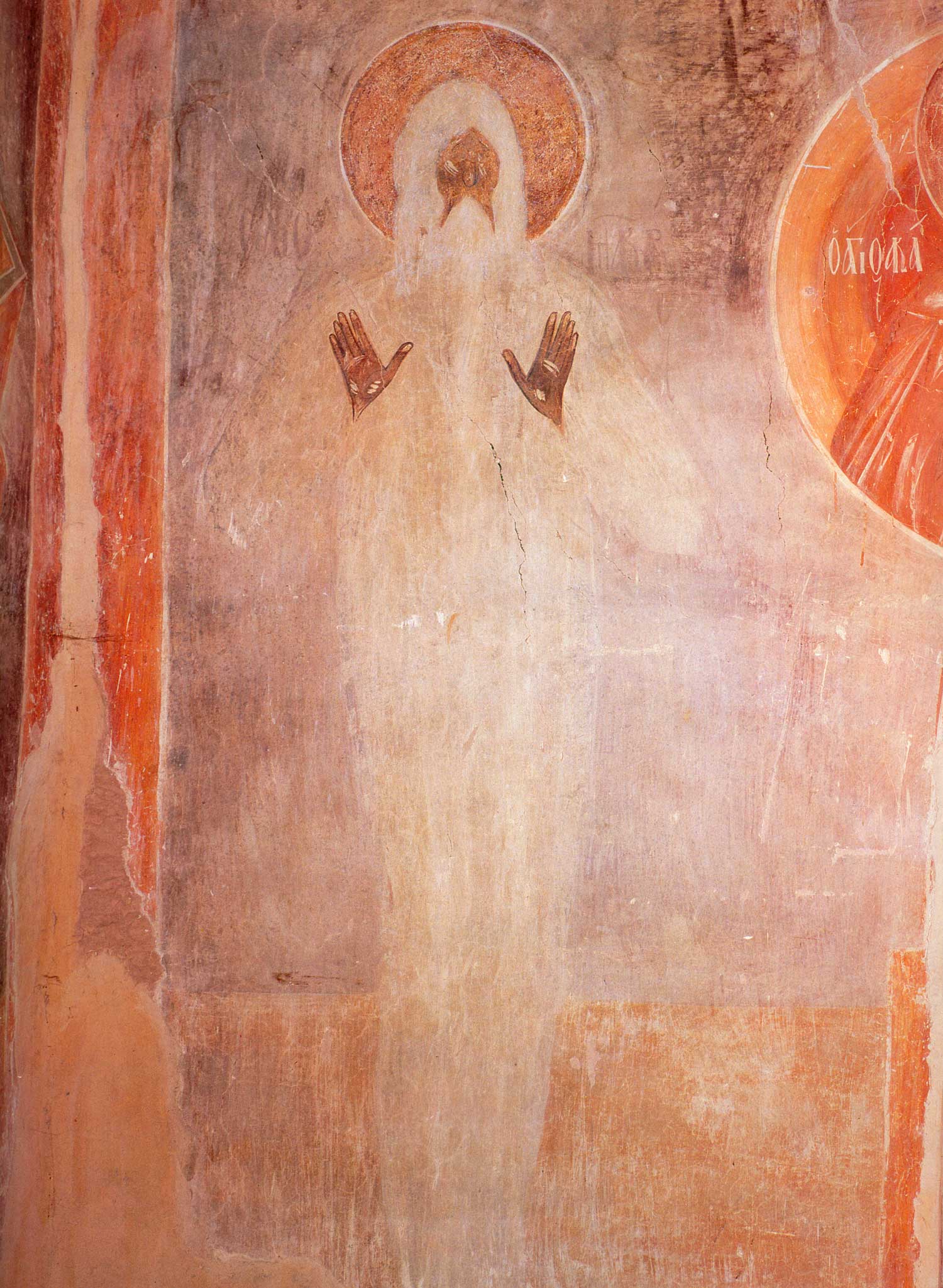 St. Macarius the Great - depicted without bodily eyes to highlight a 'spiritual sight', and depiction of a spiritual reality over a physical likeness. Writing about this specific fresco: https://solrunn.substack.com/p/translucent-man-the-fresco-of-st
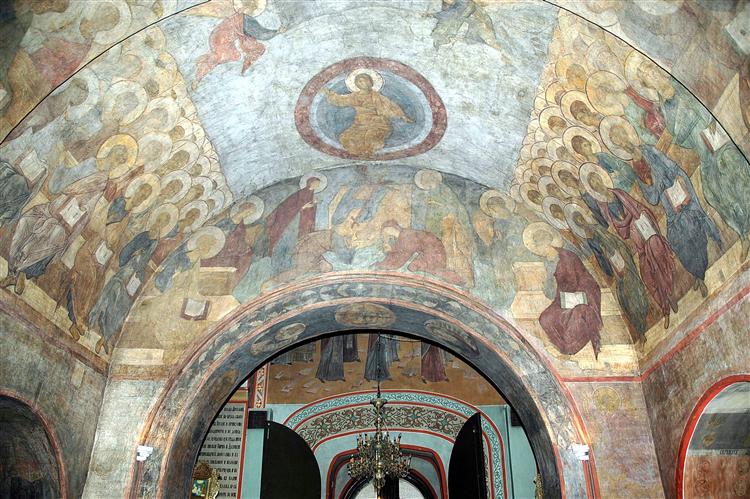
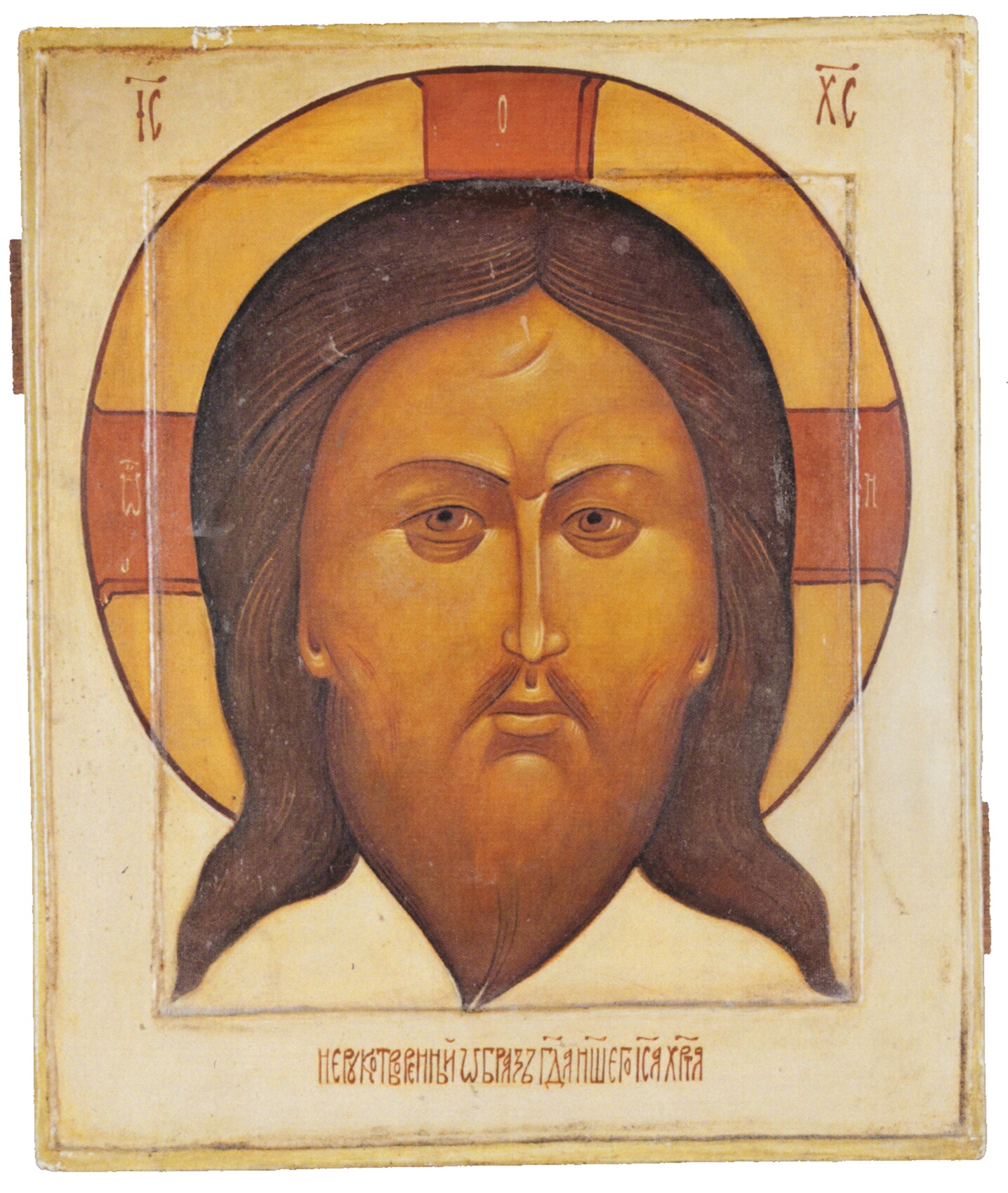 Leonid Ouspensky, The Icon of the Savior, Image Not-Made-By-Hands